


Market Rumors Nvidia Rubin Platform Plans to Reduce Memory Capacity, Storage Stocks Plunge Across the Board, SanDisk Falls Over 11%.



AI Podcast


Rumors of an NVIDIA Rubin platform memory downgrade have negatively impacted storage stocks, with SanDisk, Micron, Western Digital, and Seagate experiencing significant declines. Speculation suggests a reduction in the Rubin NVL72 platform's SOCAMM memory configuration from 55TB to 28TB per rack, potentially halving the required memory chips and shrinking the SOCAMM market size. This adjustment, aimed at lowering rack costs for mass production, does not affect HBM4 demand, which remains robust. NVIDIA has confirmed Samsung, SK Hynix, and Micron have qualified to supply HBM4 for the Vera Rubin platform, entering mass production.
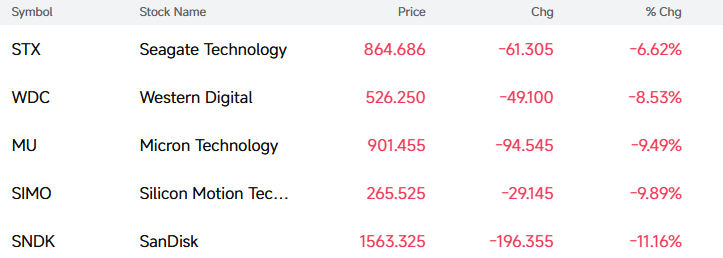
Tradingkey - On June 5, rumors surfaced regarding a memory specification downgrade for NVIDIA's Rubin platform, causing storage stocks to plunge today. As of press time, SanDisk ( SNDK) fell 11.16%, Micron Technology ( MU) fell 9.49%, Western Digital ( WDC) fell 8.53%, Seagate Technology ( STX) fell 6.62%.
Market rumors suggest that NVIDIA may downgrade the standard SOCAMM memory configuration for the Rubin NVL72 platform, with the total capacity per rack being reduced from 55TB to 28TB. This implies that the amount of memory equipped in computing units under the new architecture will decrease, triggering concerns over memory demand.
It is reported that SOCAMM is a dedicated memory for the CPU side of AI servers, with a clear division of labor from the HBM memory at the GPU core. Previously, the standard configuration was expected to be 192GB modules, but it may now be changed to 96GB, with only high-capacity custom options remaining.
Simply put, if everyone uses 96GB memory, the number of memory chips required would be half of previous expectations, leading to a downward adjustment in the overall market size for SOCAMM.
It should be noted that this adjustment does not involve HBM4 at all; the 20.7TB HBM4 configuration per rack remains unchanged and continues to be the core support for AI performance. Analysts say NVIDIA's move is aimed at reducing total rack costs to facilitate mass production of the Rubin platform. Currently, market sentiment is clearly divided: while the certainty of HBM demand remains recognized, the high growth expectations for SOCAMM have begun to cool.
Furthermore, according to the latest reports, NVIDIA CEO Jensen Huang announced in Seoul on Friday that Samsung Electronics, SK Hynix, and Micron Technology have all passed certification to supply HBM4 high-bandwidth memory chips for NVIDIA's next-generation AI platform, Vera Rubin.
Huang stated that all three suppliers have passed qualification certification and entered the mass production stage, and are currently fully committed to securing supply for the Vera Rubin platform. This marks the first time NVIDIA has officially confirmed that three memory chip manufacturers have simultaneously obtained HBM4 supply qualification.
This content was translated using AI and reviewed for clarity. It is for informational purposes only.
Recommended Articles











Comments (0)
Click the $ button, enter the symbol, and select to link a stock, ETF, or other ticker.