


Today’s Market Recap: U.S. Markets Retreat Amid Intensifying Middle East Conflict and Global Supply Disruptions



Track the Market Trend
TradingKey - The major U.S. stock indices closed lower on Tuesday as a sell-off fueled by geopolitical tensions and rising oil (USOIL) prices triggered a broad market retreat, though indices did recover slightly from their intraday lows. The S&P 500 dropped 0.95% to 6,816.59, the Nasdaq Composite fell 1.02% to 22,516.69, and the Dow Jones Industrial Average slid 0.83% to 48,501.28.
Rising energy costs and instability in the Middle East weighed heavily on travel and airline stocks, which faced pressure from soaring jet fuel prices and route disruptions. In contrast, defensive plays like Berkshire Hathaway (BRKB) and defense contractor Lockheed Martin (LMT) showed relative strength, buoyed by expectations of increased military spending.
Plug Power (PLUG), a developer of hydrogen fuel cell systems, saw its stock surge 23.20% to close at $2.23. The rally followed fourth-quarter results that exceeded revenue expectations and showed improving margins, alongside the announcement of a CEO transition. While investors are encouraged by the turnaround progress, they remain focused on the company’s long-term profitability targets.
Trading activity was exceptionally high, with 222.8 million shares changing hands — roughly 122% above the three-month average. Despite the daily gain, the company, which went public in 1999, remains down 99% from its IPO price.
Shares of Blue Owl Capital (OWL), a specialist in private credit and permanent capital, fell 3.89% to close at $10.27. The decline came amid reports of liquidity strains and redemption pressures across the private credit sector. Investors are closely monitoring how potential fund "gating" (withdrawal limits) and asset sales might impact the firm's ability to raise capital in the future.
Volume for the session reached 54 million shares, surpassing the three-month average by 141%. Since its 2020 IPO, Blue Owl Capital has seen a modest overall growth of 1%.
Market Headline
President Trump has ordered a dual-track strategy to secure Gulf shipping, instructing companies to provide insurance for regional maritime trade and stating that the U.S. military will escort tankers through the Strait of Hormuz if necessary, though specific operational details remain unannounced. In response, oil price gains briefly narrowed to less than 0.7%. Meanwhile, the Iranian military warned that vessels transiting the Strait face risks from missiles or "uncontrolled" drones. Analysts suggest that if Iranian resistance persists, it could take several weeks for shipping flows to fully recover, even with U.S. security guarantees.
In a significant escalation of regional conflict, Iran claimed to have struck U.S. THAAD system targets and damaged Israeli nuclear facilities. The Iranian military announced that its operations against the U.S. and Israel would expand in depth and scope, launching a 16th wave of strikes between Tuesday night and Wednesday morning targeting military sites in central and northern Israel. Iran's UN representative stated that "now is not the time for negotiations," while President Trump remarked that Iran's desire to negotiate has come too late. Following an Israeli "large-scale strike" on Tehran that reportedly killed a senior Iranian commander responsible for Lebanese affairs, the U.S. Secretary of State warned that strikes against Iran would intensify in the coming hours and days. Additionally, reports indicate the election for Iran's Supreme Leader has entered its final stage, and the body of the late Supreme Leader Khamenei will be buried in Mashhad.
The regional instability has triggered a massive supply shock as QatarEnergy expanded its production shutdowns. Following a drone attack on its LNG export facilities, the company announced a total suspension of production for liquefied natural gas, urea, polymers, methanol, and aluminum. These disruptions, coupled with the blockage of the Strait of Hormuz, have sparked fears of restricted aluminum exports and raw material imports. Goldman Sachs noted that if these disruptions last for a month, aluminum prices could surge to $3,600.
Iraq is facing a potential production loss of 3 million barrels per day — roughly two-thirds of its capacity — due to the closure of the Strait of Hormuz and saturated storage tanks. The Iraqi Oil Ministry reported that a shortage of tankers at southern ports has forced the Rumaila south oil field to suspend operations. Furthermore, the Kurdistan Regional Government announced a halt to oil exports to the Turkish port of Ceyhan on Tuesday due to the regional situation.
Regarding U.S. monetary policy, New York Fed President John Williams stated that further interest rate cuts depend on inflationary progress. He characterized the impact of tariffs as a "one-time price shock" that is expected to fade within the year, with inflation projected to return to the 2% target by 2027. While noting a labor market defined by "low hiring and low layoffs," Williams warned that household pessimism serves as a cautionary signal, stressing that the Fed will remain prudent and data-dependent regarding rate cuts in the second half of the year.
In the tech sector, OpenAI is facing a 295% surge in ChatGPT uninstalls following its controversial contract with the U.S. military. CEO Sam Altman admitted the deal was "hasty, opportunistic, and careless," prompting an emergency contract revision that now includes clauses explicitly prohibiting the surveillance of U.S. citizens.
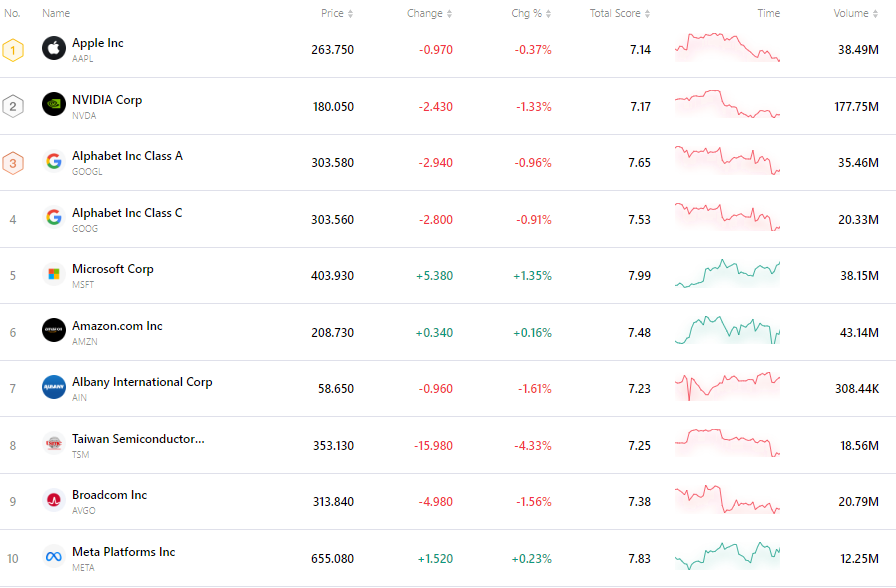
Top 10 Most Traded Stocks
The chart below lists the ten most actively traded stocks in the market. Due to their massive trading volumes and high liquidity, these stocks serve as critical benchmarks for tracking global market dynamics.
Recommended Articles






Comments (0)
Click the $ button, enter the symbol, and select to link a stock, ETF, or other ticker.