


Today’s Market Recap: AI Spending Shock Triggers Tech Rout and Crypto Selloff



Track the Market Trend
TradingKey - On February 5, 2026, the S&P 500 dropped 1.23% to end the session at 6,798, while the Nasdaq Composite declined 1.59% to 22,541, as technology stocks continued to face heavy selling pressure.
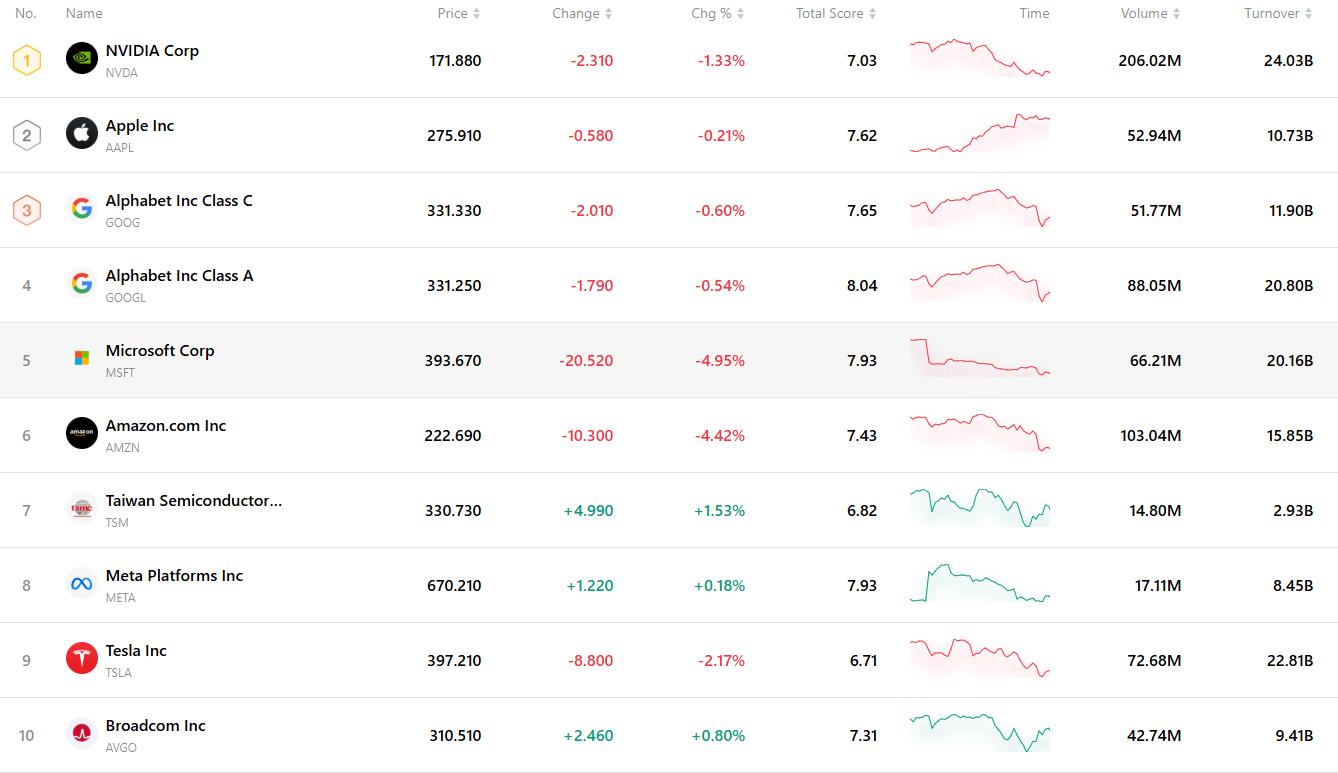
In the interactive media and services segment, Meta Platforms edged up 0.18% to settle at $670.21, contrasting with Amazon’s 4.42% slide to $222.69, highlighting diverging performance among major tech platforms.
E-commerce and cloud-related stocks also trended lower. Alibaba Group (BABA) slipped 0.87% to $157.76, and Walmart (WMT) lost 0.83% to close at $126.94, reflecting broader weakness in retail and digital platform names.
Alphabet (GOOGL) fell 0.54% to $331.25 as traders digested its announcement to raise 2026 capital expenditures on AI to approximately $180 billion. Concerns over the impact of heightened investment on future free cash flow and AI monetization weighed on sentiment. Trading volume reached 87.1 million shares, 136% above its three-month average of 36.8 million. Since its 2004 IPO, Alphabet’s stock has risen more than 13,000%.
Peloton Interactive (PTON) tumbled 25.72% to $4.39 after its fiscal Q2 earnings missed expectations and Q3 guidance came in weaker than anticipated. Market focus has shifted toward subscription performance and recent leadership changes. The day’s trading volume surged to 90.3 million shares, over seven times its three-month average of 10.9 million. The stock has lost 83% of its value since its 2019 IPO.
Amazon (AMZN) fell 4.42% to $222.69 amid a broad-based retreat in tech and AI-linked names. The decline came as investors awaited clarity on AWS cloud momentum, updated AI-related capital expenditure plans, and forward guidance.
In commodities, silver (XAGUSD) plummeted 19%, nearing the $70 level.
Digital assets faced sharp losses across the board. Bitcoin (BTCUSD) plunged 12%, falling below the $63,000 mark, while Ethereum (ETHUSD) dropped 11% to trade under $1,900.
Market Headline
Japanese bond market calms as long-end auction sees strong demand. In the face of political uncertainty surrounding the upcoming elections, demand for Japan’s 30-year government bonds rebounded. The bid-to-cover ratio rose to 3.64, easing investor anxiety and pushing the 30-year yield down by 5 basis points to 3.585%. The solid auction helped stabilize broader sentiment in Japanese fixed-income markets.
AI disruption rattles financial software stocks after Anthropic's Claude Opus 4.6 debut. Anthropic unveiled Claude Opus 4.6 on Thursday, an upgraded AI model with enhanced capabilities in financial document analysis, regulatory research, and real-time market interpretation. Designed to support institutional workflows, the model offers significant advances in coding, reasoning, and multitasking. Its release sparked a selloff in financial information providers: FactSet (FDS) dropped as much as 10%, while Thomson Reuters (TRI) lost over 8.5%, touching its lowest intraday level since March 2020. The sharp reaction reignited investor concerns about AI replacing traditional enterprise software solutions.
Amazon tanks after massive spending plans overshadow solid AWS growth. Amazon’s stock fell more than 10% in after-hours trading following the release of its earnings report and updated investment plans. Although Q4 revenue rose 14% year-over-year and AWS posted 24% growth—its fastest pace in over three years—investors were alarmed by the company’s 2024 capital expenditure guidance, which unexpectedly exceeded $200 billion, surpassing Alphabet’s. Free cash flow contracted by over 70% compared to last year, while spending on property and equipment surged nearly 59%, raising concerns about profitability and efficiency.
Bitcoin sinks to a 16-month low as confidence in risk assets deteriorates. Bitcoin plunged 12% on Thursday to around $63,000, marking its lowest level in over 16 months. The sharp decline triggered mass liquidations—over 400,000 accounts were reportedly liquidated—underscoring what some are calling a “crisis of confidence” across digital assets. The drop came amid a broader selloff in speculative investments, with market participants rotating out of high-volatility assets.
Top 10 Most Traded Stocks
The chart below highlights the ten most actively traded stocks in the current market. With their substantial trading volumes and high liquidity, these names serve as key benchmarks for tracking global market dynamics.
Recommended Articles








Comments (0)
Click the $ button, enter the symbol, and select to link a stock, ETF, or other ticker.