


Platinum (XPTUSD) Is up by 2.47% on Jul 2: Is the Demand Outlook Changing?



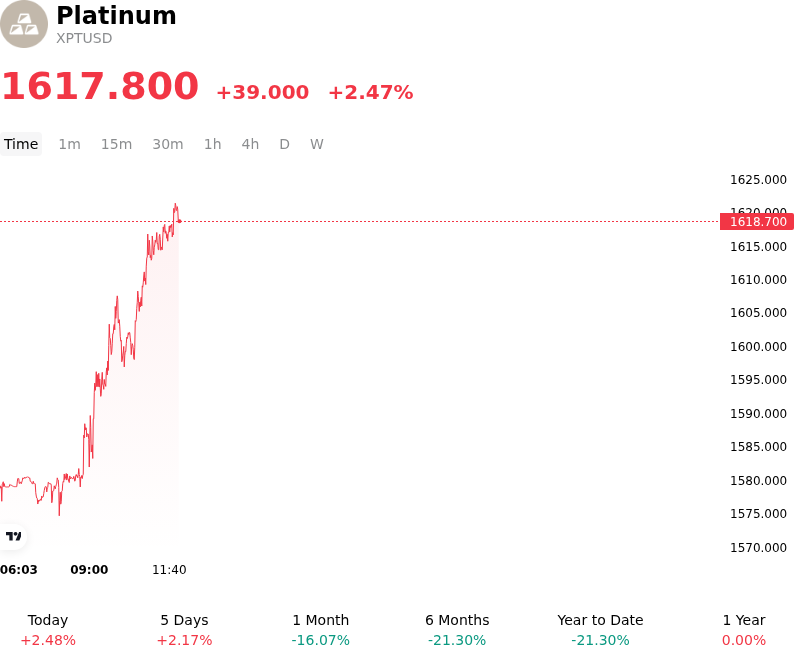
Platinum (XPTUSD) is up 2.47% at Jul 2 00:00(ET), now at $1617.8, with a 7-day up of 1.00%.
What is driving Platinum (XPTUSD)’s stock price up today?
The rebound in platinum prices represents a correction of deeply oversold conditions, driven by a modest easing of the macroeconomic headwinds that dominated the second quarter of the year. After suffering persistent selling pressure throughout June—prompted by hawkish Federal Reserve projections and a strengthening US dollar—investors used a minor pullback in the greenback and US Treasury yields to re-engage with the metal. The correction also highlights a technical defense of critical support near the key threshold of fifteen hundred dollars per ounce.
From a structural standpoint, the underlying physical fundamentals remain highly supportive, preventing a broader breakdown. The World Platinum Investment Council maintains its projection of a fourth consecutive annual supply deficit for the global platinum market, forecasting a shortfall of nearly three hundred thousand ounces. This structural deficit continues to erode above-ground stocks, which are hovering at multi-year lows equivalent to roughly three to four months of global demand. Supply constraints from major producers, particularly South Africa and Russia, continue to limit global output, while resilient industrial demand—specifically driven by glass-capacity expansions and emerging green hydrogen technologies—underpins the medium-to-long-term investment case.
The immediate trigger for the upward movement was a shift in macro sentiment ahead of key US labor market data. A slight dip in the ten-year US Treasury yield relieved the high opportunity costs associated with holding non-yielding precious metals. Additionally, a minor softening of the US dollar made dollar-denominated commodities more attractive to international buyers. Although investor participation in exchange-traded products and speculative futures has cooled from the peak levels seen earlier in the year, the underlying physical tightness ensures that any macro-driven relief triggers swift, technical buying.
While the broader macroeconomic picture is still clouded by hawkish central bank policies and easing geopolitical premiums in the energy sector, the physical market balance remains tight. Investors continue to monitor upcoming economic indicators, particularly US employment data, to gauge whether the Fed will pursue additional tightening. This macroeconomic data remains the primary risk factor capable of shifting the delicate balance between short-term bearish sentiment and long-term structural supply deficits.
Technical Analysis of Platinum (XPTUSD)
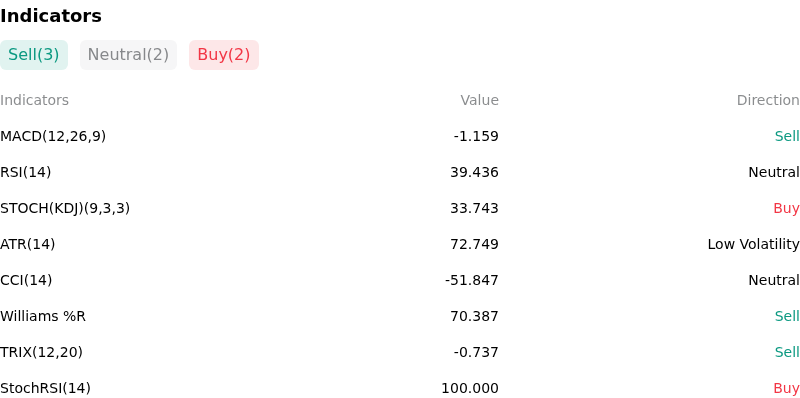
Technically, Platinum (XPTUSD) shows a MACD (12,26,9) value of -1.159, indicating a sell signal. The RSI at 39.436 suggests neutral condition and the Williams %R at 70.387 suggests sell condition. Please monitor closely.
More details about Platinum (XPTUSD)
An analysis of the current market highlights several downside volatility risks for platinum (XPTUSD):
Recent Events and Risks:
- Downshift to Market Surplus and Price Target Downgrades: In recent sessions, financial institutions including UBS slashed their platinum price forecasts by $300 an ounce, citing a "risk of a surplus" by the end of the year. After expectations of a balanced market, weakening investment interest and softening demand across key industrial and retail sectors threaten to tip the market into oversupply, weighing heavily on spot and futures prices.
- Sharply Weakening Investment and ETF Demand: Reversing the robust inflows of the previous year, investors have increasingly pulled capital out of the metal, liquidating approximately 500,000 ounces in exchange-traded fund (ETF) holdings. High prices and broader macro uncertainty have prompted investors to seek liquid assets elsewhere, leading to a recorded quarterly surplus that continues to cap near-term recovery efforts.
- Macro Pressure from Hawksh Federal Reserve Policy: Ongoing bets on a restrictive monetary policy stance and hawkish Federal Reserve rate projections have elevated bond yields and kept the U.S. dollar strong. This environment raises the opportunity cost of holding non-yielding precious metals, driving spot platinum (XPTUSD) to hover near multi-month lows around the $1,550 to $1,600 range and maintaining sharp technical downward momentum.
- Declining Demand in Key Automotive and Jewelry Sectors: Demand in the automotive sector faces a drag due to an expected decline in the production of internal combustion engine vehicles. Concurrently, global jewelry consumption has softened as economic growth concerns and high retail prices deter consumers, weakening a critical pillar of physical demand.
This article may include AI-generated content that is human-reviewed, which is for reference and general information purposes only and does not constitute investment advice.
Recommended Articles









Comments (0)
Click the $ button, enter the symbol, and select to link a stock, ETF, or other ticker.