


Intel Price Forecast: Nvidia Picked Xeon 6, Invested $5B, Yet Analysts Still Trail INTC



AI Podcast


Intel Corporation is demonstrating significant momentum, trading at $140.05 amid robust AI-driven demand. Core catalysts include NVIDIA’s $5 billion equity investment and the selection of Intel’s Xeon 6 for DGX Rubin AI systems, alongside multi-year, volume-locked agreements with Google and Microsoft. Q1 2026 data shows strong revenue growth in Data Center/AI and Foundry segments, with AI-linked revenue reaching 60% of the mix. While currently trading above consensus analyst targets, the valuation is supported by evolving commercial fundamentals. Technically, the stock remains in a neutral-bullish trend, with a potential move toward $159.90 if it clears $150.40 resistance.

TradingKey - Intel Corporation (NASDAQ: INTC) sits at $140.05, holding firm on the ascending trendline within the 2H timeframe. The RSI indicator is currently reading 55.21, positioning it as neutral-bullish, while green candles continue to soak up sell orders in close proximity to the trendline-resistance alignment. This rally translates into a ~465% gain for the company's stock over the prior 12 months, climbing from a $18.97 low, a climb so massive that the 12-month average analyst price target of $93.93 now sits 33% behind the actual price of shares, creating an enduring wedge between where analysts have modelled the stock to end and where they find it today.
Intel’s July investment thesis does not hinge on the Apple deal or Trump’s social media post, topics I’ve written about in the past few issues; rather, it turns on the fact that NVIDIA invested $5B into Intel as well as opted for Intel Xeon 6 as the host CPU in their DGX Rubin NVL8 AI systems. Put another way, it’s the most important GPU company of our day endorsing Intel’s CPU.
Jensen Huang Picked Intel — What the Xeon 6 Selection for DGX Rubin Means
NVIDIA could have gone with any CPU to accompany their Rubin GPU, but they went with Intel Xeon 6 to power the DGX Rubin NVL8, the AI system that will power the data centre for the next two to three years. CEO Lip-Bu Tan recently said Xeon 6 now plays the role of “the orchestration layer and critical control plane for the entire AI stack” and highlighted that the CPU:GPU ratio for inference is beginning to shift from 1-to-8 to 1:1, meaning the ratio of CPUs needed to support the GPU is actually increasing, not decreasing (the prior narrative was that GPUs would ultimately take over the CPU role).
Jensen Huang’s decision to build the DGX Rubin NVL8 on Xeon 6 coupled with their $5B equity investment in Intel represents the strongest signal yet from a third party that Intel’s CPU is competitive. This is not an Apple rumor or an announcement on social media: This is a CPU architecture decision from the world’s largest infrastructure company in AI.
Q1 2026 showed the beginning of the revenue impact of this AI CPU positioning, with Data Center and AI reaching $5.1B (up 22% year-over-year), and non-GAAP EPS reaching $0.29 while GAAP was negative $0.73 (this was after heavy foundry investment charges). Meanwhile, Intel Foundry saw revenue of $5.4B (up 16% year-over-year), which translates to a Foundry segment that is now over $20B in annualised revenue (still negative earnings but not quite the rounding error it was). CFO David Zinsner characterized the quarter as having “unprecedented demand for silicon” and Q2 guidance is $13.8 to $14.8B, indicating continued sequential revenue strength. About 60% of this quarter's revenue mix now comes from AI-linked sources, compared with a little less than 25% a year ago.
The Google Deal — Multiyear, Locked Pricing, Custom ASIC Co-Development
Google's Q1 2026 announcement is the second major confirmed hyperscaler commitment that brings contractual revenue certainty to the Intel thesis. Google inked a multiyear deal for continued use of Intel Xeon processors in Google's workload-optimized instances, including the newest Xeon 6 processors that power C4 and N4 instances. The companies also are partnering on custom-designed ASIC Infrastructure Processing Unit (IPU) chips that will help boost utilization, lower system complexity, and scale more efficiently for AI tasks.
CEO Tan said the agreements span three to five years, with locked volume and pricing. That represents a rare and tangible commitment in an industry to provide revenue visibility for the term. The structure directly addresses the main criticism of Intel's revenue run-rate so far this year, which is that demand is not real but order-driven (front-loaded).
Add to the list of commitments NVIDIA's $5B equity commitment plus Xeon 6 product selection, Google's multi-year Xeon and custom ASIC deal, and Microsoft's previously confirmed 18A wafer deal, plus Apple foundry negotiations that are ongoing.
This deal stack is where the current price stands relative to the average price target of $93.93 on the stock from analyst coverage. This gap represents how fast the new Intel story is unfolding versus the rate at which sell-side analysts are updating their models: Cantor Fitzgerald raised its price target to $150 from $90 in early July 1 and still held a Neutral rating noting its price target remains a mere 13.9% above current levels.
Current valuation checks (per Simply Wall St) show Intel trades at a price-to-sales multiple of 13.1x vs. a suggested fair price multiple of 15.1x given its combination of foundry + AI exposure, and scores 2 of 6 on its broader valuation checks. While INTC is not cheap on an absolute basis, it's not obviously expensive when compared to the group of peers and the confirmed customer stack.
INTC Technical Setup — Trendline Defense at $140, RSI 55.21, Target $159.90
On the 2H chart, INTC is holding the ascending multi-touch black trendline after a series of rejections of the descending red trendlines from the $169 plus highs and is holding above the EMAs200 at $106.07 with higher lows. RSI at 55.21 is neutral-bullish with room to rise above before becoming overbought and does not have any divergence, as buyer absorption of sell orders (seen on green candles) near the trendline-resistance confluence.
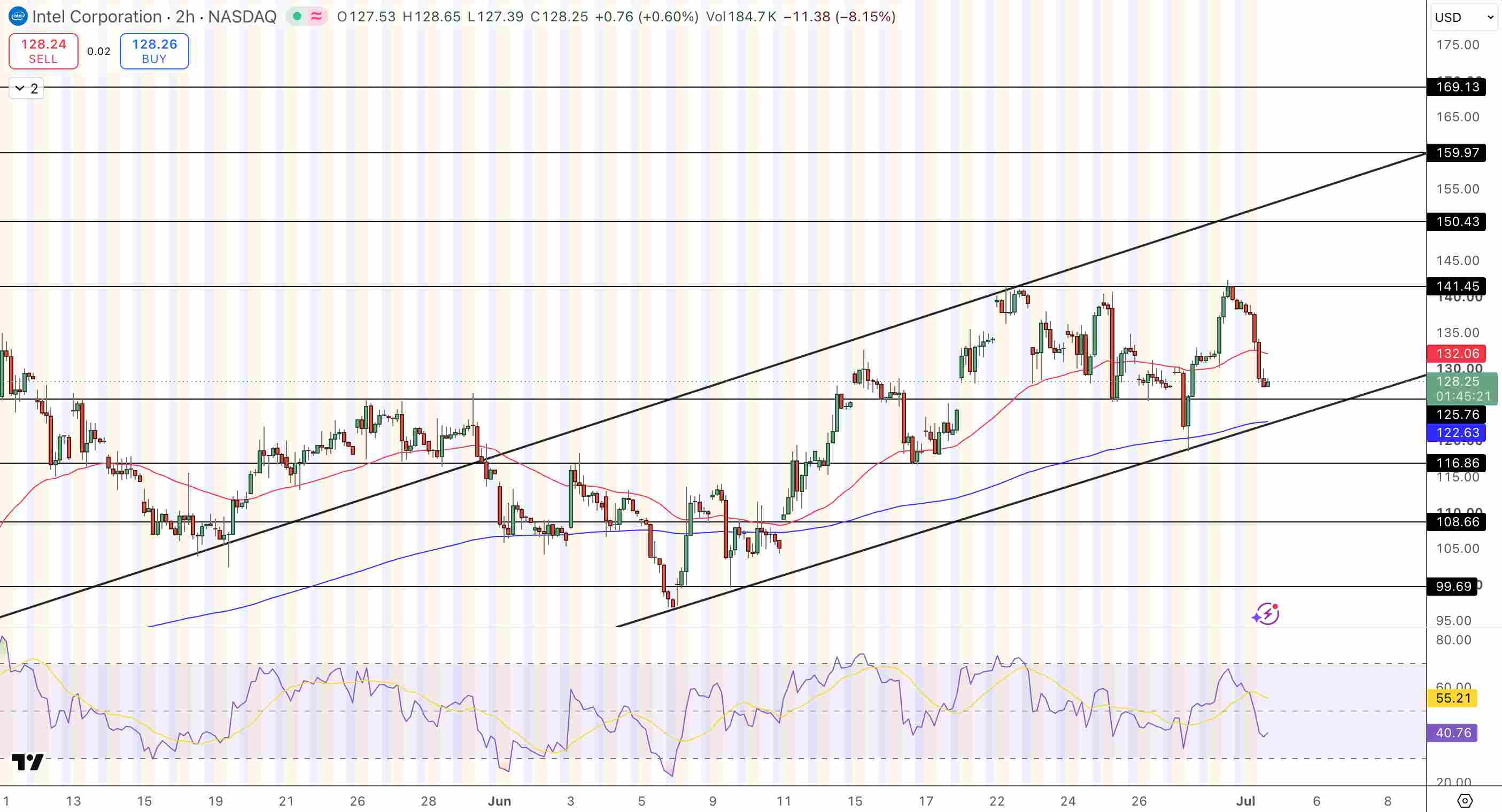
Resistance overhead sits at $150.43 to $159.97. If INTC holds the trendline, and confirms a move above $150.40, the next price target is $159.90. If it breaks down below $126.20, the next price target is $117.07.
- Entry: Long above $150.40 — trendline and resistance cleared
- Target: $159.90 — trendline bounce extension
- Stop Loss: Close below $126.20 — ascending trendline fails
- NVIDIA selection: Xeon 6 chosen as host CPU for DGX Rubin NVL8; $5B equity investment
- Google deal: Multiyear, locked pricing 3–5 years, custom ASIC IPU co-development
- Next earnings: July 23, 2026
Why Did NVIDIA Invest $5 Billion in Intel and Select Xeon 6 for Its AI Systems?
NVIDIA allocated $5B of equity to Intel and chose Intel's Xeon 6 as the host CPU for its DGX Rubin NVL8 AI systems, the AI product to set the benchmark for data centre AI systems for the next product cycle? Here's the explanation from Lip-Bu Tan: "The CPU has become the orchestration layer, the control plane of the entire AI infrastructure. In inference workloads, we're starting to shift from 1 CPU to 8 GPUs towards 1 CPU to 1 GPU." Jensen Huang's choice of Xeon 6 is a product architecture decision, by the company that's the benchmark for defining AI infrastructure, not an investment, or a promotion, from NVIDIA: Jensen's selection of Xeon 6 is the best possible validation of Intel's CPU competitive position.
What Did Intel Report in Q1 2026 and What Is Q2 Guidance?
In Q1 2026, Data Center and AI (DC&A) was $5.1 billion (+22% YoY) and Foundry was $5.4 billion (+16% YoY). Non-GAAP earnings per share was $0.29 per share, compared with $0.73 (GAAP) because of foundry capital investment charges for 18A. Intel expects Q2 to continue expanding sequentially with revenues of $13.8 billion to $14.8 billion. "AI-linked revenue is now approximately 60% of the quarterly mix, as compared with a year ago when it was under 25%," said CFO David Zinsner. The quarter was defined by unprecedented demand for silicon and Intel's determination to use the entire factory network as a means to maximize output. "Our long-term deals span three to five years, with locked volumes and pricing," said CFO Zinsner.
Why Is the Average Analyst Target at $93.93 When Intel Trades at $140?
That's a 33% difference, which shows how rapidly the Intel story has evolved relative to the time required for sell-side equity research analysts to update their models. Cantor Fitzgerald increased its 12-month price target to $150 on July 1 while keeping a Neutral rating, stating that the new price target was 13.9% above the current stock price. The majority of Wall Street firms haven't yet updated their financial models to account for the NVIDIA $5B equity investment, the Google multiyear deal, and a full risk production announcement for 18A. The Simple Wall St analysis places "fair value" Price/Sales of 15.1 vs. 13.1, which suggests that Intel is not significantly overvalued vs. peer group P/S at current trading levels.
Bottom Line
Intel is up 465% over the past year and now trades 33% above the consensus analyst 12-month price target of $93.93. That gap exists because the story, now anchored around NVIDIA's investment and product choice, the Google and Microsoft signed deals, has moved a long distance relative to the ability of sell-side research analysts to update models. Those commercial agreements are no longer a rumour.
The Intel story now includes a $5 billion equity investment from NVIDIA for Xeon 6 as the host CPU for DGX Rubin NVL8, a Google multiyear agreement with locked volume and pricing (3-to-5-year deployment and co-development of Intel custom AI accelerators (ASIC)), and Microsoft has signed a deal for wafers using 18A technology.
Q1 2026 was Data Center and AI $5.1 billion (+22%), with an average of 60% AI-linked of the mix. Technicals are a defense at $140, with the average ascending trendline, plus RSI at 55.21, neutral-bullish. Confirmation above $150.40 will send prices to a $159.90 price target. A stop at $126.20 would protect against a failure. Q2 2026 guidance to be issued at July 23 earnings is the next checkpoint, where we'll hopefully see a large component of the stack materialize in guidance.
Recommended Articles







Comments (0)
Click the $ button, enter the symbol, and select to link a stock, ETF, or other ticker.