


NZD/USD (NZDUSD) Is down 0.50% on Jun 23: What Signals Does the Macro Data Send?



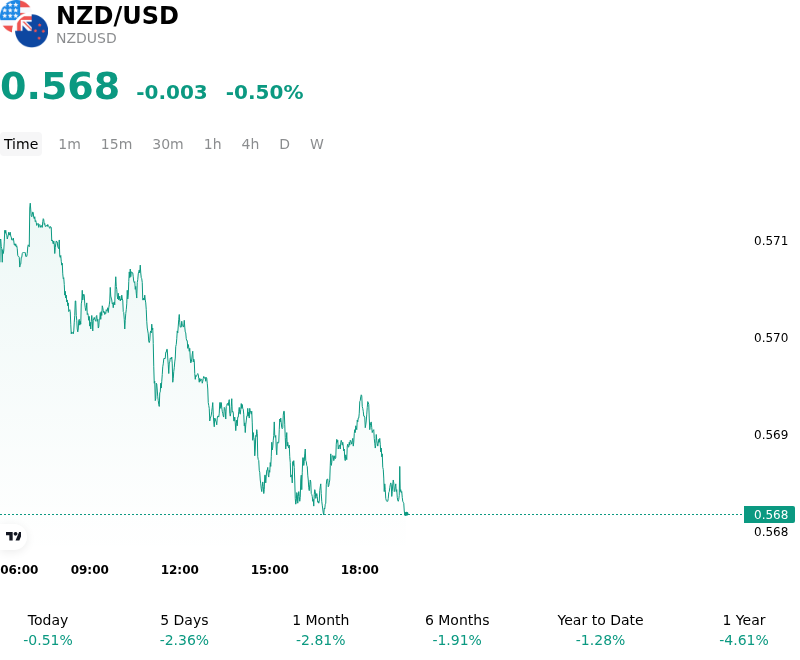
NZD/USD (NZDUSD) is down 0.50% at Jun 23 07:35(ET), now at $0.56818, with a 7-day down of 2.52%.
What is driving NZD/USD (NZDUSD)’s stock price down today?
The New Zealand Dollar faced persistent downward pressure against its US counterpart, extending its multi-session slide to slip below the key psychological support level near 0.5700. A critical headwind driving this weakness is the prevailing risk-off sentiment across global financial markets, fueled by deepening skepticism regarding the US-Iran peace negotiations. Although a temporary ceasefire had initially provided market relief, recent statements from negotiators indicating a lack of a concrete plan to reopen the strategically vital Strait of Hormuz have reignited energy supply concerns. As a high-beta, growth-linked currency, the Kiwi remains highly sensitive to global risk dynamics, leaving it vulnerable to this defensive shift in investor sentiment.
On the other side of the pair, the US Dollar has drawn significant strength from a rapid hawkish repricing of the Federal Reserve’s monetary policy trajectory. Following the June Federal Open Market Committee meeting, which marked the debut of the new Chair, Kevin Warsh, and included the release of the Summary of Economic Projections, market participants have aggressively upgraded their tightening expectations. The Fed’s upward revision of both near-term core inflation forecasts and the projected terminal federal funds rate has pushed US Treasury yields higher. Fed funds futures are now pricing in a near-90 percent probability of a rate hike by December, alongside a strong likelihood of a September move, presenting a stark contrast to expectations just a week ago. This surge in yields has widened interest-rate differentials in favor of the greenback, drawing institutional capital flows away from riskier peers.
This policy divergence is further highlighted by the domestic backdrop in New Zealand. While local economists still expect the Reserve Bank of New Zealand to eventually raise the Official Cash Rate, recent selected price index data revealed that cooling demand is effectively containing cost-push pressures. This moderation in inflation has granted the RBNZ more policy flexibility and breathing room, reducing the urgency for immediate, aggressive monetary tightening. The widening yield spread between a hawkishly repositioned Federal Reserve and a more patient RBNZ, compounded by fragile geopolitical conditions, suggests that the downward pressure on the currency pair is firmly supported by broader macroeconomic trends.
Technical Analysis of NZD/USD (NZDUSD)
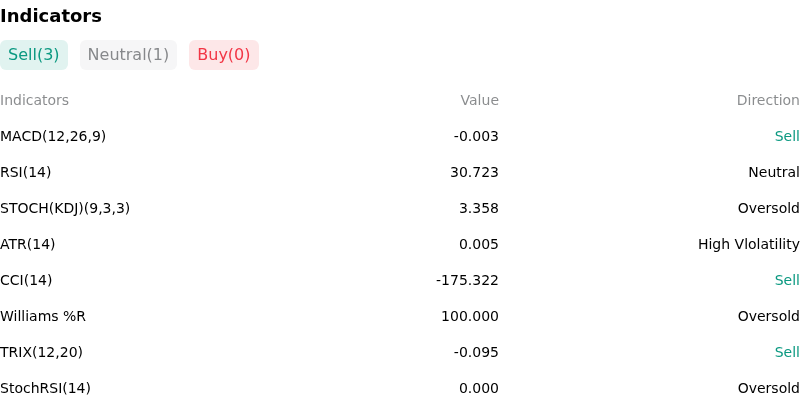
Technically, NZD/USD (NZDUSD) shows a MACD (12,26,9) value of -0.003, indicating a sell signal. The RSI at 30.723 suggests neutral condition and the Williams %R at 100.000 suggests oversold condition. Please monitor closely.
More details about NZD/USD (NZDUSD)
Recent Events and Risks:
- Hawkish Federal Reserve Re-pricing and Rising US Yields: Following a hawkish shift in the Fed's June dot plot, market participants and major institutional strategists have aggressively re-priced US interest rate expectations, with Bank of America pivoting on June 22 to project 75 basis points of hikes by the end of 2026. This hawkish momentum under Fed Chair Kevin Warsh has pushed US Treasury yields to multi-month highs, strengthening the US Dollar and widening yield spreads to the detriment of the NZD.
- NZIER Economic Growth Downgrade: In its June Quarterly Predictions released on June 23, the New Zealand Institute of Economic Research (NZIER) warned that the global fuel crisis has derailed the domestic recovery. NZIER downgraded New Zealand's GDP growth forecast to 0.6% for the year ending March 2026 and slashed the March 2027 forecast to 1.6%, signaling acute stagflationary risks as high fuel prices drag on household consumption and business investment.
- Geopolitical Risk and Strait of Hormuz Supply Shocks: Risk sentiment remains highly fragile as market participants express deep skepticism over the progress of US-Iran peace talks. Despite the conclusion of technical negotiations, the continued closure of the Strait of Hormuz—which handles approximately 20% of global oil transit—has kept risk-off flows active, disproportionately punishing the risk-sensitive New Zealand Dollar.
- Technical Breakdown Below the 0.5700 Support Level: NZDUSD price action has experienced a steady intraday decline, breaching the psychological 0.5700 threshold to test its year-to-date lows near 0.5680. Trading below the 50-period EMA alongside negative MACD and Relative Strength Index (RSI) indicators points to strong bearish momentum, exposing the pair to further downside targets near the 0.5640 zone.
This article may include AI-generated content that is human-reviewed, which is for reference and general information purposes only and does not constitute investment advice.
Recommended Articles









Comments (0)
Click the $ button, enter the symbol, and select to link a stock, ETF, or other ticker.