


SAP SE Stock (SAP) Closed Down by 3.64% on Jun 17: What Signal Does It Send?



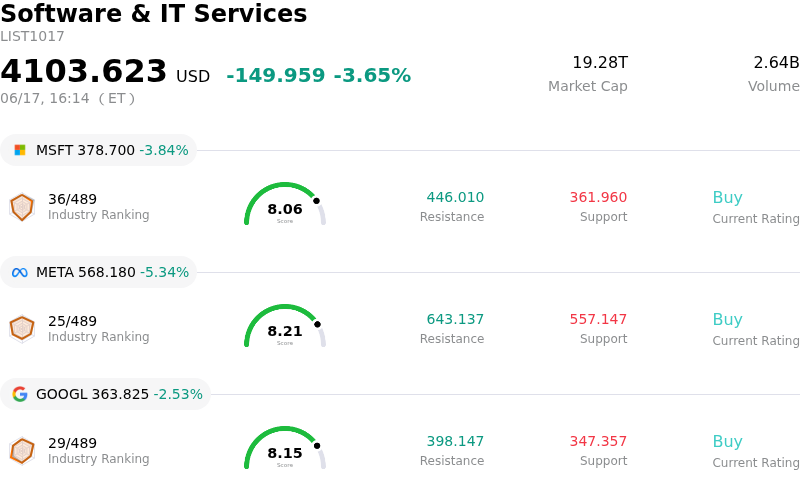
SAP SE (SAP) closed down by 3.64%. The Software & IT Services sector is down by 3.65%. The company outperformed the industry. Top 3 stocks by turnover in the sector: Microsoft Corp (MSFT) down 3.93%; Meta Platforms Inc (META) down 5.34%; Alphabet Inc Class A (GOOGL) down 2.53%.
What is driving SAP SE (SAP)’s stock price down today?
The primary driver behind the intraday volatility and downward pressure on SAP was a sharp shift in macroeconomic sentiment following the Federal Reserve’s June monetary policy meeting. While the central bank kept interest rates unchanged, the release of its updated economic projections showed that nearly half of the policymakers anticipate a rate hike later in the year. Under newly appointed Chairman Kevin Warsh, the Fed’s signaling of a potentially tighter monetary path and its intent to reduce forward guidance caught market participants off guard. This hawkish repricing immediately pressured high-multiple technology and growth stocks, as higher-for-longer interest rates lift the discount rates used to value future cash flows.
Additionally, SAP has been grappling with sector-wide margin concerns that were recently amplified by direct competitor Oracle's massive capital expenditure plans for the coming fiscal year. Oracle’s aggressive infrastructure spending targets to scale its artificial intelligence offerings have intensified fears among investors regarding the high capital intensity required to remain competitive in the enterprise software space. This competitive dynamic is causing a reassessment of profitability across the industry, raising concerns that software giants may have to endure compressed profit margins to support their AI agent layers and maintain their market share.
These industry-wide pressures are compounded by company-specific headwinds. Analysts at Goldman Sachs recently adjusted their financial outlook for SAP, lowering gross margin forecasts for the second half of the year due to anticipated increases in hardware and cloud infrastructure costs. This adjustment, combined with slower-than-expected cloud conversions and decelerating growth in cloud backlogs, has created near-term earnings visibility issues. Concerns that the transition to cloud-based subscriptions and AI integration could temporarily weigh on profitability have kept buyers on the sidelines.
Finally, broader geopolitical and regional economic headwinds continue to influence investor appetite. With a substantial portion of its revenue tied to Europe, SAP remains vulnerable to regional economic slowdowns and inflationary pressures. The convergence of a hawkish macroeconomic shift, heightened capital demands in the AI software sector, and downward analyst revisions to near-term profitability have combined to trigger a risk-off rotation, fueling the recent sell-off and volatility in SAP's stock.
Technical Analysis of SAP SE (SAP)
Technically, SAP SE (SAP) shows a MACD (12,26,9) value of -4.693, indicating a neutral signal. The RSI at 40.705 suggests neutral condition and the Williams %R at 85.204 suggests oversold condition. Please monitor closely.
Fundamental Analysis of SAP SE (SAP)
SAP SE (SAP) is in the Software & IT Services industry. Its latest annual revenue is $41.49B, ranking 14 in the industry. The net profit is $8.07B, ranking 13 in the industry. Company Profile
Over the past month, multiple analysts have rated the company as Buy, with an average price target of $271.49, a high of $367.98, and a low of $154.99.
More details about SAP SE (SAP)
Company Specific Risks:
- Competitive AI Infrastructure Capex Shock: Direct rival Oracle’s massive $95 billion fiscal 2027 capital expenditure guidance has triggered industry-wide fears of margin compression, raising concerns that SAP will be forced to aggressively increase its own infrastructure capital requirements to remain competitive in the generative AI race.
- Goldman Sachs Gross Margin Cut: Goldman Sachs recently lowered its price target and trimmed its second-half 2026 gross margin forecast for SAP, citing anticipated headwinds from elevated hardware costs and rising component pricing.
- Slowing Cloud Backlog and Conversion Headwinds: Market analysts continue to raise concerns over a structural deceleration in SAP's current cloud backlog (CCB) growth rate as the mature migration base shows slower-than-expected conversion of legacy on-premises systems to modern consumption-based cloud pricing.
- Critical NetWeaver Cybersecurity Flaws: SAP's recent Security Patch Day highlighted 15 vulnerabilities, including high-severity flaws CVE-2026-44748 (CVSS 9.9 SAML authentication bypass) and CVE-2026-27671 (CVSS 9.8 NetWeaver memory corruption) which have no workarounds and require immediate kernel-level patching, exposing enterprise networks to potential operational disruptions.
This article may include AI-generated content that is human-reviewed, which is for reference and general information purposes only and does not constitute investment advice.
Recommended Articles







Comments (0)
Click the $ button, enter the symbol, and select to link a stock, ETF, or other ticker.