


US Stocks Close: Three Major Indexes Diverge, Chip Stocks Fall Across the Board; SpaceX Market Value Briefly Surpasses Microsoft, Market Focuses on Upcoming Fed Policy Meeting



AI Podcast


On Eastern Time June 16, U.S. markets showed caution amid the Fed leadership transition and global carry-trade volatility. The Dow rose 0.64%, while the Nasdaq and S&P 500 declined. Tech sector performance was divergent; notably, SpaceX surged 4.77% following its planned acquisition of Anysphere, while chip stocks faced a broad sell-off. Macro-wise, the G7 summit focused on Ukraine support, and the ECB warned of lingering energy-driven inflation. Despite intense AI-related capital demand, financial institutions remain liquid. Meanwhile, strategic corporate developments include Apple’s AI-focused hardware roadmap and potential M&A activity in the semiconductor space.

TradingKey - On June 16, Eastern Time, as the newly appointed Federal Reserve Chairman Warsh is set to chair his first policy meeting, and Japan's rate hike weighs on the carry trade, both factors have fueled a strong wait-and-see sentiment in the U.S. stock market. The three major U.S. stock indexes ended mixed, with only the Dow Jones Industrial Average closing higher. Technology stocks led the declines, while consumer and financial shares bucked the trend to strengthen.
At the close of trading, the Dow Jones Industrial Average rose 0.64% to 51,999.67; the Nasdaq Composite Index fell 1.15% to 26,376.34; and the S&P 500 Index slid 0.57% to 7,511.35.
Tech stock performance
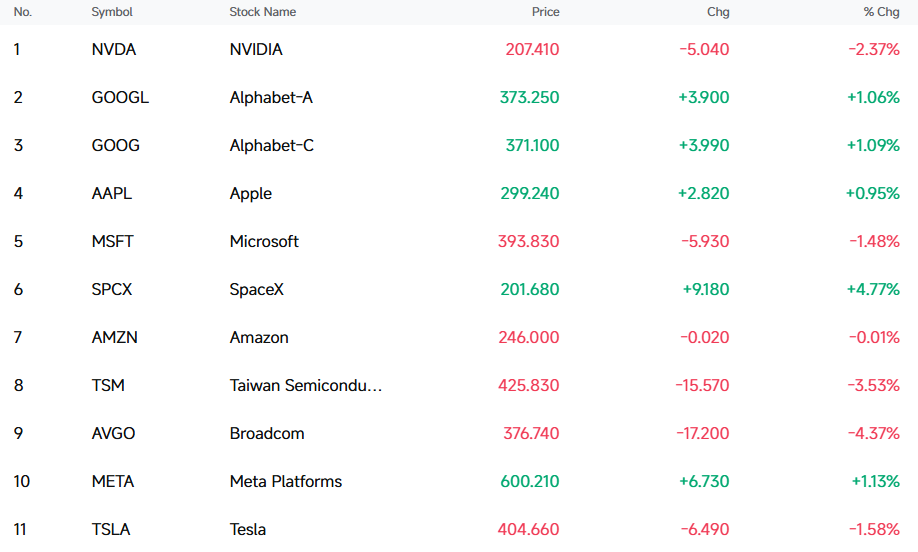
SpaceX (SPCX) surged and then pared gains, hitting an intraday high of $225.64, with its market capitalization briefly surpassing Microsoft (MSFT) to rank fourth in the US. It closed up 4.77% at $201.68, with its latest market capitalization standing at $2.66 trillion.
SpaceX said on Tuesday that it will acquire Anysphere, the developer of the popular AI coding agent Cursor, for $60 billion to expand its footprint in the enterprise AI market. SpaceX expects this acquisition to close in the third quarter of 2026. Like OpenAI and Anthropic, Cursor is one of the Silicon Valley startups that have attracted a large number of developers in recent years.
Among mega-cap tech stocks, SpaceX rose 4.77%, Meta Platforms (META) rose 1.13%, Google (GOOGL) rose 1.06%, Apple (AAPL) rose 0.95%; on the downside, Broadcom (AVGO) fell 4.37%, TSMC (TSM) fell 3.53%, Nvidia (NVDA) fell 2.37%, Tesla (TSLA) fell 1.58%, Microsoft (MSFT) fell 1.48%, and Amazon (AMZN) fell 0.01%.
[Source: FutuBull]
The Philadelphia Semiconductor Index closed down 5.71% at 13,294.22 points, with all 30 of its components falling.
Chip stocks fell across the board, with Intel (INTC) down 8.45%, Advanced Micro Devices (AMD) down 7.30%, Arm Holdings (ARM) down 3.93%, Qualcomm (QCOM) down 3.05%, and Nvidia (NVDA) down 2.37%.
Chinese concept stocks suffered broad losses, with Hesai (HSAI) down 8.68%, BOSS Zhipin (BZ) down 7.04%, Kingsoft Cloud (KC) down 5.20%, Pony.ai (PONY) down 4.57%, XPeng (XPEV) down 4.49%, MINISO (MNSO) down 4.20%, and Futu Holdings (FUTU) down 4.11%.
Corporate News
Apple to Launch AirPods with Cameras and Next-Gen Foldable iPhone in 2027
Apple plans to launch all-new AirPods equipped with cameras in late 2027, alongside the debut of several other new products, including a next-generation foldable phone and a new anniversary iPhone. These new AirPods will represent Apple's first AI-focused wearable device, equipped with computer-vision cameras as sensing components to provide Siri with real-world visual information. Apple is also developing multiple next-generation process-node chips for its future devices, with plans to launch its first smart glasses as early as late next year.
Qualcomm in Talks to Acquire Tenstorrent for Up to $10 Billion
Media reports indicate that Qualcomm is in talks to acquire startup Tenstorrent to expand its AI chip capabilities. Sources say the two companies have discussed a price of at least $8 billion to $10 billion. Negotiations are still ongoing, prices are subject to adjustment, and the talks could still fall through. If the deal is finalized at the maximum valuation of $10 billion, it would mark one of the largest acquisitions in the global AI chip sector in the past three years.
Lockheed Martin to Partner with General Motors to Accelerate Weapon Production
Lockheed Martin and General Motors signed a memorandum of understanding on Tuesday. Under the coordination of the Pentagon, the two companies will focus on three key areas—supply chain reinforcement, capacity expansion, and the dual-use adaptation of civilian manufacturing technology for military applications—to jointly improve weapon production efficiency.
As a defense giant, Lockheed Martin has planned to invest $9 billion by 2030 specifically to expand production of missiles and various munitions. The core of this partnership with General Motors is to leverage the automotive industry's mass-production expertise to accelerate capacity ramp-up and meet rising global defense demand.
Snap Releases First Consumer-Grade AR Glasses "Specs"
Snap on Tuesday officially launched its first mass-market AR glasses, Specs, priced at $2,195 and scheduled to roll out in the US, UK, and France later this year. The company's CEO believes that 20 years after the debut of smartphones, users have grown tired of screen-based interaction, and spatial computing via transparent displays will become the next paradigm of computing.
Industry & Macro News
Russia-Ukraine Issue Takes Center Stage at G7 Summit as Trump Shifts Attention to Ukraine
As the US-Iran peace deal is finalized and the war in the Middle East nears its end, the strategic focus of the United States has begun to shift toward Europe. At the G7 summit in Évian, France, Donald Trump publicly urged Russia to reach an agreement to end the Russia-Ukraine war, promised more support to Ukraine, and confirmed that he had spoken with Vladimir Putin by phone about peace talks prior to the meeting. Ukrainian President Volodymyr Zelensky was also invited to attend, with his primary objectives being the reinforcement of his country's air defense capabilities and pushing for a diplomatic truce.
Europe, over its part, took the opportunity to pressure the US. As the rotating presidency, France placed maintaining support for Ukraine at the center of the summit's agenda. French President Emmanuel Macron stated bluntly that Europe is currently bearing almost the entire burden of aid to Ukraine, demanding that the US continue to fulfill its responsibilities and not weaken its support. The EU has finalized a €90 billion loan for Ukraine, which can cover two-thirds of Ukraine's financing gap through 2027, leaving the remaining third to be filled by the US and other partners.
RBC: Rapid Expansion of the AI Industry Continues to Drive Up Capital Demand
The CEO of Royal Bank of Canada (RBC) stated that despite rising credit demand across the entire AI infrastructure chain, the bank's balance sheet still has ample capacity to fully accommodate market financing needs. The global tech industry is currently in a peak financing cycle: SpaceX's valuation is approaching Amazon's post-listing, Anthropic and OpenAI are moving forward with IPOs, and leading tech companies such as Alphabet and Meta are raising substantial capital to scale up their AI investments. From chip procurement and equipment leasing to data center facilities, activity in the syndicated loan market across the entire AI value chain continues to climb.
Regarding the macroeconomic impact of AI, the bank's CEO gave a clear assessment: in the short term, AI will drive up inflation, but long-term productivity gains will exert a deflationary effect. Workforce optimization will be achieved primarily through natural attrition and demographic adjustments, with no large-scale layoffs expected, as AI tools represent an inevitable path toward improving societal efficiency.
ECB Chief Economist Lane: Energy Inflation Transmission Has Not Yet Fully Run Its Course, ECB Rate Hike Cycle Still Has Upward Potential
The finalization of the US-Iran peace agreement has not fully defused the inflationary pressures stemming from the Middle East conflict. ECB Chief Economist Philip Lane clearly warned that the inflationary effects generated by this conflict have not yet been fully transmitted to the real economy; even if the Strait of Hormuz reopens to shipping, oil prices will not return to pre-war levels, and the ECB must prepare for a long-term response.
This content was translated using AI and reviewed for clarity. It is for informational purposes only.
Recommended Articles





Comments (0)
Click the $ button, enter the symbol, and select to link a stock, ETF, or other ticker.