Procter & Gamble Co Stock (PG) Closed Down by 3.14% on Mar 18: A Full Analysis

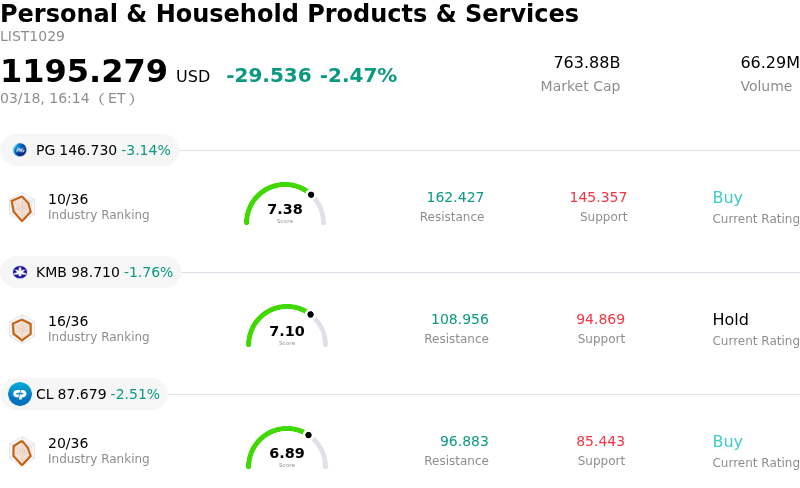
Procter & Gamble Co (PG) closed down by 3.14%. The Personal & Household Products & Services sector is down by 2.47%. The company underperformed the industry. Top 3 stocks by turnover in the sector: Procter & Gamble Co (PG) down 3.14%; Kimberly-Clark Corp (KMB) down 1.76%; Colgate-Palmolive Co (CL) down 2.51%.
What is driving Procter & Gamble Co (PG)’s stock price down today?
Procter & Gamble's share price decline appears to be primarily influenced by a confluence of factors including significant insider selling, persistent concerns regarding the company's profitability and market share, a recent analyst downgrade, and broader negative macroeconomic trends.
Notably, several company insiders, including top executives, have engaged in substantial share sales in recent weeks. For instance, the CEO divested a considerable portion of their holdings in February, and other insiders have collectively sold a significant value of shares over the past 90 days. Such extensive insider selling can often signal a lack of confidence in the company's near-term prospects, leading to negative market sentiment.
Furthermore, the company continues to face challenges related to its financial performance. While first-quarter fiscal 2026 earnings, reported in October 2025, showed core earnings per share slightly ahead of estimates, revenue marginally missed expectations. More recent reports indicate persistent pressure on gross margins, with a 50-basis-point contraction, and a decline in global market share by 30 basis points. These suggest that profitability is being squeezed amid intense competition. Despite a reduction in anticipated commodity and tariff costs for fiscal year 2026, management maintained its full-year guidance, which analysts interpret as an "implicit guidance cut" suggesting that cost savings are being reinvested to defend market share rather than to significantly boost earnings. This implies weaker underlying operational performance, further exacerbated by flat organic sales growth in key segments like Fabric & Home Care and Baby Care. Concerns also exist around a 15% decrease in category growth rates in the U.S. and a 30% drop in SK-II brand sales in Greater China, pointing to potential longer-term revenue challenges.
Adding to these company-specific concerns, a notable analyst firm, TD Cowen, downgraded Procter & Gamble from a "buy" to a "hold" rating in late January 2026. Although the firm also raised its price target, the downgrade in rating can contribute to a more cautious outlook among investors.
Macroeconomic data on the day also presented headwinds. Reports indicated that oil volatility is complicating the inflation outlook and potentially narrowing the Federal Reserve's scope for interest rate cuts. Consumer staples companies, like Procter & Gamble, are particularly vulnerable to sustained increases in transportation or packaging costs due to their typically thinner margins. Additionally, weak labor market data, including a loss of 92,000 nonfarm jobs in February and a rise in unemployment, could signal reduced consumer spending, negatively impacting demand for consumer goods. Lastly, some valuation models suggest that Procter & Gamble's stock may be trading at a significant premium, which could prompt investors to reassess its fair value and contribute to selling pressure.
Technical Analysis of Procter & Gamble Co (PG)
Technically, Procter & Gamble Co (PG) shows a MACD (12,26,9) value of [0.24], indicating a neutral signal. The RSI at 41.03 suggests neutral condition and the Williams %R at -92.38 suggests oversold condition. Please monitor closely.
Fundamental Analysis of Procter & Gamble Co (PG)
Procter & Gamble Co (PG) is in the Personal & Household Products & Services industry. Its latest annual revenue is $84.28B, ranking 1 in the industry. The net profit is $15.68B, ranking 1 in the industry. Company Profile
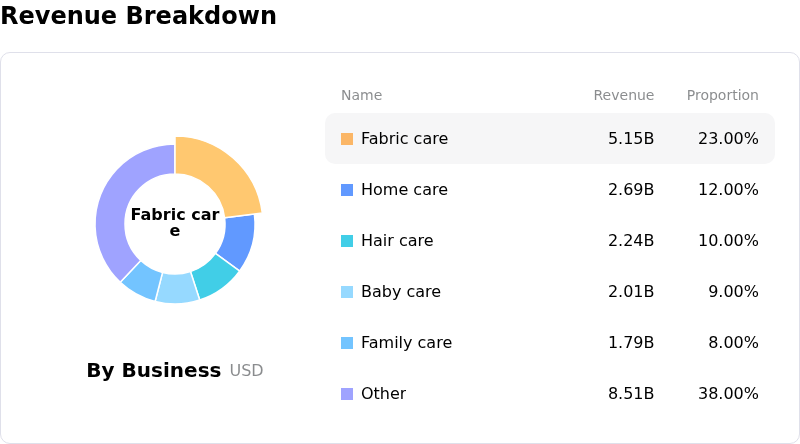
Over the past month, multiple analysts have rated the company as Buy, with an average price target of $168.05, a high of $186.00, and a low of $149.21.
More details about Procter & Gamble Co (PG)
Company Specific Risks:
- Intensifying competitive pressures from private-label brands and rivals, coupled with weakening consumer demand, are eroding P&G's market share, as evidenced by a P&G subsidiary's stock hitting a 52-week low on March 16, 2026, due to competitive underperformance.
- The company reported flat organic sales growth and a 1% volume decline in Q2 FY26, indicating a deceleration in core business performance and softening consumer demand.
- Ongoing gross margin contraction, with a 50 basis points decline in Q2 FY26, is driven by rising input costs and projected significant tariff-related expenses for fiscal year 2026, directly impacting profitability.