


Today’s Market Recap: Nvidia Leads AI Chip Stocks, Dell Surges Nearly 16%, Three Major US Indexes End Three-Day Losing Streak



AI Podcast


On September 2 Eastern Time, U.S. equities rebounded as tech and AI shares strengthened, led by Nvidia and Dell's upbeat forecasts. However, persistent geopolitical tensions in the Middle East, elevated oil prices, and looming September Federal Reserve rate-hike expectations capped broader gains. Broadcom exceeded third-quarter expectations and raised its long-term AI revenue outlook, highlighting sustained infrastructure demand. Meanwhile, weak ADP employment data pointed to a softening labor market ahead of the nonfarm payrolls report. Gold rebounded on lower yields, while Bitcoin remained resilient despite ongoing regulatory and macroeconomic headwinds.

Tracking Market Trends
TradingKey - On September 2 Eastern Time, the three major U.S. stock indexes rebounded in unison, snapping a three-consecutive-session losing streak. Investors re-entered the market following recent pullbacks in tech and select cyclical stocks, with AI-related stocks such as Nvidia (NVDA) and Dell (DELL) strengthening, driving an improvement in market risk sentiment. However, as the U.S.-Iran conflict persisted, international oil prices remained above $90, and expectations for a September Fed rate hike stayed elevated, limiting the overall extent of the market rebound.
At the close, the Dow Jones Industrial Average rose 0.56% to 53,061.89; the S&P 500 Index gained 0.46% to 7,666.63; and the Nasdaq Composite Index added 0.45% to 26,217.83. Small-cap stocks outperformed, with the Russell 2000 Index climbing about 1.1%. Among the 11 major S&P 500 sectors, the materials sector led gains, while real estate was the sole sector to finish lower.
By sector and individual stock, AI and semiconductor shares regained strength. Nvidia advanced 3.21%, Micron Technology (MU) rose 2.43%, and Qualcomm (QCOM) gained 2.01%, driving a rebound in the Philadelphia Semiconductor Index. Dell Technologies surged 15.81% after raising its full-year revenue and profit forecasts, with AI server demand continuing to serve as the primary growth driver.
In commodities, crude oil continued to move higher. Brent crude (UKOIL) rose 0.18% to settle at $95.37, while WTI crude (USOIL) edged down 0.06% to settle at $90.64. U.S. forces continued strikes against coastal targets in southern Iran, while Iran attacked U.S. military bases in the Middle East, sparking the largest direct clash between the two sides since July. The risk of supply disruptions in the Strait of Hormuz continued to underpin oil prices.
In precious metals, gold (XAUUSD) rebounded noticeably from a near one-month low. Spot gold gained 1.38% to $4,387.96. Pullbacks in U.S. Treasury yields and the U.S. dollar from recent highs provided support for gold. However, Fed rate-hike expectations continued to cap further gains in gold, with markets currently pricing in an approximately 64% chance of a 25-basis-point hike in September.
In cryptocurrencies, Bitcoin (BTC) hovered around $77,000, trading recently near $77,300 with little change on the day, remaining below the $80,000 threshold. Ethereum (ETH) fell about 1.1% to around $2,390. Although the U.S.-Iran conflict, rising oil prices, and elevated global bond yields weighed on risk assets, Bitcoin held onto most of its gains following its major rally in August, exhibiting relative resilience compared to U.S. equities and gold. However, with notable recent outflows from U.S. spot Bitcoin ETFs and markets awaiting Friday's nonfarm payrolls report, Bitcoin's ability to reclaim $80,000 in the short term remains constrained by Fed rate-hike expectations and the trajectory of the U.S. dollar.
Market News
Broadcom raises its long-term AI chip revenue forecast, projecting it to reach approximately $230 billion in fiscal year 2028. Broadcom (AVGO) reported third-quarter revenue of $29.59 billion, exceeding market expectations of $29.36 billion; adjusted earnings per share reached $3.32, also topping the expected $3.24. Among this, AI chip sales more than tripled year-over-year to $16.7 billion. The company raised its fiscal year 2027 AI chip revenue forecast from over $100 billion to approximately $115 billion and expects it to double further to about $230 billion in fiscal year 2028. However, overall fourth-quarter revenue guidance fell slightly short of market expectations, causing Broadcom's stock to drop over 3% in after-hours trading before narrowing losses.
Broadcom discloses large-scale AI computing deployment plans for Anthropic, OpenAI, and Meta. Broadcom management stated that the company currently sees AI infrastructure deployment plans from multiple large customers extending through 2028, including over 10 GW for Anthropic, over 5 GW for OpenAI, and over 3 GW for Meta. Broadcom's AI chip orders surpassed $30 billion last quarter, demonstrating that capital expenditures from major tech companies and AI firms remain concentrated in custom AI chips, networking equipment, and data center infrastructure.
US and Iran engage in largest direct exchange of fire since July, with Strait of Hormuz traffic remaining low. Following a new round of US strikes on targets along Iran's southern coast, Iran launched attacks on US military bases in the Middle East. Kpler data shows that only four merchant vessels passed through the Strait of Hormuz on Wednesday, significantly below the 10-day average of about 13. In addition, two tankers attempting to transit the strait were reportedly disabled by sea mines, further intensifying market concerns over energy transport security.
US August ADP employment increases by only 38,000, below market expectations. ADP data shows that US private-sector employment added 38,000 jobs in August, below the market expectation of 48,000, while the July figure was revised up to an increase of 46,000. Among these, manufacturing lost 17,000 jobs, and professional and business services declined by 16,000 jobs. The labor market continues to display a "low-hiring, low-layoff" state, with market focus shifting to Friday's release of the August nonfarm payrolls report.
US government supports AI companies using copyrighted content for model training. At the G20 meeting, the US government urged countries to establish copyright rules favorable to AI development, allowing AI companies to train models using original content under a "fair use" framework. Meanwhile, the Trump administration filed court documents supporting OpenAI's position in copyright litigation with media outlets such as The New York Times, maintaining that AI training generally constitutes fair use. As companies including OpenAI, Anthropic, Google, and Meta face a growing number of copyright lawsuits, legal rules regarding AI training data are becoming an important policy variable affecting business models in the AI industry.
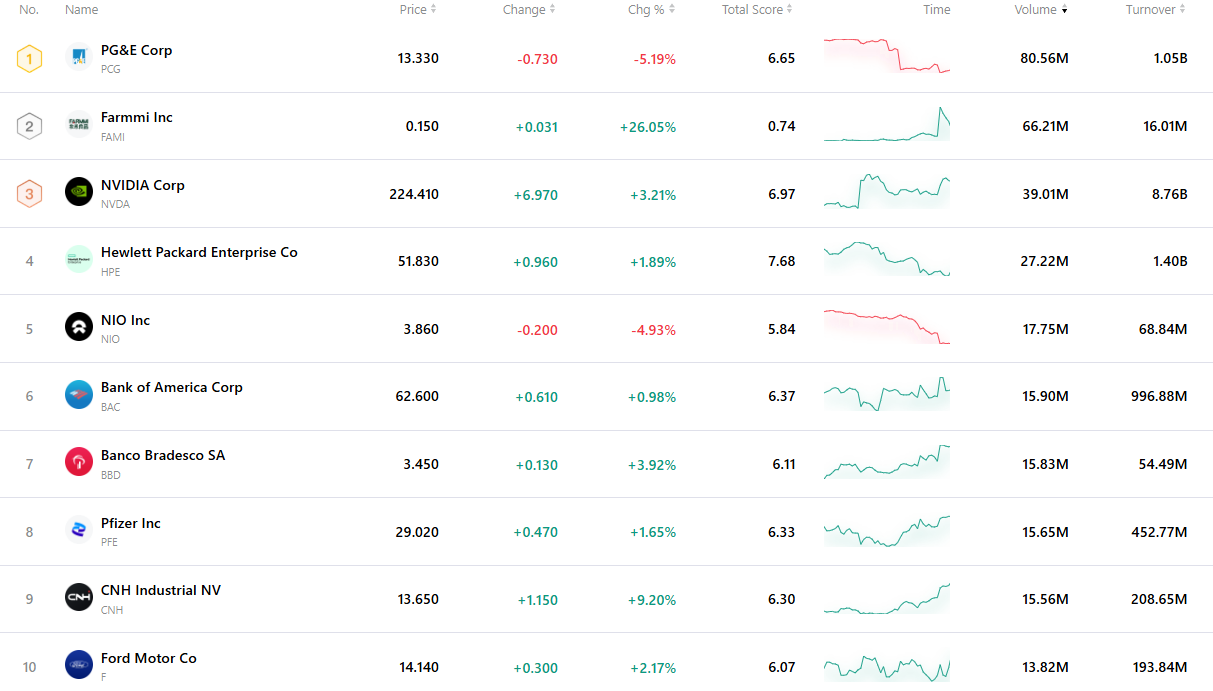
Top 10 Most Active Stocks
The table below lists the ten most actively traded stocks in the latest market session. Supported by massive trading volumes and robust liquidity, these assets have become key benchmarks for tracking global market dynamics.
This content was translated using AI and reviewed for clarity. It is for informational purposes only.
Recommended Articles











Comments (0)
Click the $ button, enter the symbol, and select to link a stock, ETF, or other ticker.