


Micron Technology Stock Price Forecast: How Will It Perform in Second Half of 2026? Will It Continue to Surge Toward $2,000?



AI Podcast


Micron Technology’s Q3 FY2026 results exceeded expectations, with its stock surging past $1,200. Growth is primarily driven by explosive demand for High Bandwidth Memory (HBM) and severe DRAM supply shortages. By securing long-term, non-cancelable contracts, Micron has effectively decoupled from historical cyclical volatility. With an adjusted gross margin of 84.9% and a forward P/E ratio under 10x, major investment banks maintain bullish targets up to $2,000. Despite recent volatility, strong fundamentals and institutional buying support sustained momentum, rendering significant pullbacks unlikely as the company enters a structural growth phase fueled by AI infrastructure expansion.
TradingKey - On June 24, memory and storage chip giant Micron Technology ( MU) released its third-quarter financial results for fiscal year 2026, completely shattering short sellers' valuation doubts while boosting its stock price to surge past $1,200, hitting another record high.
In response to Micron's soaring stock price, Wall Street investment banks have not lowered their target prices but have instead continuously raised them, with Barclays currently being the most aggressive investment bank, bullish up to $2,000. So, can Micron's stock price really rise to this target price? How will it trend in the second half of the year?
How will Micron's stock price perform in the first half of 2026?
In the first half of this year, Micron's stock price generally continued to rise, with a cumulative gain of about 290% as of June 29. Such an astonishing increase in the mature, highly efficient, and massive U.S. stock market is definitely not just simple "outperformance," but rather a historic "ceiling-level performance," replicating the myths created by Tesla ( TSLA) in 2020 and Nvidia ( NVDA) in 2023.
During the same period this year, the S&P 500 rose by only 8%, meaning Micron outperformed the broader market by dozens of times. Furthermore, Micron's rally completely shattered the valuation ceiling of traditional memory chips, overpowering traditional giants Intel ( INTC ), AMD ( AMD ), and TSMC ( TSM ), which rose 248%, 146%, and 45% respectively over the same period.
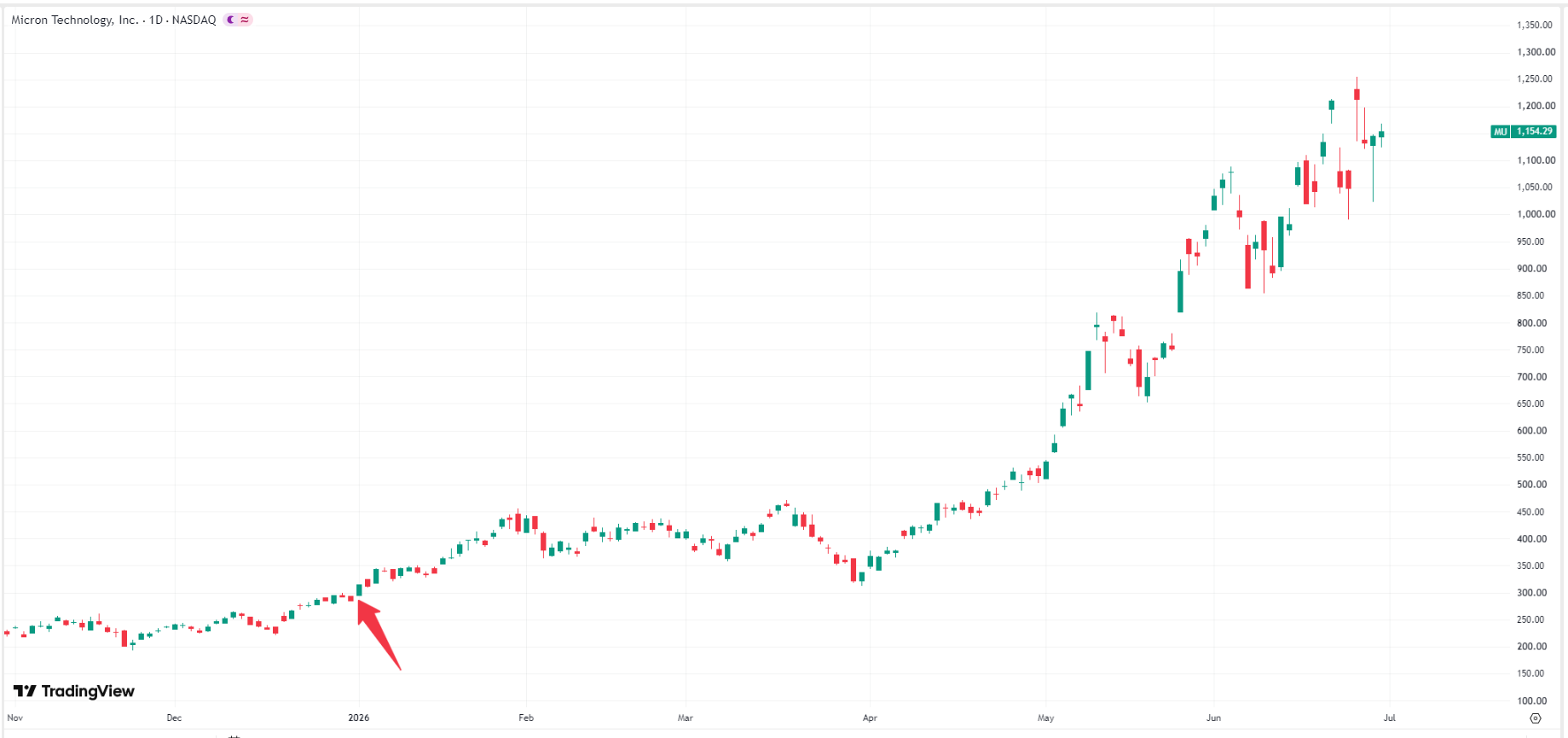 Micron stock price chart, Source: TradingView
Looking at a more specific timeframe, Micron got off to a steady start in the first quarter, climbing from the $300 level to the $400 milestone, and even experienced a pullback of over 30% in mid-to-late March, approaching its starting point for 2026. In April, Micron's stock price stopped falling and rebounded, breaking through $500 in one fell swoop at the end of April before embarking on an explosive rally. In mid-May, Micron's stock price surpassed $700 and officially crossed the historic $1,000 threshold in early June. In late June, Micron's stock price broke through $1,200, setting a new all-time high.
Why does Micron's stock price continue to rise?
Although every rise in Micron's stock price has basically been stimulated by positive news—such as its inclusion in the S&P 100 Index in April, Wall Street investment banks aggressively raising target prices in May, an epic strategic supply and investment agreement reached with AI giant Anthropic in June, and the release of better-than-expected financial results—these are merely external manifestations. The true core driver is Micron's strong intrinsic earning power.
With the frantic expansion of ultra-large-scale AI data centers driven by Nvidia's Blackwell platform and giants like Anthropic, the market's appetite for High Bandwidth Memory (HBM) has become a bottomless pit. In the first half of 2026, Micron announced ahead of schedule that its HBM capacity for the entire year of 2026 has been completely sold out, with orders even scheduled out to 2027 and 2028.
In addition, traditional Dynamic Random-Access Memory (DRAM) is facing its most severe shortage in 15 years, which has also created opportunities for Micron. Because Micron, SK Hynix, and Samsung have crowded out and redirected massive wafer capacity to manufacture HBM, which has a more complex production process, the capacity for traditional general-purpose memory has become severely insufficient. This has triggered a miracle price surge of 30% to 40% quarter-on-quarter, allowing Micron to reap epic profits from its traditional business alongside the high margins of HBM.
Even more unexpectedly, Micron has used long-term guaranteed contracts to break the cyclical curse. Micron's management revealed that they have signed 16 Strategic Customer Agreements (SCAs) with clients, which are involuntary and non-cancelable contracts. If Micron's customers breach the contract and do not take the goods, they must still pay in the end. It is precisely these contracts that have brought Micron up to $22 billion in upfront cash and financial commitments, while also setting an extremely high price floor, breaking the traditional "boom-and-bust" business cycle of the past.
What is Wall Street's target price for Micron?
On June 24, Micron announced extremely stellar Q3 FY2026 earnings after the bell, prompting major Wall Street investment banks and institutions to generally raise their target prices, with the highest bullish target currently reaching $2,000, as detailed below:
Investment Bank / Institution | Latest Target Price | Bullish Thesis |
Susquehanna International Group | $2,000 | Bullish on the HBM undersupply situation persisting until at least 2030. |
Barclays | $2,000 | Five-year strategic agreements, AI driving an HBM capacity black hole, and an epic surge in free cash flow. |
HSBC | $1,700 | Entering a super growth cycle, explosive demand driven by AI chips, and a structural shift in valuation logic. |
Needham | $1,650 | Continuous increases in memory chip quotes and capacity constraints are driving earnings growth faster than expected. |
TD Cowen | $1,600 | Long-term customer contracts feature "take-or-pay" clauses, structurally breaking away from the historical boom-and-bust cycle of memory. |
KeyBanc | $1,600 | HBM capacity is already fully sold out for 2026, with FY2027 EPS expected to potentially challenge $105-$149. |
Deutsche Bank | $1,550 | Severe structural supply-demand imbalance, strong core DRAM pricing, and capacity crowding-out effects, leading to a gross margin re-rating. |
Bank of America | $1,550 | AI hardware infrastructure spending is not slowing down; Micron's current forward P/E is only about 8-9x, which remains very cheap. |
JPMorgan | $1,540 | Breaking the cycle curse, accelerating HBM technological transformation, and wafer consumption ratios that exceed expectations. |
Cantor Fitzgerald | $1,500 | The traditional PC and smartphone markets are also starting to gradually adopt Edge AI, boosting the demand momentum for general DRAM and NAND. |
Rosenblatt | $1,500 | The start of production for 1-alpha advanced nodes in the US benefits from domestic supply chain subsidies and dual-track defensive AI demand. |
Micron Stock Price Forecast: Will It Pull Back to $85 in the Second Half of the Year?
In early June, Micron's stock price peaked and pulled back to $850 before rebounding and strengthening, leading some correction theorists to believe its price would retest this technical structure. However, Micron's latest earnings report has provided a solid cushion for the stock price. According to the released data, Micron's adjusted single-quarter gross margin surged to 84.9%, not only hitting a record high but also surpassing the 75%-78% level consistently maintained by AI chip leader Nvidia. Furthermore, the company guides that its gross margin for the next quarter (Q4) will further rise to 86%, with median revenue targeting $50 billion.
In addition, Micron's current forward P/E ratio is only around 9.2 times. Compared to other AI chip stocks with P/E ratios often in the tens, Micron offers extremely high value. Therefore, any pullback in Micron's stock price is likely to immediately attract long-term institutional capital to buy the dip, meaning it will be difficult to fall back below $1,000 in the second half of the year. Conversely, looking at the technical indicator RSI, Micron's stock price is not overbought and still has the potential to continue rising toward new highs.
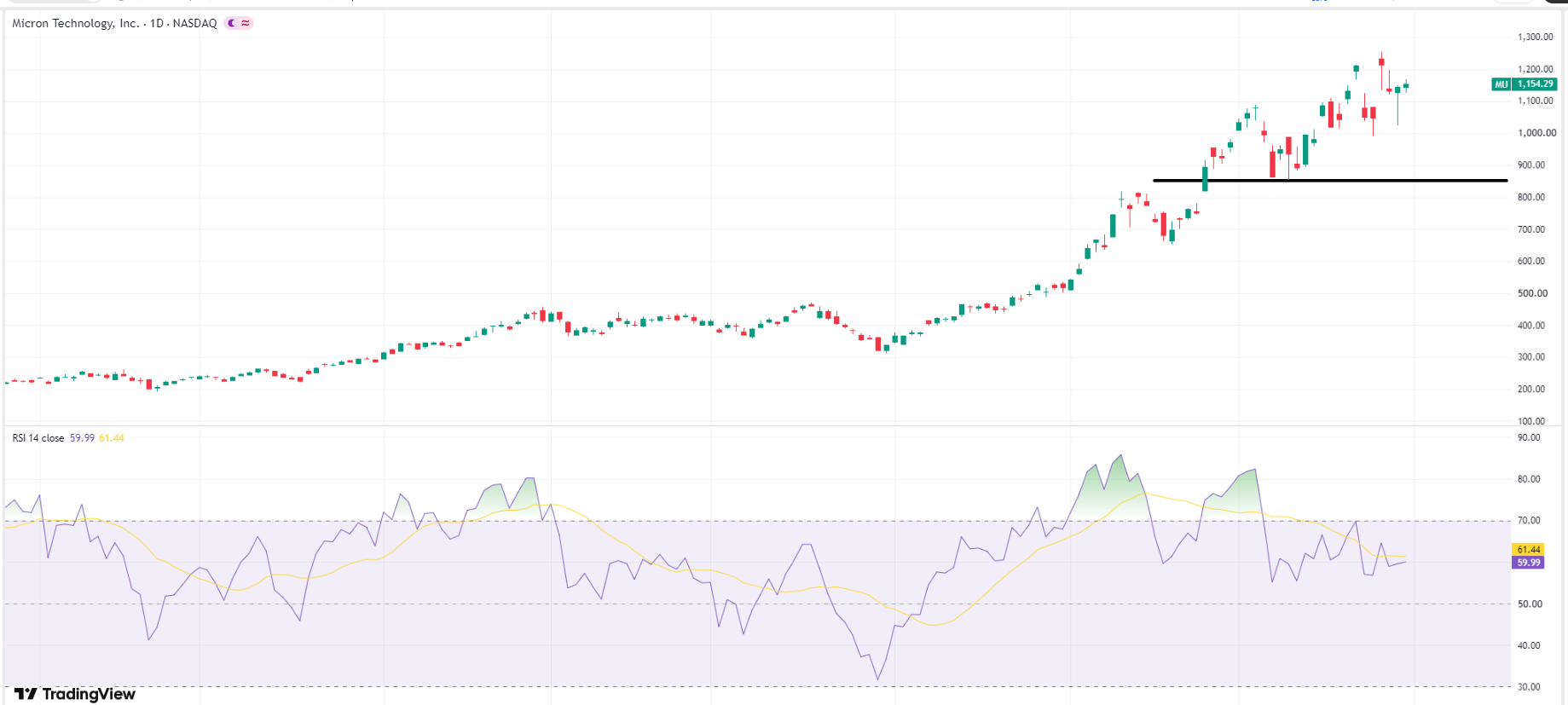
Micron stock price chart, Source: TradingView
This content was translated using AI and reviewed for clarity. It is for informational purposes only.
Recommended Articles









Comments (1)
Click the $ button, enter the symbol, and select to link a stock, ETF, or other ticker.