


Nasdaq 100 Futures Rebound Strongly After Yesterday's Decline. Wall Street Investment Banks Believe the U.S. Stock Rally Still Has Legs.



AI Podcast


Nasdaq 100 and S&P 500 futures rebounded on July 3, supported by a robust AI capital expenditure supercycle. Financial institutions, including Citi, Goldman Sachs, and Wells Fargo, have raised S&P 500 targets, citing fundamental earnings growth from AI infrastructure as a key stabilizer. While macro headwinds like weak consumer spending persist, AI-driven profit expansion is expected to drive market performance. Analysts emphasize that current momentum relies on earnings fundamentals rather than mere valuation premiums. However, Goldman Sachs notes that semiconductor valuations now reflect significant future expectations, suggesting potential risks despite the overall positive, AI-centered growth outlook.
Tradingkey - On July 3, the U.S. stock market was closed for the Independence Day holiday, but Nasdaq 100 Index futures staged a strong rebound after falling 1.7% yesterday.
As of press time, Nasdaq 100 Index futures rose 1.18% to 29,904.25 points; S&P 500 Index futures rose 0.40% to 7,558 points.
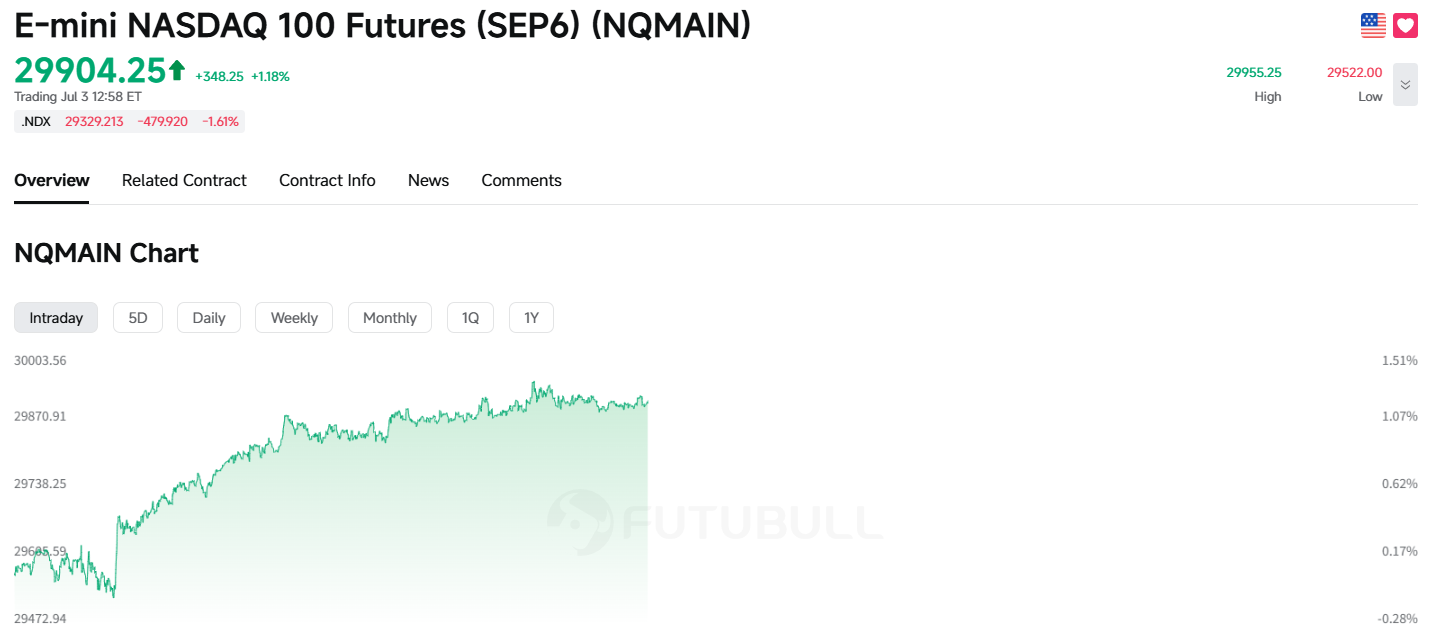
[Source: FutuBull]
Although expectations of rate hikes have repeatedly weighed on tech stocks since entering June, the mainstream market view remains that under the resonance of three major factors—the continuous expansion of AI capital expenditure, the marginal recovery of macro liquidity expectations, and the gradual broadening of the earnings growth theme—the current upward momentum of U.S. stocks has a solid foundation for continuation.
Major investment banks have collectively raised their target prices for the S&P 500 Index. The core driver stems from the resonance between substantial improvements in corporate earnings and the AI capital expenditure "supercycle." They believe that this round of the index's upward movement is not relying on the unilateral expansion of valuation premiums, but is supported fundamentally by real profit growth driven by demand for AI infrastructure such as semiconductors and data centers.
Citi stated that the current market boom has transcended the laws of traditional economic cycles, transforming into a rare "capex supercycle" that is currently only halfway through, with corporate earnings highly likely to continue beating expectations. It set a target price of 8,100 points for the S&P 500 Index.
Goldman Sachs, on the other hand, believes that steady growth in corporate earnings this year is the core engine driving the S&P 500 upward. Although operating costs remain high and consumer spending is weak, presenting significant macro-level headwinds, companies related to AI infrastructure can contribute nearly half of the index's earnings growth this year, which is sufficient to withstand the risks. However, Goldman Sachs also warned that the semiconductor sector, at the center of the AI hype, has run up a bit too much recently and has already priced in a portion of future earnings expectations. It set a target price of 8,000 points for the S&P 500 Index.
Wells Fargo stated that after macro risks eased, the previous wave of selling gradually receded and market sentiment stabilized, creating the conditions for a new round of the AI rally to launch. In its view, if monetary policy shifts toward easing in the future, equities will be the best inflation hedge, and the logic of "relying on inflation to hedge risks" is positive for the stock market. It set a target price of 7,950 points for the S&P 500 Index.
This content was translated using AI and reviewed for clarity. It is for informational purposes only.
Recommended Articles






Comments (0)
Click the $ button, enter the symbol, and select to link a stock, ETF, or other ticker.