


Nvidia Earnings Approach, Can It Lead the Nasdaq to Stop Falling and Rebound? What Should Investors Focus on Most?



NVIDIA's Q1 fiscal 2026 earnings report is a critical indicator for AI expenditure, with an expected 79% revenue growth. The market anticipates a ~6.5% stock swing post-release. Strong results could sustain the Nasdaq and chip stock rally, mirroring Intel's performance after its earnings beat. Key investor focus areas include cash returns, Vera Rubin architecture production, gross margins around 75%, the $1 trillion revenue target, and competitive pressures. Risks include data center construction pace and China market uncertainties. Exceeding expectations could boost the semiconductor sector and Nasdaq; underperformance may trigger profit-taking.
TradingKey - On May 20, Eastern Time, NVIDIA ( NVDA )'s first-quarter fiscal 2027 earnings report, to be released after the market close, has become the focus of the market. The options market has already reacted; based on options positioning data, the market expects NVIDIA's stock price to potentially fluctuate by approximately 6.5% on the day following the report's release.
For the market, this report has transcended the scope of reflecting a single company's financial performance, becoming a core validation metric for the entire AI capital expenditure cycle. According to LSEG, NVIDIA's revenue for the April quarter is expected to grow by 79%, marking its fastest growth in over a year, while adjusted profit could increase by 81.8% to reach $42.97 billion.
Analysis suggests that NVIDIA's first-quarter growth is primarily driven by major customers like Microsoft ( MSFT ), Meta and other major clients continuing to ramp up AI infrastructure spending, while total AI investment by big tech companies is expected to exceed $700 billion this year. As long as this report continues to prove that AI spending is not cooling, the Nasdaq and chip stocks have reason to sustain their momentum.
Intel ( INTC )'s market performance after its better-than-expected earnings report serves as a prime example. On April 23, after Intel released a stronger-than-expected second-quarter revenue outlook, its shares surged 19% in after-hours trading, while Nasdaq futures also rose 0.3% at the time; the following day, the Philadelphia Semiconductor Index gained 4.32%, AMD and Arm also rallied sharply, while NVIDIA rose by 4.32% on the same day. This demonstrates that when a heavyweight chip company provides strong guidance, the market not only reprices the stock itself but also spreads optimism about AI infrastructure demand across the entire tech sector.
From an investor's perspective, there are five key areas to focus on regarding NVIDIA's upcoming report. First, whether cash returns can be increased; between fiscal 2022 and 2025, NVIDIA returned only about 47% of its free cash flow through dividends and buybacks, below the approximately 80% payout level of other mega-cap tech stocks. Second, whether the Vera Rubin architecture can successfully enter mass production in the second half of 2026. Third, whether gross margins can hold at around 75% despite rising memory and component costs. Fourth, adjustments to the company's $1 trillion revenue target for 2025–2027. Fifth, the extent of competitive pressure from Google TPUs, agentic CPUs, and other custom chips.
Beyond these five points, NVIDIA faces two more practical challenges. One is the pace of data center construction. Reuters cited analysts saying that while customer demand for GPUs is robust, the slower-than-expected pace of data center build-outs could limit short-term demand. The second is uncertainty in the Chinese market. Although Jensen Huang's recent visit to China with U.S. President Trump boosted market expectations, the trend of the Chinese government pushing for local alternatives remains a variable, and NVIDIA's H200 chips are still not sold in China.
Overall, following the release of this report, if NVIDIA delivers revenue, gross margins, and guidance that all beat market expectations—and if the Vera Rubin architecture is on track for mass production with no downward revision to the $1 trillion revenue target—the company could lead the semiconductor sector and even the Nasdaq higher, much like Intel did. Conversely, if results miss expectations and guidance is lowered, it is highly likely to trigger profit-taking, weighing on overall tech stock performance and pushing the Nasdaq into a deeper corrective phase.
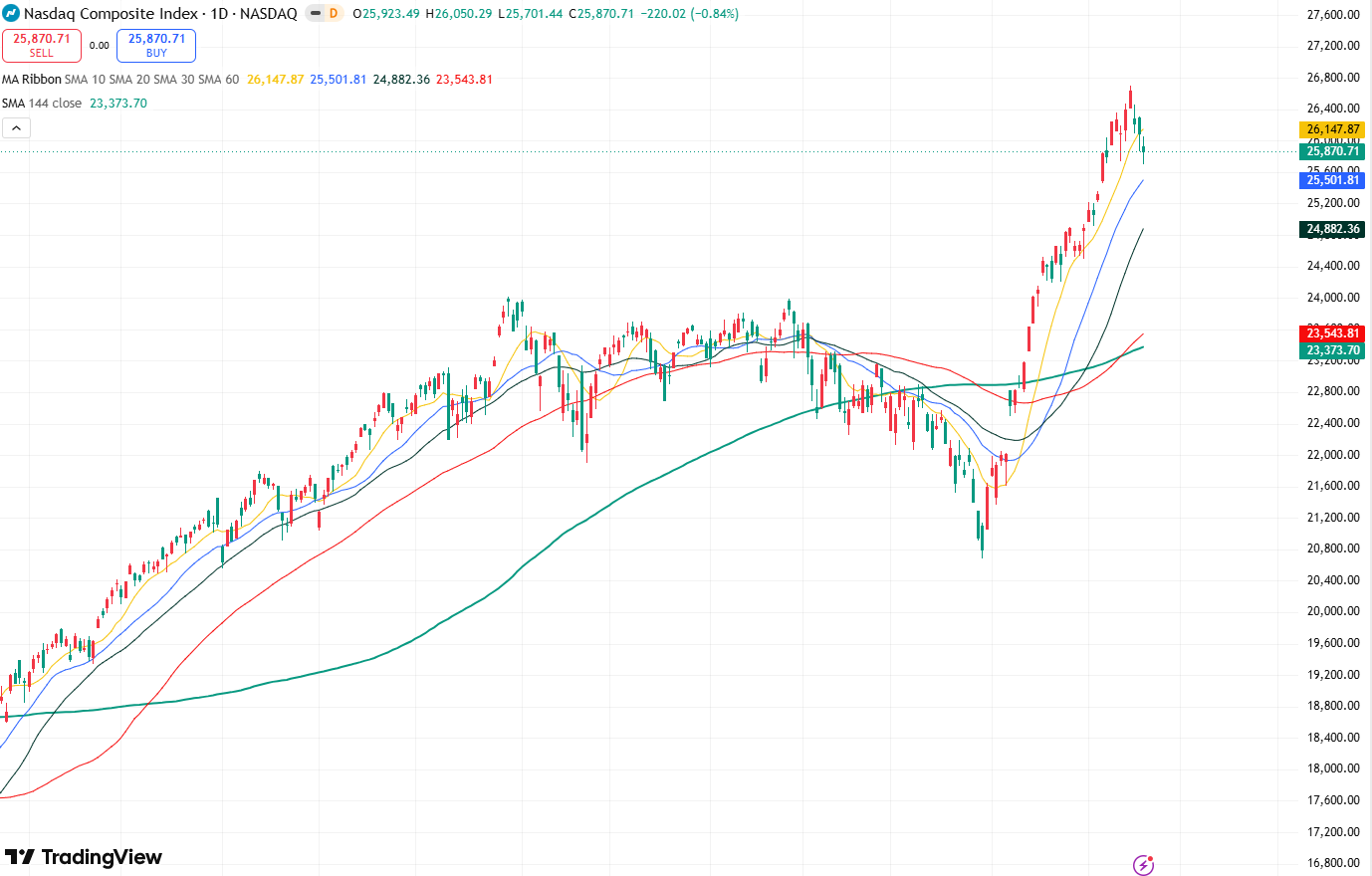
Nasdaq Index Daily Chart, Source: TradingView
This content was translated using AI and reviewed for clarity. It is for informational purposes only.
Recommended Articles







Comments (0)
Click the $ button, enter the symbol, and select to link a stock, ETF, or other ticker.