


Software Stocks Are Continuing to Rebound, Should Investors Buy Oracle or Microsoft Now?



Oracle's stock rebounded significantly, driven by strong cloud infrastructure revenue growth and substantial Remaining Performance Obligations. However, the company faces extreme cash flow fragility and high debt. Management claims partner funding and new contracts mitigate this. Conversely, Microsoft exhibits robust revenue, net income, and free cash flow growth, supported by its strong ecosystem and AI investments, with analysts favoring its stable fundamentals and large RPO. Investors seeking high growth with high risk might consider Oracle, while those prioritizing stability may prefer Microsoft.

TradingKey - Following April 13, Oracle (ORCL.US) After the stock price surged 12.7% in a single day and its market capitalization increased by $50.4 billion, the stock continued its rally on April 14, rising another 4.74% to $163, with trading volume expanding to $9.783 billion.
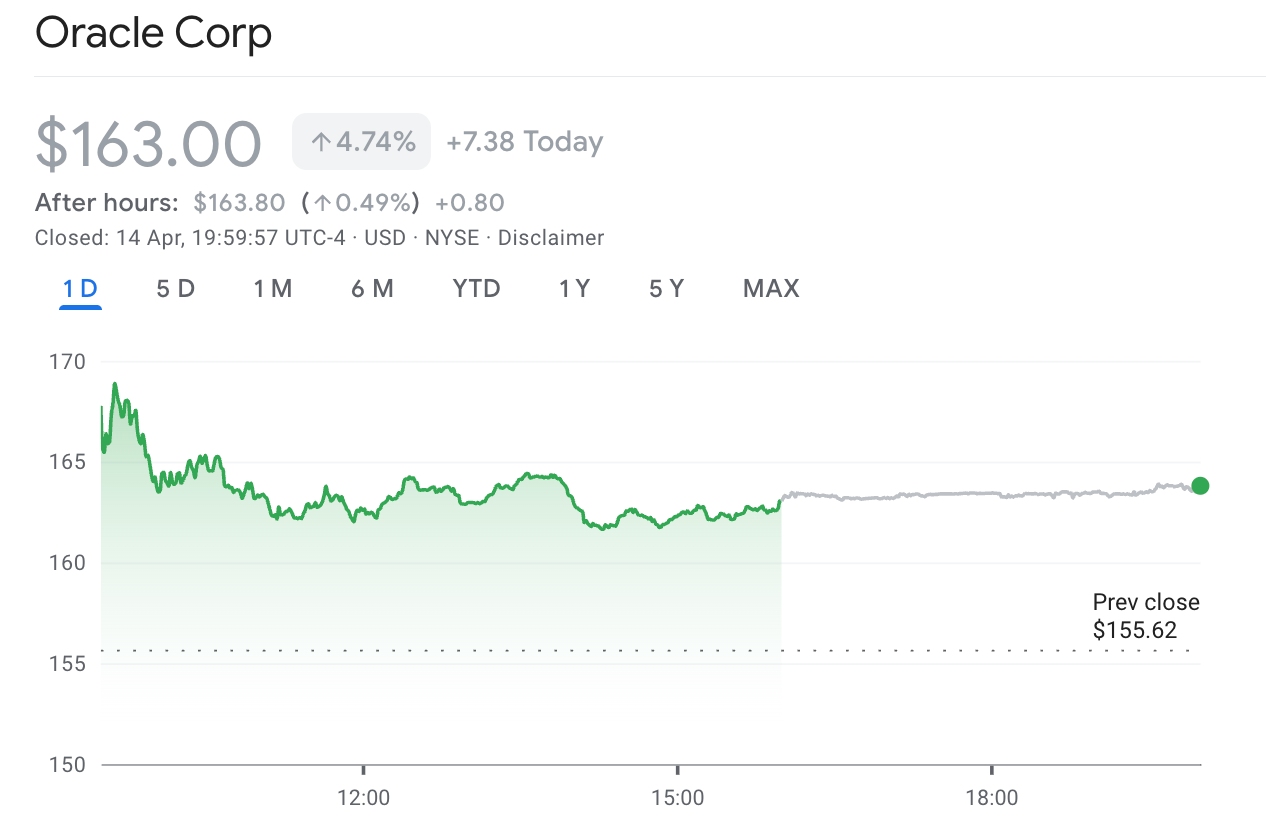
[Oracle stock price trend on April 14, Source: Google Finance]
The IGV Software ETF rose sharply for two consecutive days, with a single-day surge of 5.4% on April 13, marking its largest one-day gain in a year; heavyweight stocks such as Microsoft, Palantir, and Salesforce strengthened in tandem.
Previously, the rapid development of generative AI and AI agents had been shaking the foundations of traditional software business models. In early 2026, Anthropic successively released tools such as the enterprise-grade AI task assistant Cowork and Claude Code. These tools were promoted as potential AI alternatives to some SaaS products, sparking deep market concerns that the software industry would be disrupted by AI.
Affected by this, the software sector suffered a sustained and violent sell-off, with Oracle's year-to-date decline once exceeding 20%. Microsoft (MSFT) Its year-to-date decline also exceeded 20%.
With software stocks now rebounding across the board, which high-quality company should investors choose between these two giants deeply tied to OpenAI to achieve greater returns?
Oracle: A High-Growth, High-Risk "Growth Stock"
Oracle's investment thesis is highly concentrated. As of the third quarter of fiscal 2026, the company's total revenue was $17.2 billion, up 22% year-over-year, while cloud infrastructure revenue surged 84% to $4.9 billion.
Remaining performance obligations reached $553 billion, an increase of over 300% year-over-year, signifying that revenue for the next several years is already locked in.
However, Oracle's continuous cash outlays have made its cash flow extremely fragile. Through the first three quarters of fiscal 2026, Oracle's free cash flow was -$43.8 billion, a stark contrast to the positive $26.2 billion in fiscal 2025.
Capital expenditure for fiscal 2026 is projected to reach $50 billion. Although the revenue target for fiscal 2027 is $90 billion, the capital expenditure forecast has not yet been disclosed.
Barclays previously predicted that Oracle might run out of cash by November 2026 and warned its credit rating could be downgraded to BBB-, nearing junk-bond territory. Its debt-to-equity ratio is as high as 500%, far exceeding Amazon's 50% and Microsoft's 30%.
Oracle's management has been proactively responding. During the Q3 earnings call, Clay Magouyrk, CEO of Cloud Infrastructure, revealed that "over 90% of the more than 10 gigawatts of power and data center capacity" planned for the next three years is "fully funded by partners." Furthermore, through "bring-your-own-hardware" and prepayment models, the company signed over $29 billion in new contracts to "continue expansion without consuming any of Oracle's negative free cash flow." The CFO also reiterated that an investment-grade rating will be maintained and that debt issuance this year will not exceed the previously announced $50 billion cap.

[Oracle Analyst Ratings, Source: TradingKey]
From an analyst perspective, Wall Street's average 12-month price target for Oracle is approximately $246, implying an upside potential of about 50%.
Microsoft: A "Cash Cow" with a Robust Ecosystem
Compared to Oracle's "all-in" approach, Microsoft offers a starkly different path.
On a fundamental level, Microsoft has demonstrated greater resilience. In the second quarter of fiscal 2026 (fourth quarter of 2025), Microsoft reported revenue of $81.3 billion, up 17% year-over-year, and net profit of $30.9 billion, up 23% year-over-year. Azure cloud revenue grew 39% year-over-year, and Microsoft Cloud quarterly revenue surpassed $50 billion for the first time.
Total commercial backlog reached $625 billion, with approximately 45% coming from OpenAI contracts, reflecting the strong pull-through effect of AI demand. On the profitability side, Microsoft's operating margin was approximately 46.7%, far exceeding Oracle's 31.9%. Microsoft's free cash flow margin stood at a positive 25.3%, compared to Oracle's -21.6%.

[Microsoft Analyst Ratings, Source: TradingKey]
Wall Street maintains a consistently high target price for Microsoft, with the average target price reaching $586, implying nearly 50% upside from the current share price. Previously, Jefferies maintained a street-high target of $675, while Morgan Stanley maintained a target of $650.
Ahead of Microsoft's earnings release on April 29, Bernstein analysts noted: "An industry giant like Microsoft has not been left behind by the times; instead, it is actively embracing AI technology—the company has already invested billions of dollars in OpenAI. Furthermore, no matter how excellent the coding technology of any AI model may be, it cannot replace Microsoft's foundational software and cloud services."
Judging by their fundamentals, Microsoft may have the upper hand. For investors who prioritize stable fundamentals and a solid moat, Microsoft might be the best investment vehicle; based on its performance, its growth prospects remain relatively stable. In contrast, Oracle may be more suitable for investors with a higher risk appetite who value its future development potential. However, it is worth noting that while its stock price offers greater volatility, it also carries significant risks, such as a long-term lack of cash flow.
From the perspective of valuation ranges, after undergoing a deep correction, Oracle has fallen into the valuation range typical of normal growth stocks. Investors should pay attention to whether the company's performance reveals a loss of momentum or if its future room for growth continues to expand.
This content was translated using AI and reviewed for clarity. It is for informational purposes only.
Recommended Articles









Comments (0)
Click the $ button, enter the symbol, and select to link a stock, ETF, or other ticker.