


Why Is IBM Seeking to Partner with Arm? Can This Drive IBM Earnings Growth?



IBM and Arm announced a strategic partnership on April 2, 2026, to develop dual-architecture hardware for AI and data-intensive enterprise tasks, enhancing flexibility, reliability, and security. This collaboration expands Arm software to IBM platforms, meets AI requirements, and strengthens the software ecosystem. This move signifies IBM's embrace of a multi-architecture landscape beyond x86 and Power, aligning with its hybrid cloud + AI strategy. For Arm, this partnership extends its reach from cloud servers into mission-critical enterprise systems like IBM's Z-series mainframes, demonstrating its architecture's capability for high-reliability tasks. Market optimism favors IBM due to its valuation and cash flow, while Arm's prospects rely on its transformation.
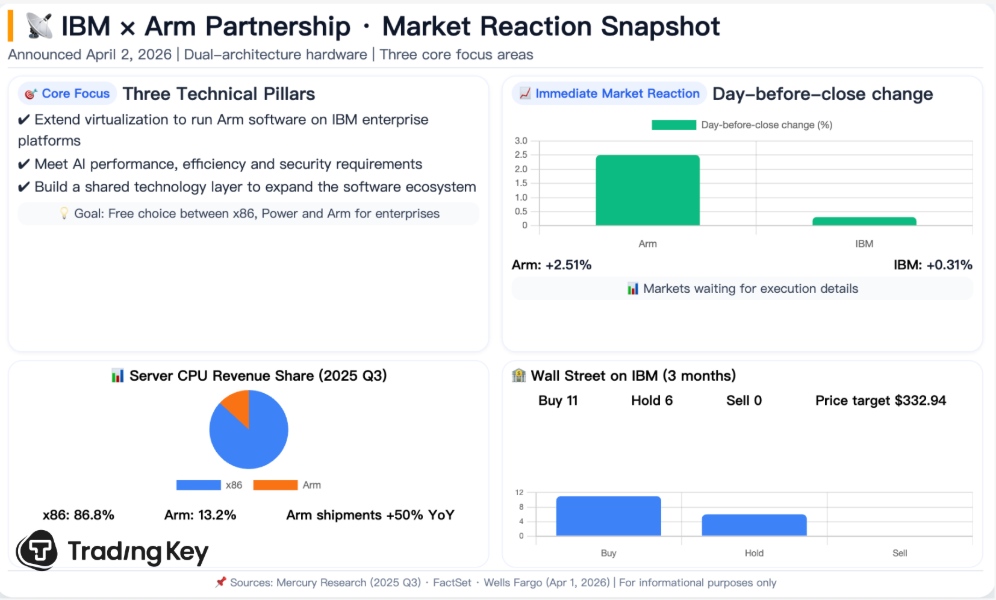
TradingKey - April 2, 2026, IBM ( IBM) and Arm ( ARM) announced a strategic partnership. The two parties will develop "dual-architecture hardware" to help enterprises run AI and data-intensive tasks with greater flexibility, reliability, and security.
The collaboration focuses on three key areas:
- Expanding virtualization technology to enable Arm software to run on IBM enterprise platforms.
- Simultaneously meeting the rigorous requirements of AI applications for performance, efficiency, and security.
- Establishing a shared technology layer to expand the software ecosystem.
"This collaboration brings the Arm ecosystem into mission-critical enterprise environments," said Mohamed Awad, Executive Vice President of Arm's Cloud AI Business Unit. Tina Tarquinio, Chief Product Officer of IBM Z, stated: "We are helping enterprises build capacity ahead of the market inflection point."
Why IBM? — Not Betting on a Single Architecture
IBM has historically relied on its proprietary Power architecture and Z-series mainframes. Introducing Arm effectively creates an additional path alongside x86 and Power.
Patrick Moorhead, founder of Moor Insights, put it directly: "Enterprise infrastructure priorities have changed; flexibility, workload portability, and ecosystem coverage are now just as important as performance and reliability."
Data supports this assessment. Mercury Research figures show that as of the third quarter of 2025:
- Intel's server CPU shipment share fell to 72.2%, a historic low.
- AMD rose to 27.8%.
- The Arm architecture has already captured 13.2% of server sales revenue, with shipments growing by 50%.
IBM is embracing Arm at the perfect time—the x86 moat is narrowing, and a multi-architecture landscape is taking shape.
This collaboration is also part of IBM's "hybrid cloud + AI" strategy. Less than a month ago at GTC 2026, IBM deepened its cooperation with Nvidia(NVDA). In February this year, IBM CEO Arvind Krishna stated clearly: "2026 will accelerate innovation in AI, hybrid cloud, and specialized hardware." Including the Arm partnership, the Nvidia alliance, and the $11 billion acquisition of Confluent, IBM is piecing together a complete enterprise-level AI computing roadmap.
Why Is Arm Doing This? — From the Cloud to the Enterprise Core
Arm previously focused primarily on mobile chips. However, over the past two years, it has aggressively expanded into the data center space. Just two weeks prior to the announcement of this partnership, Arm unveiled its first proprietary data center chip, the AGI CPU.
The partnership with IBM provides Arm entry into core enterprise systems exemplified by the Z-series mainframes. This is a high-barrier-to-entry market encompassing financial transactions and government systems, where reliability requirements are exceptionally stringent. Arm finally has the opportunity to demonstrate that its architecture is capable of powering not only cloud servers but also mission-critical workloads.
Market expectations for Arm are already elevated. As of April 1, 2026, Arm's market capitalization stands at approximately $164 billion, with a P/E ratio of 207x. The analyst consensus is a "Moderate Buy," with an average price target of $168.58. On the day preceding the partnership announcement, Wells Fargo upgraded Arm to "Overweight" with a price target of $175, driving a 2.5% gain in the stock. However, Arm’s valuation remains high, and both the CEO and CFO have recently reduced their holdings.
Market Views
The short-term market reaction remained calm on the trading day prior to the announcement of the partnership:
- Arm closed up 2.51% at $155.07
- IBM closed up 0.31% at $243.14
This suggests the market is in a wait-and-see mode—waiting for technological implementation and a specific timeline.
In the long run, Wall Street remains relatively optimistic about IBM. Over the past three months, 11 brokerages recommended a "Buy" for IBM, six suggested "Hold," and none issued a "Sell" rating. The average price target of $332.94 represents an upside of approximately 37% from current levels. IBM's own guidance is also solid: revenue growth is expected to exceed 5% in 2026 (outpacing Wall Street's 4.1% forecast), with free cash flow projected at $15.7 billion.
By contrast, although Arm operates in the same space, Wall Street sentiment is more divided: 19 brokerages recommend "Buy," six suggest "Hold," and one suggests "Sell." The average price target of approximately $168.17 implies an upside of only 7%–23%, significantly lower than IBM's 37%. With a P/E ratio exceeding 200, Arm could face sharp volatility if earnings fall even slightly short; meanwhile, IBM's P/E of around 20 provides a much thicker margin of safety. In short, the market's optimism for IBM is built on cash flow and valuation support, while the bet on Arm relies more on the realization of its transformation.
Industry Trend: Enterprise Computing No Longer Has a Single Winner
IBM's partnership with Arm marks a major trend: enterprise computing is shifting from x86 dominance toward the coexistence of multiple architectures.
There are three forces behind this:
- Technology: AI's demand for computing power is differentiated—training requires high-performance GPUs, inference and edge computing require Arm's energy efficiency, and core transactions demand extreme reliability.
- Business: Enterprise customers do not want to be locked into a single architecture. Having more choices provides greater bargaining power.
- Geopolitics: As countries pursue technological autonomy, they are also driving the adoption of open-source architectures (such as RISC-V) and supplier diversification.
Summary
As Patrick Moorhead noted: "The full impact will take time to manifest. But behind this partnership lies deeper platform innovation and ecosystem investment."
Whether the IBM-Arm alliance can truly transform the enterprise computing landscape depends on the pace of technical implementation and the willingness of customers to migrate. But one thing is certain: as IBM's zSystems mainframes begin to support Arm architecture, IT decision-makers have another option that warrants serious consideration.
Recommended Articles









Comments (0)
Click the $ button, enter the symbol, and select to link a stock, ETF, or other ticker.