


Miner Bitfarms Posts Over $200 Million Loss. Shares Rise as Market Bets on Its AI Transformation.



AI Podcast


Bitfarms reported a $209 million net loss for 2025 despite a 72% revenue increase to $229 million. The loss stemmed from equipment impairment, Bitcoin price declines, and infrastructure renovation. The company is pivoting to High-Performance Computing (HPC)/AI infrastructure, rebranding as Keel Infrastructure (KEEL). This strategic shift addresses post-halving economic pressures and AI computing demand, offering higher gross margins and attracting investor interest through a revaluation from a cyclical miner to a growth tech stock.

TradingKey - Mining company Bitfarms recorded a net loss of $209 million for the full year of 2025, yet its stock price rose instead of falling. What does this mean?
On April 1, Eastern Time, cryptocurrency mining company Bitfarms ( BITF) reported a widening net loss for its 2025 performance, but the company's stock price rose 6.6% against the trend to $2.73. Year-to-date, the stock has cumulative losses of over 17%.
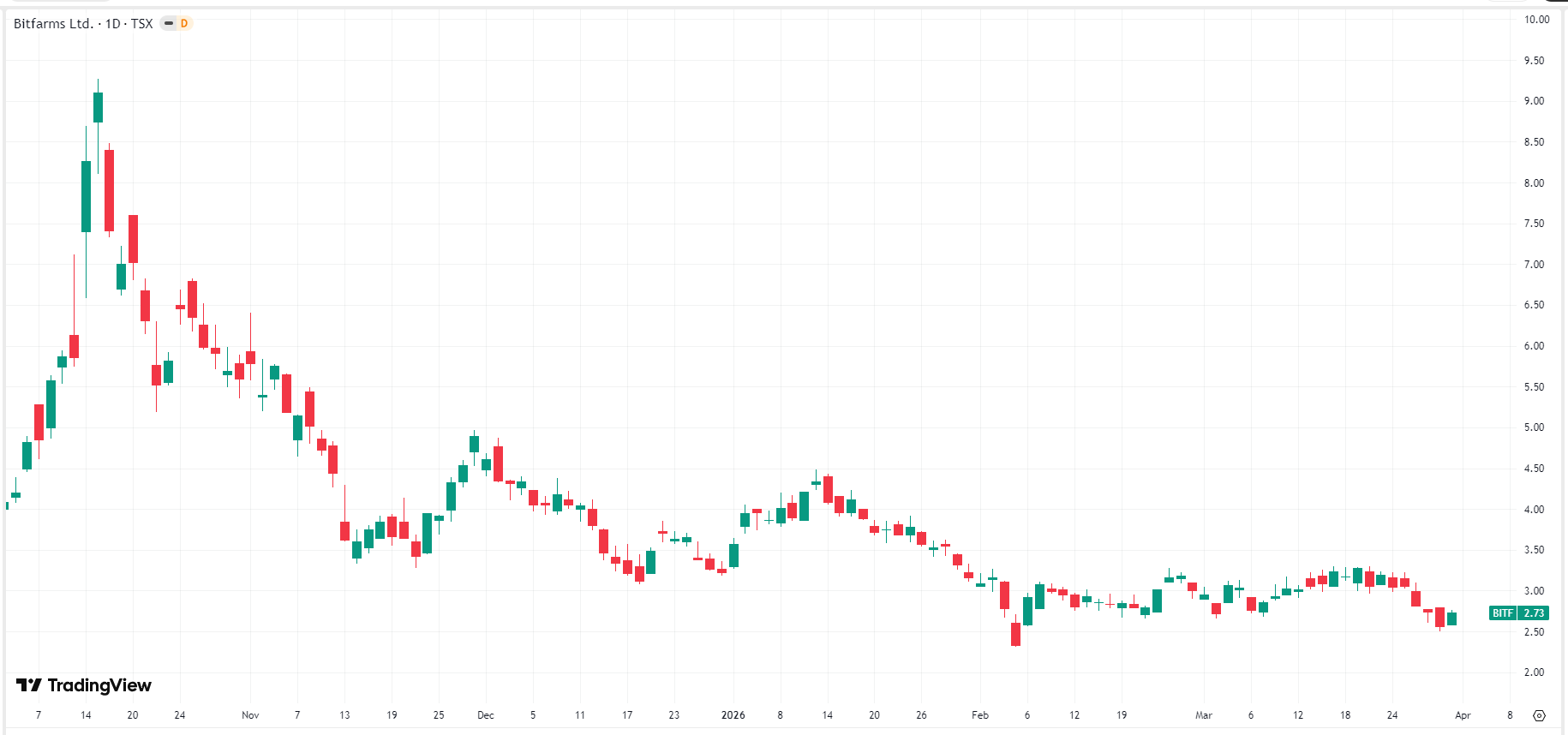 Bitfarms stock price chart, Source: TradingView
According to financial reports, total revenue for fiscal year 2025 grew 72% to $229 million, but the company recorded a massive net loss of $209 million for the full year, with profitability under extreme pressure. This substantial loss of over $200 million was primarily driven by the following three factors:
- Equipment impairment and technological replacement: As the Bitcoin network hashrate competition intensified heading into 2026, Bitfarms replaced older mining rig models on a large scale, resulting in significant non-cash impairment charges.
- Bitcoin price impact: After peaking at $126,000 in October 2025, Bitcoin prices continued to retreat, eroding US dollar-denominated profit margins given a fixed production volume.
- Infrastructure renovation expenditures: The company is investing heavily to retrofit existing air-cooled data centers into water/liquid-cooled facilities suitable for hosting GPU clusters. This capital expenditure (CapEx) directly weighed on current earnings.
Faced with falling Bitcoin prices and high operating costs, Bitfarms, like Cipher Mining ( CIFR ), Riot Platforms ( RIOT ), and MARA Holdings Inc ( MARA ), has chosen to pivot toward HPC/AI infrastructure. Simultaneously, it announced a name change to Keel Infrastructure, with its ticker symbol changing to KEEL.
What are the benefits of this cross-industry "Great Migration" for Bitfarms and numerous other miners? This is not a whim, but a strategic move driven by the combined forces of post-halving economic pressure, the extreme shortage of AI computing power, and the reconfiguration of capital valuation logic.
1. Core Driver: Upgrading from "Energy Extraction" to "Energy Leasing"
Typically, constructing a new data center with hundreds of megawatts (MW) of power licensing requires a 3 to 5-year approval and construction cycle. However, with "ready-made" power facilities, miners only need to retrofit existing "containerized" air-cooled farms into "water/liquid-cooled" high-density data centers to be operational within 6 to 12 months—far faster than building from scratch.
2. Economic Logic: Post-halving "Survival Crisis" vs. "Gross Margin Allure"
The Bitcoin halving in 2024 and beyond has caused the production cost per Bitcoin to skyrocket. During price slumps, gross margins can drop below 20%, whereas providing compute leasing or infrastructure services often maintains margins above 60%. Furthermore, rather than risking the volatility of Bitcoin mining, it is more lucrative to "lease" sites equipped with robust power systems to AI companies needing to run NVIDIA ( NVDA) GPU clusters, thereby earning steady hosting fees.
3. Capital Market "Valuation Reshaping"
Wall Street uses entirely different pricing models for "miners" versus "AI infrastructure companies." Miners are typically viewed as "high-risk, cyclical commodity producers" with low P/E ratios, whereas AI infrastructure is seen as "digital real estate" or "growth tech stocks," commanding significant valuation premiums. For example, Bitfarms and Core Scientific ( CORZ) have seen their stock prices rise despite reporting losses after announcing their pivot to AI, thanks to a "shift in valuation logic."
Bitfarms' transformation has not only gained investor approval, turning its stock price performance around, but it may also attract more miners to follow suit. This could solve their survival challenges while helping to ease hashrate competition across the mining industry.
This content was translated using AI and reviewed for clarity. It is for informational purposes only.
Recommended Articles








Comments (0)
Click the $ button, enter the symbol, and select to link a stock, ETF, or other ticker.