


Micron Plunges 10%, Earnings Beat Expectations, Stock Price Falls 30% Consecutively, Can AI Memory Chips Still Be Bought?



AI Podcast


Micron Technology's stock has declined nearly 30% post-earnings despite robust financial results, signaling market re-evaluation of the AI storage boom's sustainability. While Q2 revenues and Q3 guidance exceeded expectations, increased capital expenditure for 2026 and 2027 suggests future supply growth. Concerns over AI demand elasticity and potential technological shifts reducing memory requirements are driving this recalibration. The market is shifting from "scarcity" to validating demand quality, leading to a valuation re-rating rather than a reversal of industry fundamentals.
TradingKey - Micron Technology ( MU )'s recent stock price movement has become almost a microcosm of the shifting sentiment in the AI storage sector. Despite clearly robust earnings, the stock price has weakened steadily following the announcement, with a cumulative decline of nearly 30%. The market is beginning to re-examine the sustainability of this AI storage boom.
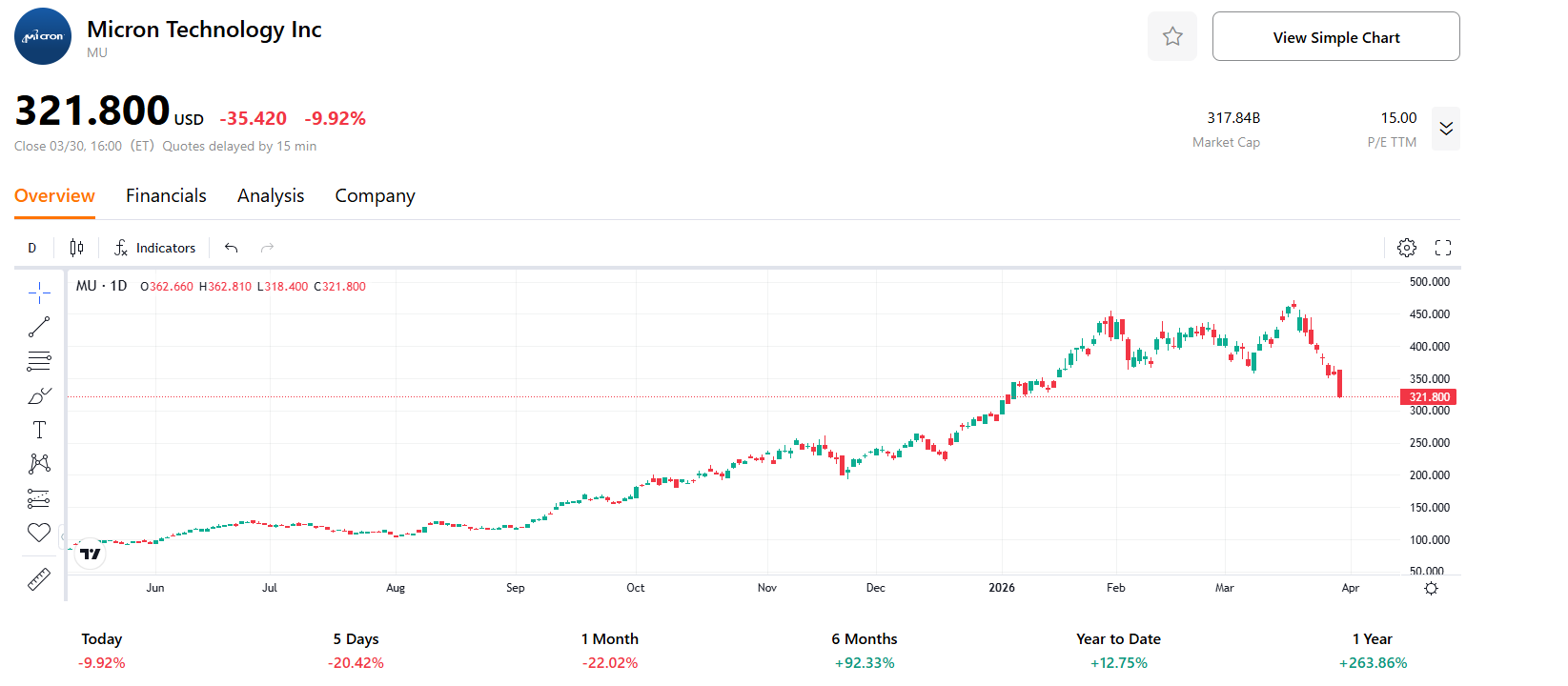
Yesterday (March 30), Micron Technology tumbled another 9.92%. The stock price has fallen continuously since the earnings report on March 18, reaching a cumulative decline of 30%. This downward trend in Micron's shares no longer resembles ordinary post-earnings profit-taking.
The earnings report released by the company on March 18 was undeniably strong. It showed second-quarter revenue reached $23.86 billion, nearly triple that of the same period last year. Furthermore, the revenue guidance for the third fiscal quarter was as high as $33.5 billion, significantly exceeding market expectations.
However, the stock price did not sustain its strength; instead, it has weakened consecutively since the earnings announcement, exhibiting a classic divergence where "stronger performance leads to a falling share price."
If the earnings were sound, then where does the problem lie?
From a fundamental perspective, Micron's earnings report was indeed stellar. Revenue, gross margin, EPS, and free cash flow all hit record highs in the second quarter. Management also projected third-quarter single-quarter revenue to levels unprecedented in the company's history.
More critically, revenue from DRAM, NAND, HBM, and various business units reached record highs, demonstrating that AI-driven storage demand is not merely a concept but is tangibly reflected in the financial statements. However, the market's concern is not whether "this quarter was good," but rather "how long this performance can last."
Following the earnings report, Reuters noted that Micron increased its capital expenditure for fiscal year 2026 by another $5 billion, pushing the total to over $25 billion. Moreover, spending is expected to continue rising in 2027, with construction-related expenditures projected to exceed last year's by more than $10 billion.
Investors see more than just simple capacity expansion; it is a direct signal that industry supply will eventually catch up, and the extreme shortages of the past may not be sustained indefinitely.
The AI Thesis Persists, but the Market Is Recalculating the Duration of Memory Scarcity
A significant backdrop to this sell-off is the market's growing concern regarding the elasticity of AI memory demand. Over the past year, Micron has been viewed as one of the quintessential beneficiaries of the AI storage chain, as data center expansion drove up demand for HBM, DRAM, and NAND simultaneously.
However, recent compression technologies like Google's TurboQuant have prompted the market to reconsider: if model inference requires less memory, will the scarcity premium of storage chips be eroded? Such concerns are among the key catalysts for the recent decline in storage stocks.
Yet, this does not equate to a peak in AI demand; it is more like the market shifting from a focus on "scarcity" to "validating the quality of demand."
Morgan Stanley believes that interpreting TurboQuant as a collapse in demand is premature. The real metrics to watch are whether AI capital expenditures continue to expand and whether data center storage procurement is still accelerating. In other words, the issue is not that AI no longer needs memory, but whether the market is willing to continue paying high valuations for "higher memory unit prices" and "prolonged supply-demand tightness."
Historical Trends Also Serve as a Reminder: For Micron, Strong Earnings Often Precede Price Corrections
Looking back at Micron's history, similar scripts are not unfamiliar. Micron's stock rose by over 240% in 2025 and surged more than 61% at one point this year; following such gains, pullbacks can occur very rapidly at the slightest softening of market expectations.
During this correction, Micron fell nearly 30% from the high set on March 18. Furthermore, it has declined in seven of the last eight trading days, erasing most of its year-to-date gains and leaving only 12%.
This is actually the most typical cyclical characteristic of the storage industry. When supply is tightest and profits are highest, the stock price often prices in optimistic expectations for a long period ahead. Once capacity expansion, capital expenditure, and depreciation start being magnified by market interpretation, the stock price tends to weaken ahead of the fundamentals.
Micron's current situation can be summarized as follows: earnings pushed "current prosperity" to an extreme high, but the market has begun trading on whether "that prosperity can maintain the same pace," leading to the sustained drop in stock price.
This Is More Like a Valuation Re-rating Than a Reversal of Industry Fundamentals
From a business perspective, Micron's AI story remains intact. In its earnings report, the company clearly stated that AI demand, structural supply constraints, and strong execution collectively drove this performance jump. Furthermore, management emphasized that memory has become a strategic asset in the AI era.
The business structure presented in the report is also clear: the cloud, core data center, mobile and client, and automotive and embedded businesses are all setting revenue records, indicating that growth is not being propped up by a single customer or a single product.
However, the capital markets look beyond mere business growth to whether that growth justifies a high valuation. When a stock has already experienced an exaggerated rally, the addition of concerns over capacity expansion, technological substitution, and cyclical reversion makes it easy for the share price to enter a re-pricing phase.
The core of Micron's current decline is not that the earnings report ruined the narrative, but that the market has begun to doubt whether the AI storage dividend is long-cycle and sustainable or highly cyclical and prone to retreat. While the final answer is not yet in, the stock price has already made a preliminary judgment for the market.
Recommended Articles











Comments (0)
Click the $ button, enter the symbol, and select to link a stock, ETF, or other ticker.