


Retail Trading Hub Robinhood Sinks Again, Slumping Over 7% After Hours, Signaling Lack of Interest in Crypto?



AI Podcast


Robinhood's Q4 revenue of $1.28 billion missed expectations, driven by a 38% decline in cryptocurrency trading revenue to $221 million. Net income fell 34% to $605 million. The stock price dropped over 40% from its peak, with further declines in after-hours trading. Despite growth and S&P 500 inclusion, its valuation remains high relative to peers. Key risks include sustaining user growth momentum and navigating a potential economic recession, which could significantly impact its business model and stock performance.

TradingKey - Robinhood (HOOD) Fourth-quarter net income declined 34% to $605 million, and total revenue of $1.28 billion missed Wall Street expectations. Cryptocurrency trading revenue plummeted 38% to $221 million, becoming the primary drag on the earnings report. The company's stock price has fallen from a high of 153.86 to 85.6, a cumulative drop of over 40%; shares continued to slide 7.6% in after-hours trading following the announcement.
Robinhood announced its Q4 2024 financial results: net income was $605 million (or 66 cents per share), down 34% year-over-year but slightly above the analyst estimate of 64 cents; however, total revenue was $1.28 billion, falling short of the Wall Street consensus of $1.34 billion.
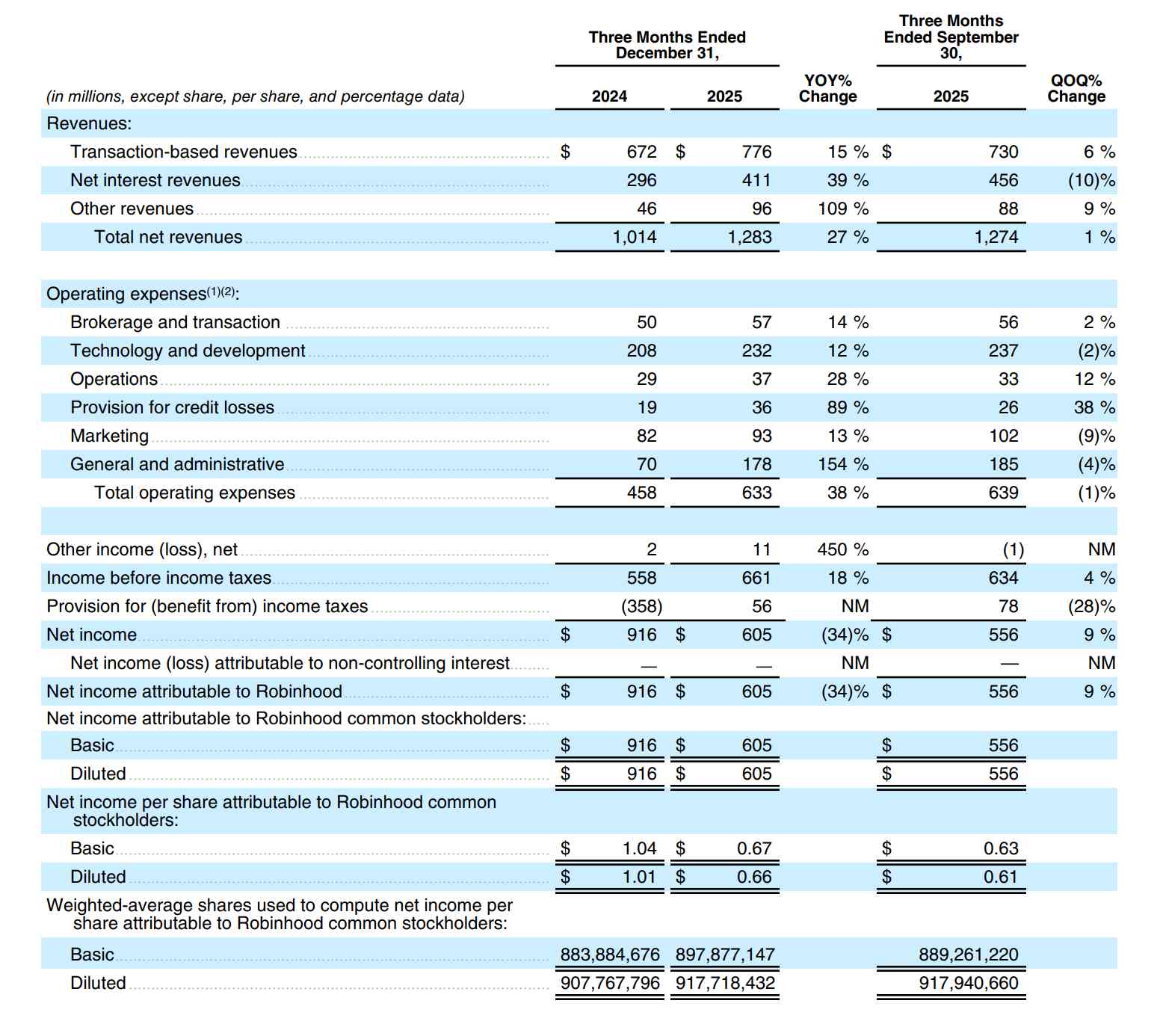
[Robinhood Earnings Report, Source: Robinhood ]
Among the results, cryptocurrency trading revenue saw a sharp year-over-year decline of 38% to $221 million, significantly missing market expectations of $248 million. This weak performance is closely tied to the market environment—since October 6, 2025, when Bitcoin (BTC) reached a record high, its price has fallen by a cumulative total of more than 50%, once dropping to $60,000. Reduced market trading activity has directly dampened crypto trading volumes on the platform.
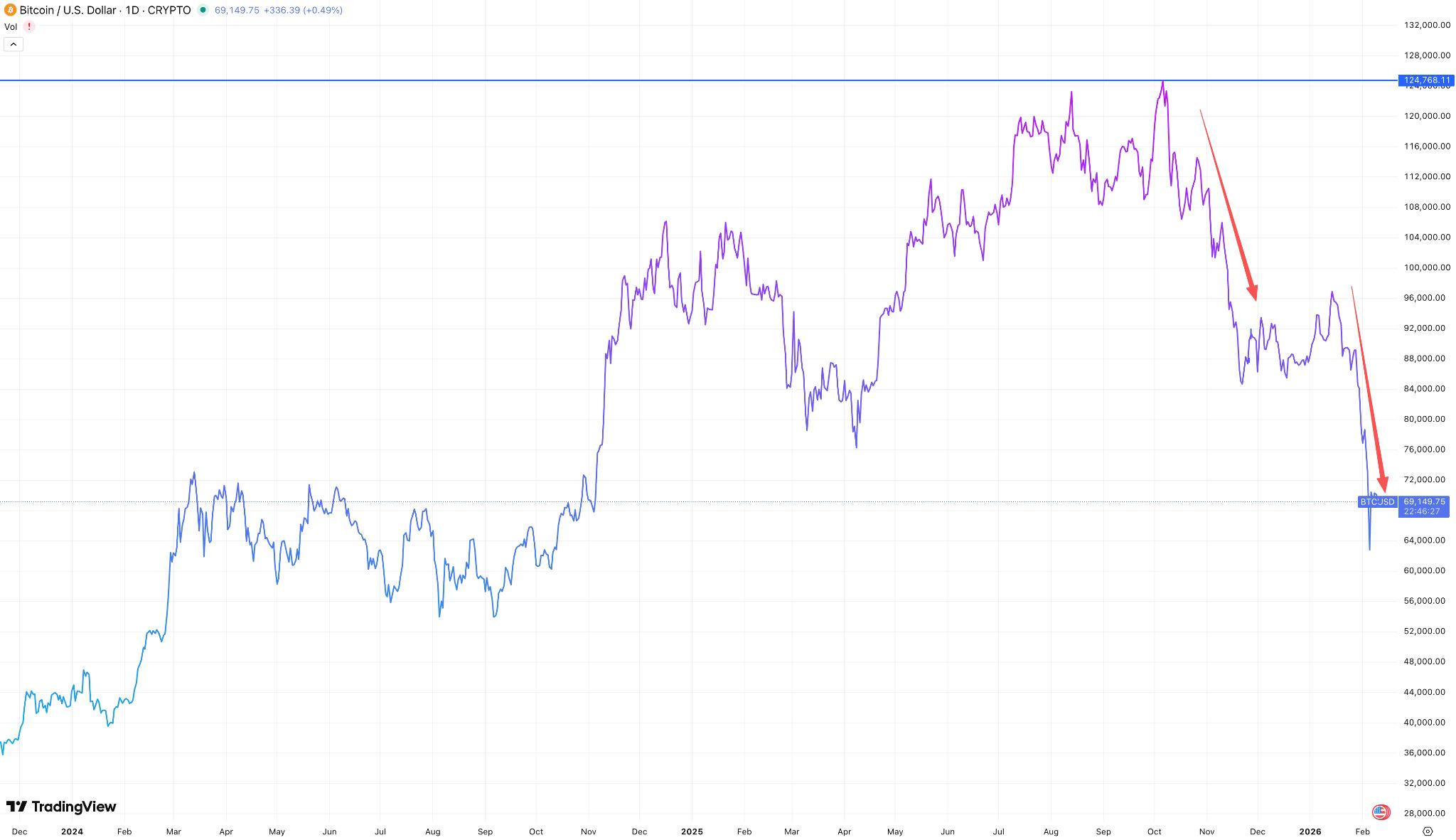
[Bitcoin has trended lower since its peak, Source: TradingView]
Robinhood holds a limited amount of crypto assets itself, so its profitability is highly dependent on spread income from user trades. Consequently, the significant slowdown in the crypto business has become a key factor weighing on overall revenue. Impacted by this, the stock price fell 6.6% in after-hours trading after the earnings release.
Is Now the Time to Invest in Robinhood?
Benefiting from the buoyant financial markets in recent years, Robinhood's scale has continued to grow, leading to its inclusion in the S&P 500 Index in September 2025. Robinhood is a popular investment platform among younger generations, often called the stronghold of retail investors, and it also operates in cryptocurrency trading and prediction markets.
Valuations were extreme at the stock's peak, with a P/E ratio near 70x. Although the current 34.5x is lower, the company remains one of the more highly valued among brokers, still trading at a premium compared to its competitor Charles Schwab (SCHW) , with a P/E ratio of approximately 21x.
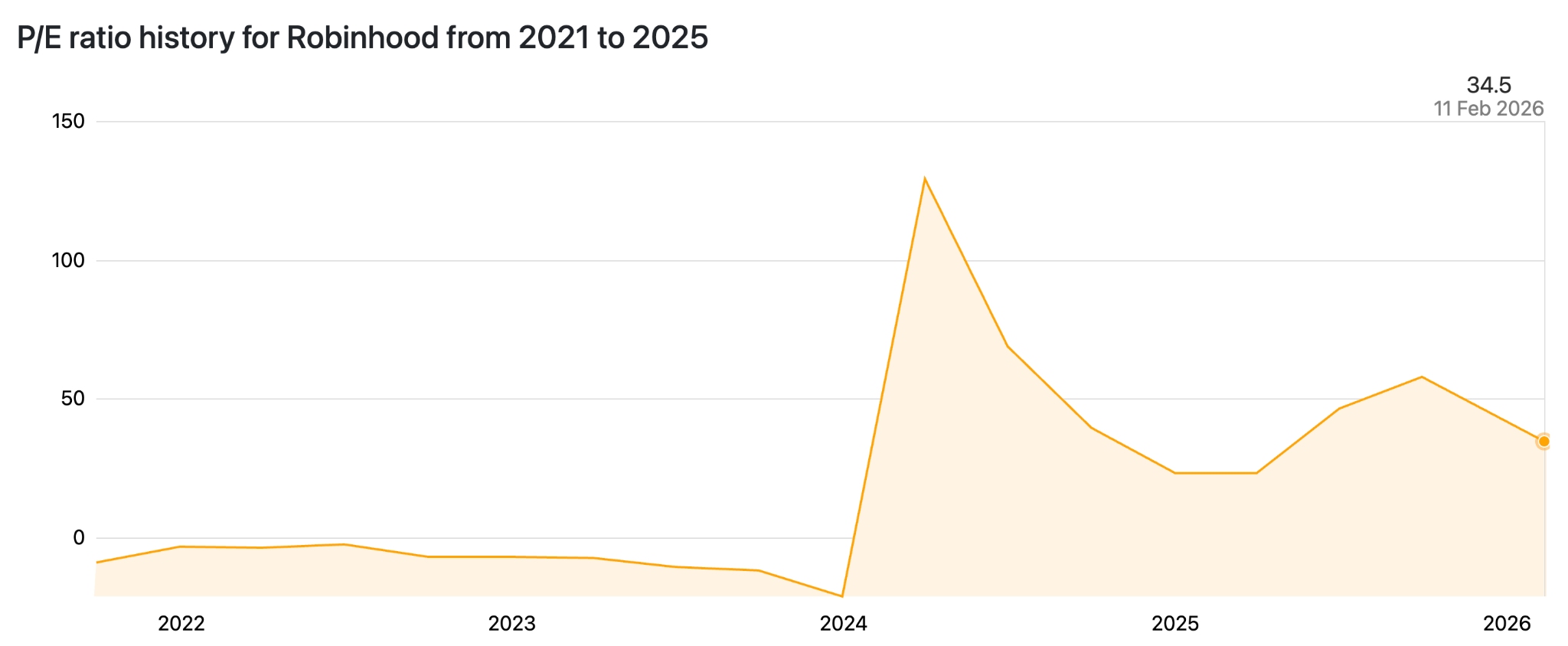
[Robinhood Historical Valuations, Source: Companiesmarketcap]
Robinhood is growing, but even after the stock price correction, such a premium stands out in the brokerage sector. It remains debatable whether there is still further downside potential for the stock.
Investors should note that the company attracted a massive number of clients in a very short time, which undoubtedly drove the stock price higher. If this momentum in user growth cannot be sustained, the stock may lose its upward narrative.
Furthermore, Robinhood's customers appear to favor speculating on high-risk assets, a tendency reflected in the company's expansion into sports betting. Since the Great Recession of 2007–2009, the market has not truly experienced a deep bear market or a severe downturn.
As a relatively new public company, Robinhood has not yet navigated an economic recession. It is difficult to predict whether Robinhood can maintain its high-growth momentum during a bear market.
Historically, major market and economic downturns have tended to hit young, aggressive investors hard. A common reaction is to immediately cut losses and exit the market, withdrawing what capital remains. If this scenario repeats, the upward trend in assets and customer growth that previously fueled Robinhood could reverse, leading to a rapid loss of both.
Given Robinhood's valuation is still high relative to its peers, Wall Street's view of the stock is likely to become even more negative if a bear market or recession occurs. Currently, the market continues to monitor U.S. economic data for signs of recession, which would affect not only Robinhood but brokerage stocks across Wall Street as a whole.
This content was translated using AI and reviewed for clarity. It is for informational purposes only.
Recommended Articles












Comments (0)
Click the $ button, enter the symbol, and select to link a stock, ETF, or other ticker.