


Tesla Earnings Preview: With EV Sales Slowing, Can Tesla's Energy Storage Business Boost Its Earnings?



AI Podcast


Tesla's energy storage business, comprising residential Powerwall and grid-scale Megapack, shows strong growth but currently represents a small portion of overall revenue. While its profitability may not immediately offset EV segment weakness, long-term potential is significant due to AI and energy transition demands. Investors should monitor its expansion as a future growth driver, with projections suggesting it could eventually rival or exceed the scale of Tesla's automotive business.

TradingKey - Previously, we mentioned that Tesla's EV business has experienced a slowdown in growth, and sales volume in certain regions has even declined year-on-year. Although Tesla's energy storage business has shown rapid growth, it may be difficult for it to replace the revenue dominance of Tesla's EV business in the short term. In the long run, we believe Tesla's energy storage business possesses sustainable competitiveness.
What is Tesla's energy storage business?
Tesla's energy storage business refers to the storage of electrical energy through battery systems and its release when needed, thereby achieving power dispatch, backup, or optimized usage. This business mainly targets three scenarios: residential storage, commercial storage, and grid-scale storage. Its flagship products are the Powerwall and Megapack.
Powerwall is a lithium battery storage device installed in home garages or on exterior walls, usually used in conjunction with rooftop solar panels. After solar power is generated during the day, excess electricity can be stored in the Powerwall; at night or during power outages, households can still use the stored electricity, which both improves energy self-sufficiency and enhances power security.
Megapack is a massive battery system designed by Tesla for large-scale projects. It is widely used in scenarios such as grid peak shaving, renewable energy integration (such as wind farms and solar power plants), and industrial backup power. For instance, several large-scale energy storage stations in California, Australia, and China have adopted the Megapack.
Can Tesla's energy storage business boost profitability?
Although Tesla's energy storage business has shown rapid growth, it may be difficult for it to replace the revenue status of Tesla's EV business in the short term. The reasons are as follows:

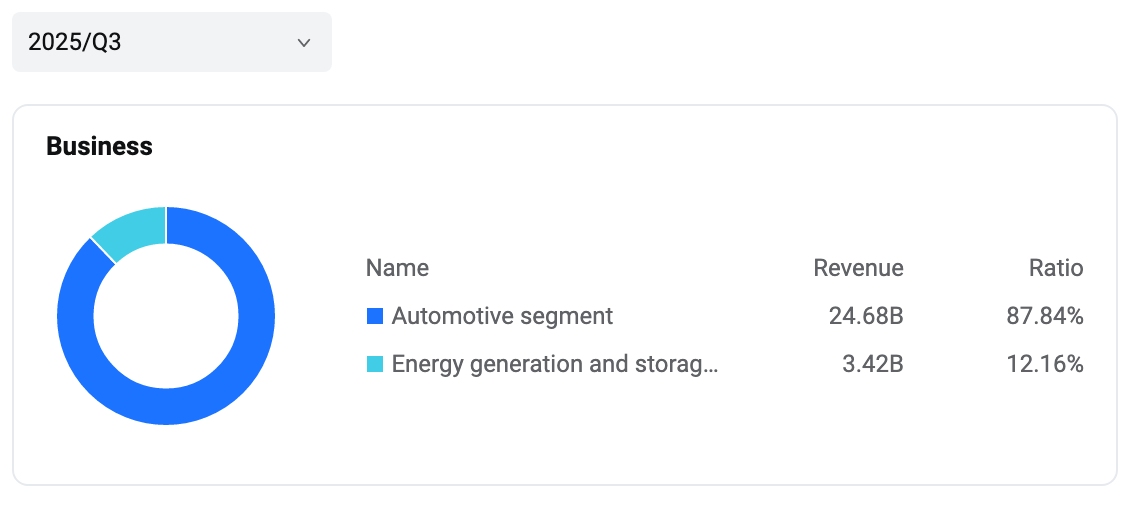
In 2024, revenue from the energy storage business accounted for only 10.32%. Although the growth rate of the energy storage business in Tesla's financial reports continues to accelerate, its share of revenue in Q3 2025 was only 12.16%. Despite the strong growth performance of the storage segment, its profitability cannot offset the weakness of the EV segment in the short term.
Elon Musk once told analysts that the stationary battery business—the Megapack business—will be comparable in scale to the automotive business, or perhaps even larger. Therefore, investors need to monitor the expansion of the energy storage business in upcoming earnings reports to identify new growth drivers amid relatively weak financial statements.
We believe that in the long run, thanks to the exponential growth of AI and the explosive demand generated by the energy transition, there is still significant room for growth in the energy storage business. This provides a very positive growth outlook for the energy storage segment, and its contribution to Tesla's profitability is only a matter of time.
This content was translated using AI and reviewed for clarity. It is for informational purposes only.
Recommended Articles









Comments (0)
Click the $ button, enter the symbol, and select to link a stock, ETF, or other ticker.