


Netflix Stock Analysis: Why Netflix Stock Keeps Falling, and When Should Investors Buy Netflix Stock?



AI Podcast


Netflix shares have declined due to concerns over its proposed acquisition of Warner Bros. Discovery and an escalating bidding war. While investor sentiment is negative regarding short-term profitability, the current valuation presents a long-term opportunity. Netflix remains a global streaming leader with a strong content ecosystem and expanding advertising and gaming businesses. Recent stock performance has been volatile, influenced by original content success, pandemic-driven growth, and market shifts. Despite short-term challenges from tax issues and acquisition risks, Netflix's fundamentals are solid, and a more reasonable valuation enhances investment appeal for risk-tolerant investors.
TradingKey - Recently, Netflix shares have faced sustained pressureamid its proposed acquisition of Warner Bros. Discovery (WBD) and an escalating bidding war with Paramount Skydance. The acquisition battle,fueled by Paramount Skydance's aggressive competition, has continuously driven up acquisition costs, leading to investor concerns about the deal's impact on short-term profitability. This has prompted widespread selling and reflects a lack of market confidence in the acquisition's prospects.
While the final terms for Netflix's acquisition of WBD remain uncertain in the short term, we view the recent decline, driven by market sentiment, as a significant long-term undervalued opportunity. The return to more realistic valuations enhances the investment appeal of Netflix stock. We therefore recommend that investors consider opportune dip-buying.
What Kind of Company is Netflix?
Without this company, we might still be renting DVDs to watch movies.
Netflixis a global leader in the streaming entertainment industry, with an influence extending far beyond merely "producing shows, listing them, and collecting subscriptions." Over the past decade, Netflix has fundamentally reshaped global film and television production and distribution models. Its command over the content supply chain—from original production and simultaneous global launches to extensive multilingual localization—gives it a competitive edge that most rivals cannot match in the short term.
Currently,Netflix'spaid membership reaches approximately 190 countries and regions. Its content library spans series, films, documentaries, and interactive content, with a stable release schedule. Its most iconic works include: House of Cards, Squid Game, Stranger Things, and K-Pop: Demon Hunters.
Beyond content, Netflix has continuously expanded its boundaries in recent years. Its advertising business has shown impressive initial results, investments in gaming content are progressively increasing, and popular intellectual properties (IPs) are also moving into offline licensing development. Overall, Netflix is no longer just a streaming platform; it is building a global content ecosystem spanning film, interactive entertainment, and advertising.
What Is Netflix Stock's Historical Performance?
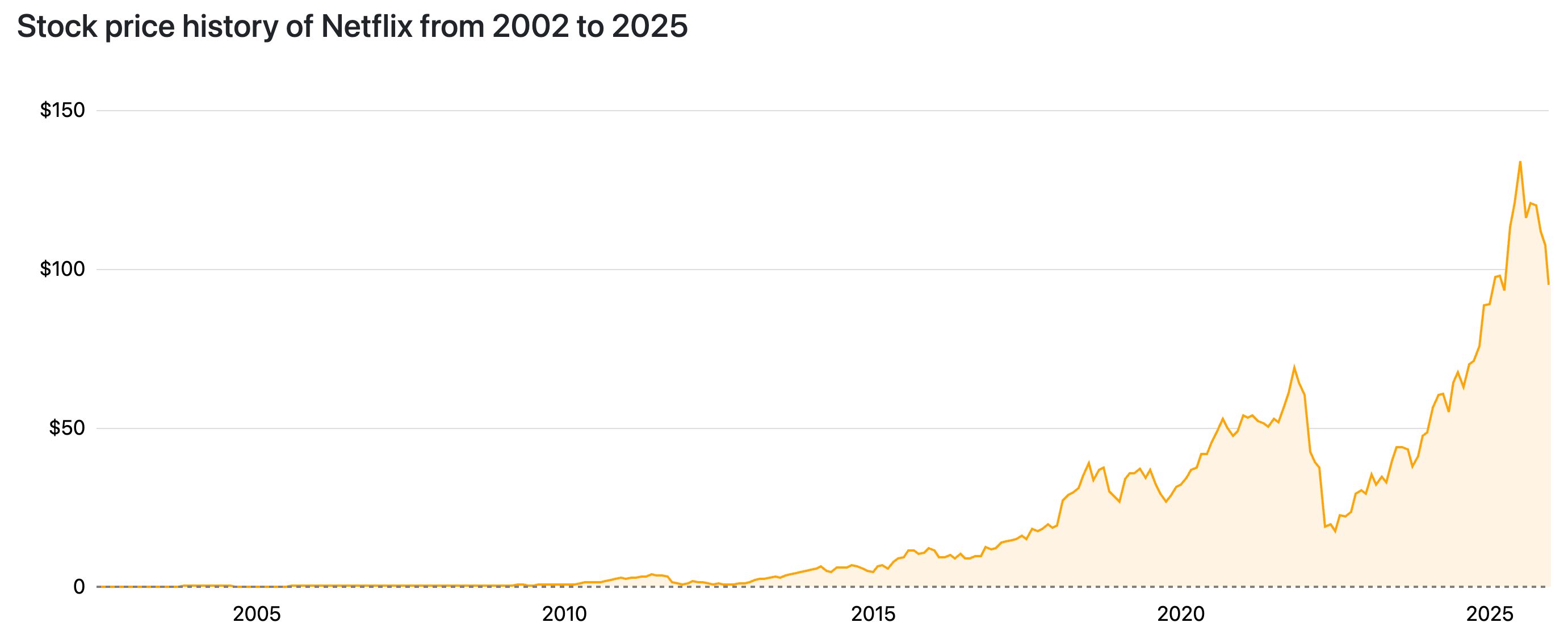
【Netflix Stock Price Historical Performance (Split-Adjusted), Source: companiesmarketcap.com】
Netflix went public on May 23, 2002, with an opening price of approximately $16 (unadjusted). However, due to the dot-com bubble and market skepticism towards unproven stocks, the share price quickly plummeted to less than $5 (unadjusted) within months.
The turning point arrived in 2007 when Netflix quietly launched its streaming service. Initially a beta version of its DVD rental service, it quickly eclipsed DVD rentals. This unheralded transition laid the groundwork for a pivotal shift in the company's trajectory.
By 2009, as broadband penetration accelerated, Netflix's stock price began to climb, rising 67% by year-end. Between 2002 and 2010, the company's user base expanded from 857,000 to 20 million. Revenue surged from $150 million to $2.1 billion, and net profit climbed from a $21 million loss to $160 million.
Starting in 2011, Reed Hastings announced Netflix'sfull transition to a streaming-centric model.
In 2011, Netflix ,having just lost nearly 800,000 subscribers that summer due to a 49% price hike, delivered another surprising blow. On September 18, CEO Reed Hastings announced the DVD rental business would be spun off and rebranded as Qwikster.From then on, streaming and physical disc rentals would be charged separately, requiring users desiring both services to pay two distinct bills.
Investors decried this as "suicidal greed," while customers expressed their anger through a wave of cancellations. In less than three weeks, Netflix CEO Hastings publicly acknowledged the mistake and announced the complete cancellation of the Qwikster plan.
This fiasco caused Netflix's stock to be repeatedly halved from its high that year, but it also exposed the growing pains of the streaming transition. Reassuringly for investors, Netflix's paid subscribers still rose from 21 million at the start of 2011 to 23.82 million by the end of the year, even after the Qwikster debacle.
What truly set Netflix on a path of explosive growth was the push for original programming after 2013. Netflix boldly bet $100 million on "House of Cards" in February 2013. This, Netflix's first significant foray into self-produced content, fueled a stock surge. That year alone, the share price soared nearly 300%, reaching a market capitalization of almost $22 billion.
Data showed that "House of Cards" led to a 22% surge in U.S. subscribers, proving that original content could lock in loyalty and prevent churn. Investors rewarded this vision, viewing Netflix as a content factory rather than merely a distributor.
From 2014 through late 2015, this growth trend continued. Fueled by international expansion,Netflix's stock price and market capitalization continuously climbed,rising nearly 160% as global subscribers surged to 100 million. The market cap reached almost $53 billion, reflecting Netflix's transformation into a global giant.
The bull market from 2017 to 2019 cemented Netflix's dominant position, with shares tripling to $350 by the end of 2019. Hit shows like "Stranger Things" and "The Crown" fueled this rise, while aggressive content spending propelled annual revenue to $15 billion. Its market capitalization soared to $142 billion, surpassing competitors like Disney.
The pandemic era from 2019 to 2021 boosted its streaming business expansion, causing the stock price to continuously surge and its market capitalization to temporarily exceed $300 billion. In Q2 2020 alone, global subscribers surged by 36 million, marking its largest quarterly gain ever and demonstrating streaming's recession-proof appeal. Furthermore, broader tech enthusiasm, amplified by zero-interest rate policies, further magnified the gains.
From 2021 to 2022, the stock plunged as vaccine rollouts and the return-to-office trend impacted streaming, compounded by macroeconomic factors. Its market capitalization plummeted from its peak, shrinking to $77 billion. Netflix's P/E ratio compressed from a market-frenzied 90x to 20x.
The launch of its ad-supported tier sparked a recovery by late 2022. By 2024, Netflix had regained momentum, with shares rising 82% to over $800, pushing its market capitalization to $388 billion. Key catalysts included the November 2024 boxing match between Jake Paul and Mike Tyson, which shattered streaming records by attracting 108 million viewers. Furthermore, a foray into "Stranger Things"-related mobile games brought diversification, and advertising revenue surged 40% year-over-year.
Entering 2025, influenced by the broader tech narrative, the stock repeatedly hit new highs. It also benefited from its NFL Christmas Day game broadcast, which attracted an average of 50 million viewers per game—the most-watched live NFL games in history. Its market capitalization temporarily surpassed $552 billion.

【NFLX Historical Valuation Overview, Source:companiesmarketcap.com】
However, the third quarter brought a shock: in October, the stock price plunged nearly 20% due to disappointing third-quarter results and weaker-than-expected guidance.
In December 2025,Netflix's aggressive $75 billion bid for Warner Bros. Discovery assets triggered a bidding war with Paramount, prompting regulatory scrutiny and debt concerns. Due to antitrust worries and integration risks, the company lost nearly $50 billion in market value.
Why Has Netflix Stock Declined Recently?
We believe this is primarily attributable to two factors:
I. High Valuation and Imbalanced Growth Momentum
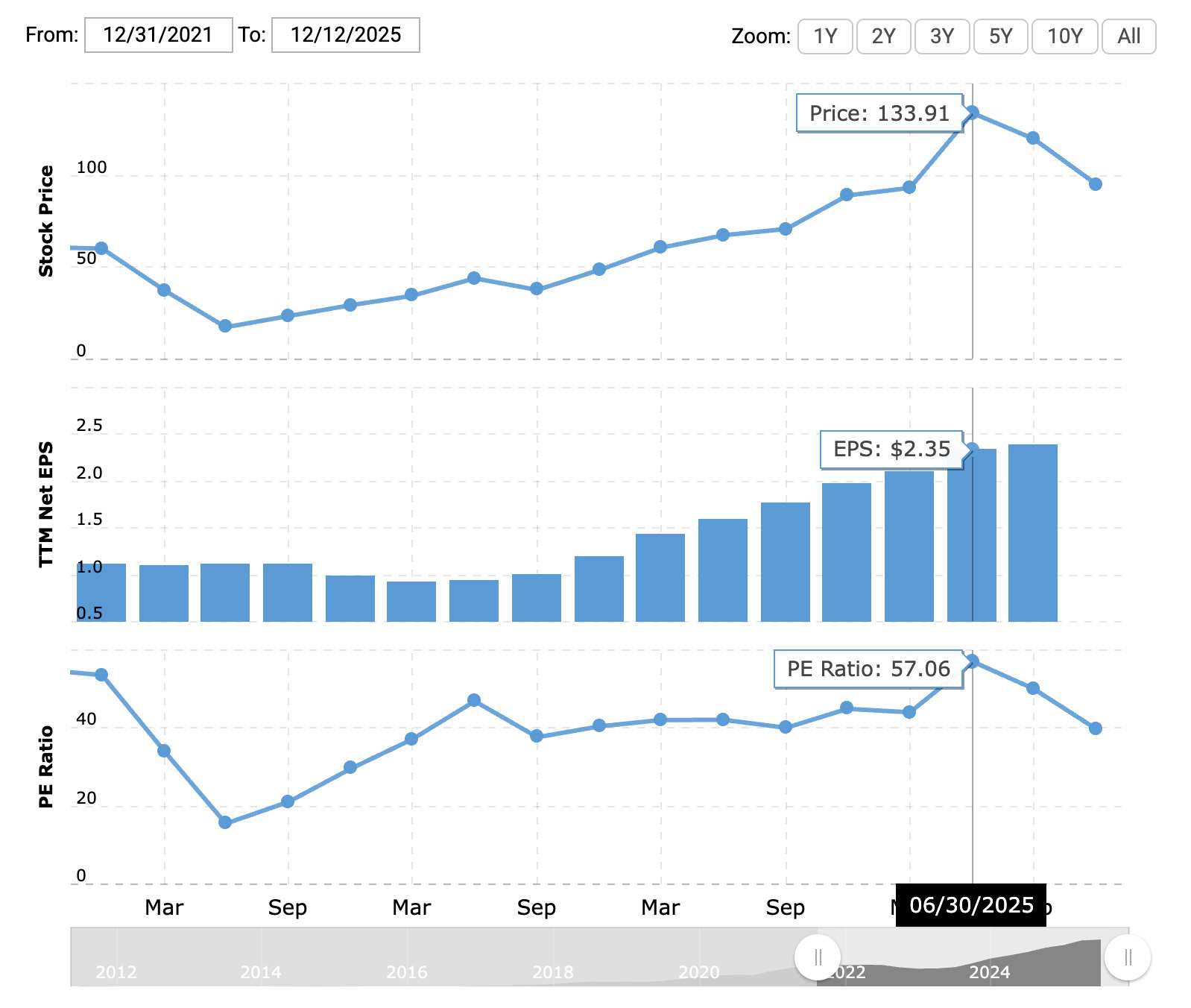
【NFLX P/E Data for the Last 4 Years, Source: www.macrotrends.net】
Over the past four years,Netflix's stock price has continuously climbed, with its highest single-day P/E ratio exceeding 65x. For a streaming giant, maintaining a P/E of 65x is akin to walking a tightrope; any misstep could lead to a devastating blow.
Although Netflix's performance continues to improve, the market has already fully priced this in. Expectations were for faster growth in earnings reports. However, the Q3 2025 earnings data and conservative quarterly guidance largely disappointed the market, leading to a more than 10% drop in stock price after the Q3 release.
Netflix attributed this to an unexpected expenditure stemming from an ongoing dispute with Brazilian tax authorities. The company stated that, excluding this expense, its profit margins would have exceeded targets, and it does not expect this tax issue to significantly impact future performance.
Nevertheless, the elevated valuation continues to fuel market concerns about thesustainability of Netflix's stock price.
II. Netflix's WBD Acquisition Triggers Investor Confidence Crisis
Netflix's acquisition offerproposed a massive total transaction value of nearly $72 billion in equity and $10.7 billion in debt, representing a substantial investment. Analysts worry this deal could forceNetflixto shoulder a massive debt burden, potentially impacting its credit rating and thereby increasing financing costs and long-term risks.
Furthermore, Netflix's bidding war with Paramount Skydancehas seen Paramount Skydance'saggressive competition continuously elevate acquisition costs, further eroding Netflix's profits. WBD's overall valuation has now reached $108.3 billion.
Second, investors are concerned thatNetflix's acquisition of WBD would involve taking on WBD's traditional film production and theatrical distribution businesses—areas where Netflix lacks core expertise. Investors fear this large acquisition could dilute its traditionally high profit margins and innovation speed, resulting in a "combination of redundant, low-growth legacy assets."
Moreover,Netflix's acquisition of WBD also faces the regulatory antitrust "30% red line." Based on streaming viewership hours, Netflix currently holds approximately 20% of the U.S. market, while HBO Max holds about 15%. A combined 35% market share would exceed the 30% "presumptive illegality" threshold outlined in the U.S. Department of Justice's 2023 antitrust guidelines.
In response, while Netflix has countered with arguments citing high user overlap, an expanded market definition, and international competition, investors remain unconvinced.
When Is the Right Time for Investors to Buy Netflix Stock?
From a fundamental perspective, although Netflix's growth has decelerated, its fundamentals remain solid. Short-term profits were impacted by a one-time expenditure due to the Brazilian tax issue. This does not indicate a deterioration in operational quality but affects short-term market sentiment regarding stock valuation.

【NFLX Q3 Income Statement, Source: Netflix】
Netflix's revenue trend maintains a continuous upward trajectory, and its core business continues to perform strongly.
We believe that while the final terms for Netflix's acquisition of WBD remain uncertain in the short term, the recent decline, driven by market sentiment, presents a significant long-term undervalued opportunity. The return to more reasonable valuations makes Netflix stock more attractive for investment. We therefore recommend that investors with higher risk tolerance consider opportune dip-buying. For investors with lower risk tolerance, we suggest waiting for clearer signals regarding the acquisition's certainty before entering the market.
This content was translated using AI and reviewed for clarity. It is for informational purposes only.
Recommended Articles









Comments (0)
Click the $ button, enter the symbol, and select to link a stock, ETF, or other ticker.