


Tesla (TSLA) Stock Price Forecast 2026: 480K Deliveries Beat by 18% - Why Did the Stock Drop 7%?



AI Podcast


Tesla’s Q2 2026 deliveries reached 480,126 units, an 18% consensus beat, significantly reducing inventory levels. Despite this, shares declined due to profit-taking, intense competition from BYD, and a high 204x forward P/E valuation, which emphasizes AI and autonomy over vehicle sales. Investors are shifting focus toward the July 22 earnings report, prioritizing automotive gross margins and progress on FSD, Cybercab, and Optimus projects. Technically, the stock remains supported at the $395 Fibonacci level. Future valuation sensitivity relies heavily on autonomous technology commercialization rather than delivery volume alone.
TradingKey - Tesla (NASDAQ: TSLA) is currently trading at $394.35. The stock is hovering over the ascending trendline as well as the 0.618 Fibonacci retracement of $395.06. Tesla fell 7.49% on July 2nd despite having the Q2 2026 deliveries report that better than expected. Tesla reported 480,126 deliveries compared with the consensus of 406,024, or a beat of 74,102 or 18%. This is Tesla’s best Q2 ever by 25% year-over-year and 34% higher than Q1’s deliveries of 358,023.
The price drop was more a result of profit taking from the run up ahead of the report, more competition from BYD that has taken the top global EV sales spot back from Tesla, as well as Tesla’s elevated valuation of 204 times forward earnings which is more about AI and autonomy then it is vehicle deliveries. RSI at 57.47 is constructive while Q2 Earnings are due on July 22nd.
480,126 Deliveries Shows Inventory Is Moving Again
Tesla’s 74,102 beat was well above even the top Wall St estimates of somewhere near 418,000 to 420,000 vehicles. Of those vehicles, there were 467,762 Model 3s and Model Ys and the other 12,364 came from the Model S, X, Cybertruck, and Semi. More importantly, Tesla delivered 480,126 vehicles while making 451,758 of them leaving roughly 28,000 fewer in inventory. This is a big turnaround from Q1 when they added approximately 50,000 to their inventory, so there is good evidence that demand is improving.
Wall St. currently expects Tesla to deliver 1,654,808 vehicles in 2026 which is only about 1% annual growth after having cut 35,000 from those deliveries in March. So after the great quarter that Tesla just had, they will need to deliver about 716,000 total in the next two quarters to reach their goal. The numbers are encouraging for that with European car registrations jumping 85% to 90% year over year just this past May. Energy storage is also on an upswing with deployments at 13.5 GWhs which is a 40% increase from a year ago. In April, they made a $269 million dollar sale to SpaceX from their filing of their initial public offering.
204x Forward P/E Keeps Focus on AI, Not Deliveries
Tesla's 7.49% decline, even after an 18% beat in deliveries, tells us exactly what the market is paying for today. At a forward P/E of 204x, the stock price reflects primarily the company's AI and AI-driving possibilities rather than delivery performance, and a portion of the Q2 delivery surprise was likely already priced in.
The next leg of the bullish thesis will likely be driven by catalysts including the commercial launch of FSD, Cybercab production, Optimus production, and TSLA's compute buildout. Progress on these fronts may have a far greater effect on TSLA valuation than a quarterly delivery beat.
Meanwhile, the competitive landscape is still quite fierce. In Q2, BYD again claimed the #1 spot in global EV sales, adding to TSLA's competitive headwinds in the biggest EV market. Additionally, Michael Burry recently opened a TSLA short (along with shorts in NVDA, AMAT, and CAT), which suggests he may think there's not much margin of safety in TSLA's high multiple with potential FSD and Cybercab slippage.
TSLA reports Q2 earnings on July 22. Watch TSLA's automotive gross margin as a barometer of whether better deliveries came with higher prices. And expect TSLA Cybercab, TSLA FSD, TSLA AI, and other catalysts as primary stock drivers post-quarter.
TSLA Technical Analysis: $395 Support Holds, $421.70 in Focus
TSLA bounced off the 0.618 Fib at $395.06 and the rising trendline after the delivery-induced selloff. RSI at 57.47 remains bullish, and there's room for further upside. A move back over the 0.5 Fib at $403.30 would set up a test of $411.52, $421.70, and the previous high of around $438.18.
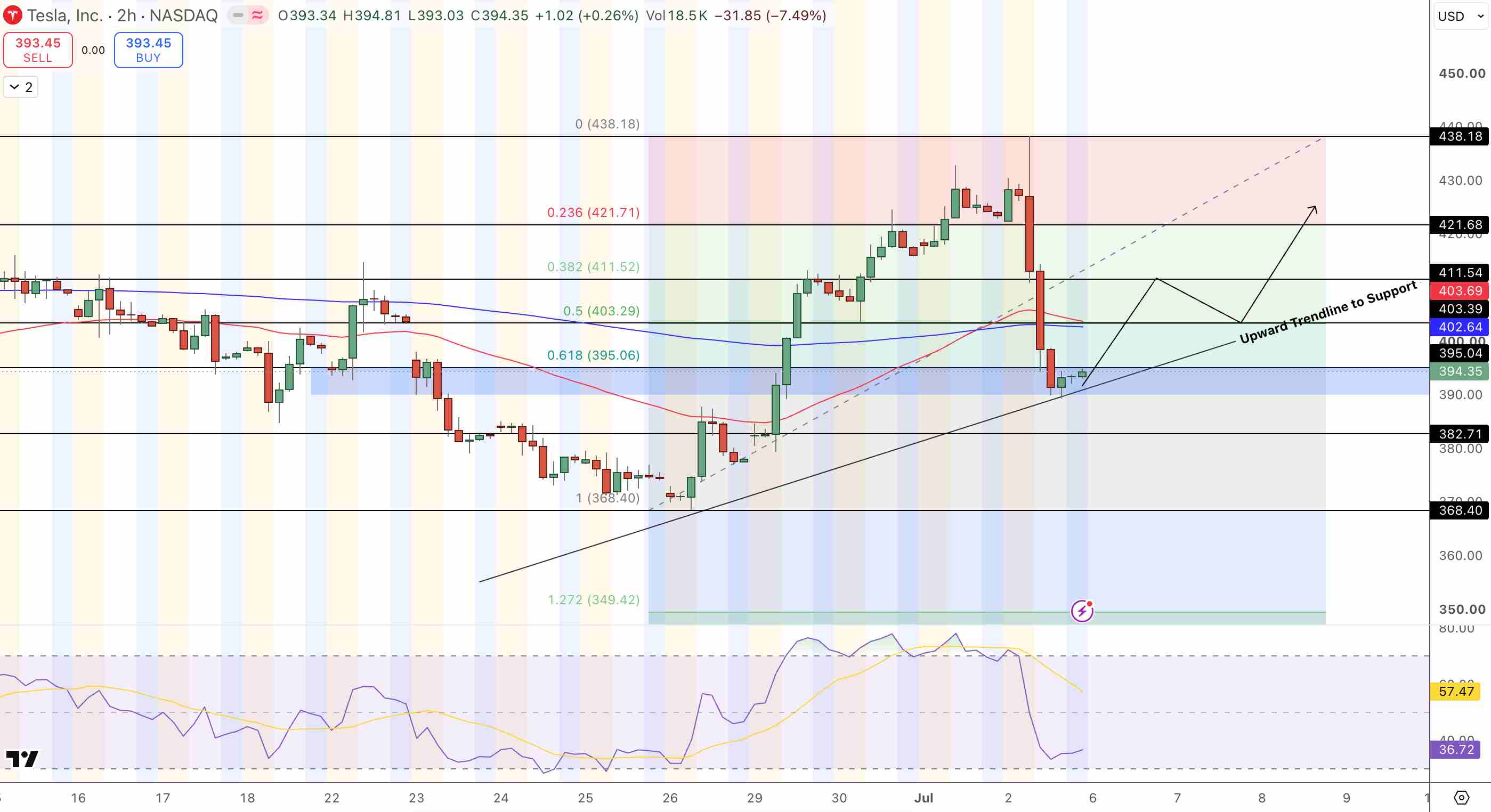
- Entry: Long above $403.30, cleared 0.5 Fib
- Target 1: $421.70, 0.236 Fib
- Target 2: $438.18, 0 Fib, prior high
- Stop Loss: Close below $368.40, trendline and 0.618 Fib fail
Key catalysts
- Q2 deliveries: 480,126 (+25% YoY, +18% vs. consensus)
- Energy deployments: 13.5 GWh (+40% YoY)
- Next earnings: July 22, 2026 (margins, Cybercab, FSD, and AI updates)
What Is the SpaceX Megapack Deal and Why Does It Matter?
In its IPO prospectus, the aerospace firm revealed that it spent $269 million on Tesla Megapacks in April 2026. It's a notable acquisition to be sure, particularly because both companies are controlled by Elon Musk, making it a related-party transaction rather than a typical commercial contract. Tesla also revealed that SpaceX purchased $131 million worth of Cybertrucks in 2025. While the Megapack order supports Tesla's growing energy storage business, the company did not highlight the contract in its Q2 delivery update. The earnings, though, are supposed to show up in Tesla's Q2 report on July 22. Investors will be looking to see whether this deal helped boost Tesla's record 13.5 GWh in energy storage deployments, up 40% from the year-ago quarter.
What Should Investors Watch at Tesla's July 22 Earnings?
Tesla's Q2 earnings report on July 22 will determine whether the company delivered a record 480,126 vehicles at the expense of margin. Automotive gross margin will be the key watch point. Any signs that automotive gross margin stayed close to the 17% to 18% range despite strong deliveries, it would indicate strong profitability despite an increase in supply and support Tesla's higher valuation. Investors also will be focused on updates for the Cybercab, FSD, and Optimus. More progress in the autonomous driving business and commercialization of the Cybercab likely will have a bigger impact on the stock than just vehicle deliveries and the associated revenue and profit.
Bottom Line
Tesla's Q2 deliveries exceeded Wall Street estimates by 74,102 vehicles. At the same time, inventory declined by around 28,000 vehicles. The increase in deliveries and decrease in inventory should be a sign that demand for the firm's vehicles is increasing. The test now is for Tesla to translate these record delivery numbers into profits.
In short, with Tesla's shares trading at around 204 times forward earnings, investors will focus on more than just delivery numbers. Key watchpoints are margins, Cybercab, FSD and Optimus, all of which will determine Tesla's future valuation. A delay on any of those could weigh on the stock more than subsequent delivery beats will support it.
Recommended Articles










Comments (0)
Click the $ button, enter the symbol, and select to link a stock, ETF, or other ticker.