


South Korea’s Kospi Index Rises Over 4.8%, Kospi 200 Futures Hit 5% Upside Circuit Breaker



AI Podcast


The South Korean stock market rebounded sharply on June 9, with the KOSPI rising 4.8% driven by semiconductor giants Samsung Electronics and SK Hynix. The Korea Exchange triggered its "sidecar" mechanism due to a 5% surge in KOSPI 200 futures. This rebound follows an over 8% plunge on June 8, and is attributed to a strong overnight semiconductor index performance, NVIDIA's AI cooperation deals with Korean firms, and President Lee Jae-myung's comments on the KOSPI being undervalued. Despite a narrow market breadth, high leverage in the market presents a significant risk of amplified sell-offs if the index reverses.

TradingKey - During the early Asian session on June 9, the South Korean stock market staged a sharp rebound. The KOSPI's early gains expanded to 4.8%, with Samsung Electronics and SK Hynix both rising by approximately 6%, leading the broader market. The Korea Exchange triggered its "sidecar" mechanism as KOSPI 200 futures surged 5%, suspending program trading for five minutes.
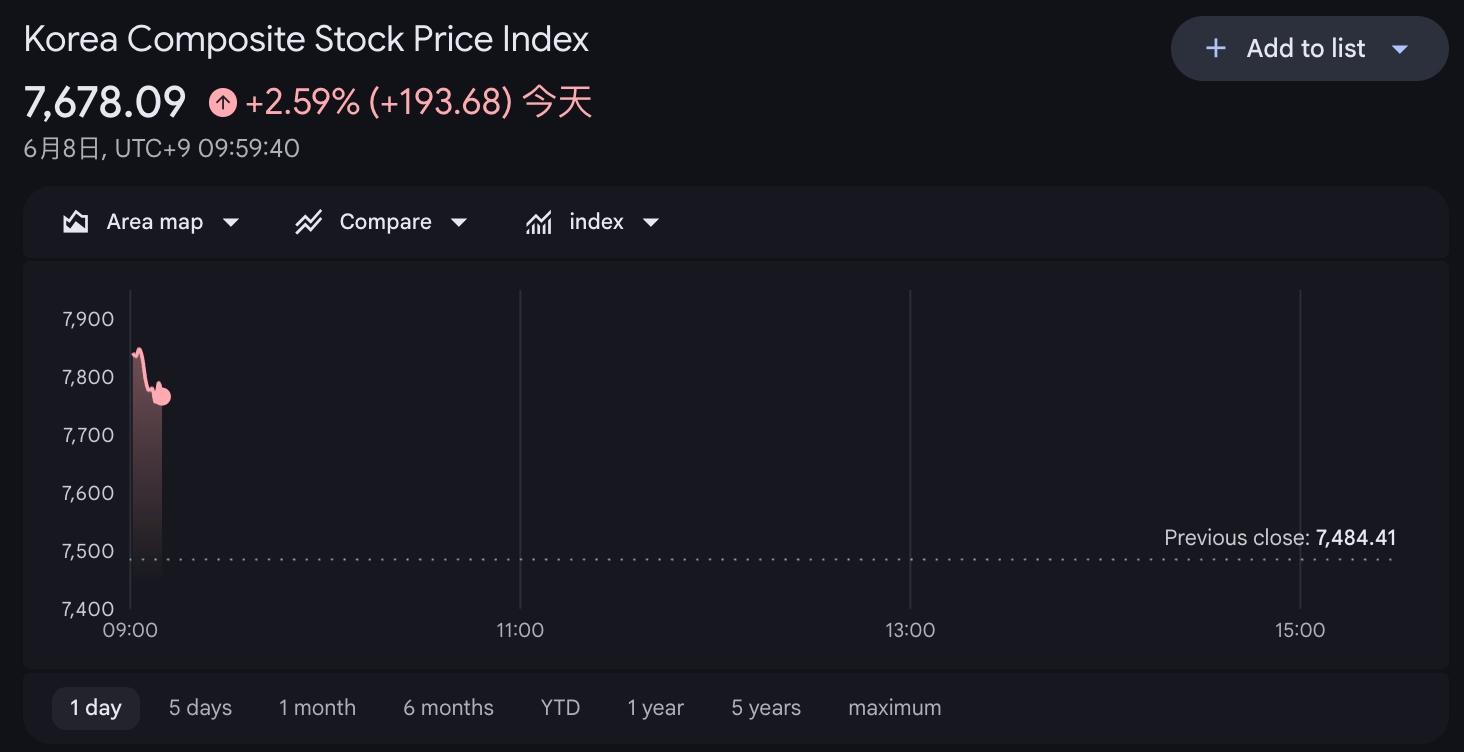
This marks the 11th time the Korea Exchange has triggered the buy-side sidecar mechanism since 2026. According to Korea Exchange rules, the sidecar mechanism is triggered when the KOSPI 200 futures price fluctuates by 5% from the previous session's settlement price for at least one minute, suspending the execution of program trading orders for five minutes.
In the previous trading session on June 8, the KOSPI index plummeted by more than 8% during Asian hours, triggering a circuit breaker that suspended trading for 20 minutes before closing at 7,484.41 points, its largest single-day decline since March 2024.
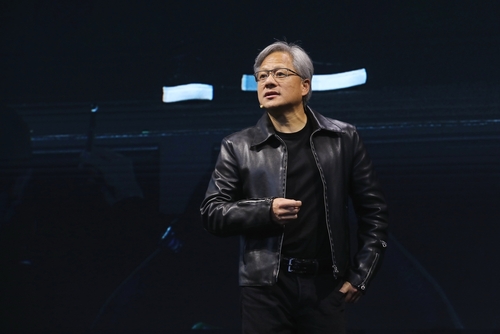
This rebound is primarily driven by a trio of factors. The strong overnight rebound in the Philadelphia Semiconductor Index, coupled with NVIDIA CEO Jensen Huang signing multiple AI cooperation agreements with South Korean companies, has bolstered investment confidence in the South Korean semiconductor supply chain.
South Korean President Lee Jae-myung explicitly stated at a press conference on June 8 marking his first anniversary in office that the KOSPI remains undervalued and that volatility stems partly from foreign portfolio rebalancing. He also revealed that the government will launch large-scale investment projects to identify new growth engines beyond the semiconductor sector.
Regarding the heavyweights driving the rebound, Samsung Electronics rose about 6% in early trading, while SK Hynix gained about 8%. Together, the two semiconductor giants have contributed approximately 72% of the KOSPI's year-to-date gains. However, market depth remains an issue; Reuters previously noted that while the Electrical and Electronics sub-index led with a gain of about 6%, only about 4% of KOSPI components are at record highs, making narrow market breadth a concern.
Caution is warranted as leverage in the South Korean stock market remains at historical extremes. As of June 5, the balance of margin trading was approximately 37.74 trillion won, and as of June 1, the balance of brokerage credit loans stood at approximately 27.8 trillion won, a 61.6% increase from the start of the year.
If the index reverses again, forced liquidations of high-leverage accounts will amplify the risk of a secondary sell-off. Goldman Sachs previously suggested that the South Korean market was poised for a rebound after the crash due to strong fundamentals, though short-term volatility remains unavoidable.
This content was translated using AI and reviewed for clarity. It is for informational purposes only.
Recommended Articles





Comments (1)
Click the $ button, enter the symbol, and select to link a stock, ETF, or other ticker.