


South Korea’s KOSPI Index Plunges Over 8% in Early Trade Triggering Circuit Breaker, Samsung and SK Hynix Both Fall 10%



AI Podcast


The South Korean KOSPI index experienced a significant plunge, triggering a 20-minute trading halt amid widespread stock collapses. The decline was driven by a combination of macro concerns, including stronger-than-expected U.S. non-farm payrolls fueling fears of further Federal Reserve rate hikes, and industry-specific issues like Broadcom's AI chip sales guidance miss. The KOSPI's heavy concentration in semiconductor stocks, particularly Samsung Electronics and SK Hynix, amplified losses. High retail margin debt heightened vulnerability to margin calls. South Korean financial authorities have pledged intervention, while currency pressure accelerates foreign outflows and market volatility endures.
TradingKey — During early Asian trading on June 8, the South Korean KOSPI index saw its opening losses widen to 8.37%, breaking below the psychological 7,500 level. The Korea Exchange announced a 20-minute trading halt as the KOSPI triggered circuit breakers following the sharp drop. Heavyweight stocks collapsed across the board, with Samsung Electronics and SK Hynix both plunging 10% intraday, leading the broader market lower.
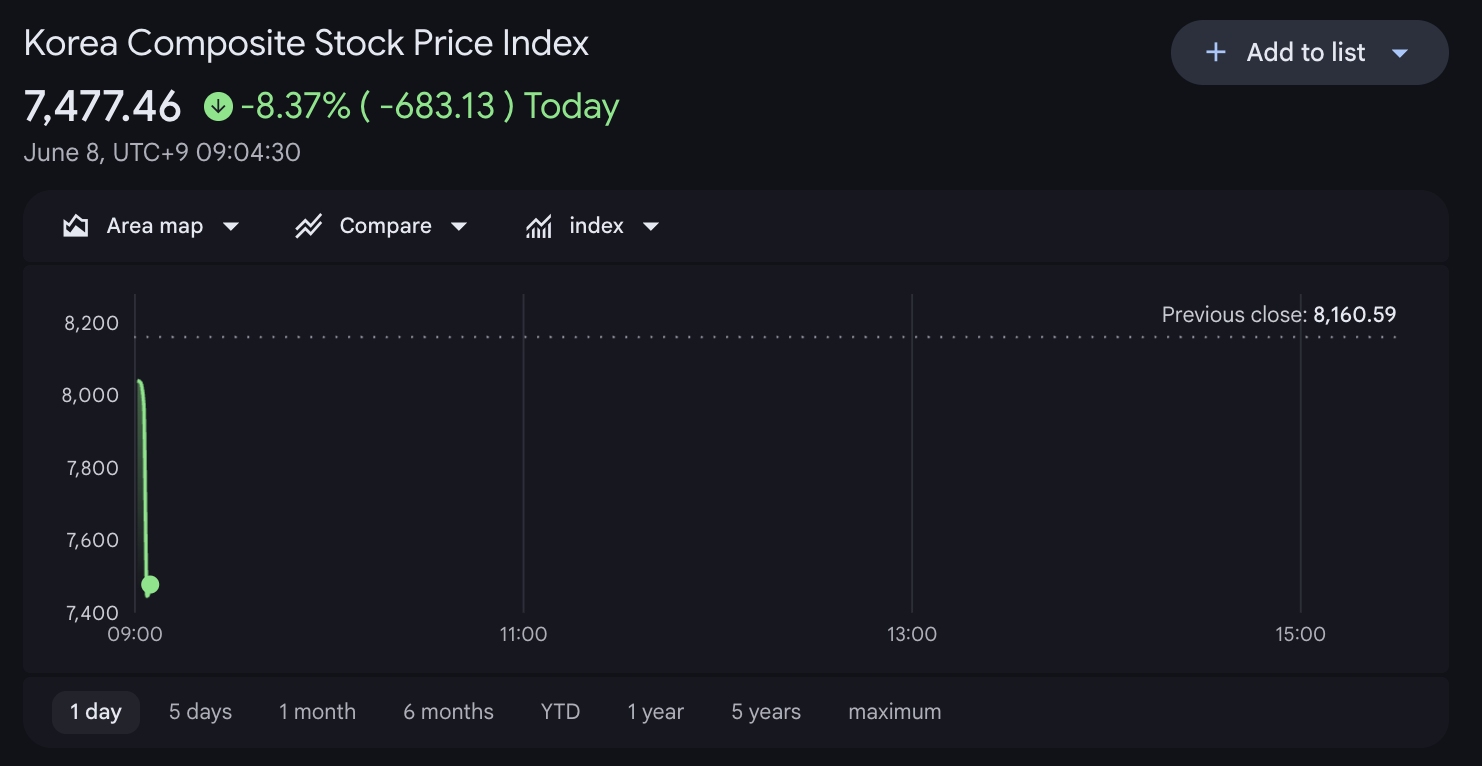
Last Friday, the KOSPI had already tumbled 5.54%, while KOSPI night session futures closed at their 8% daily limit-down.
In terms of market news, the three major U.S. indices collectively closed lower last Friday. The Dow fell 1.35%, while the S&P 500 dropped 2.64%, marking its largest single-day decline since October 2025; the Nasdaq plummeted 4.18%, its biggest one-day drop since April 2025.
The Philadelphia Semiconductor Index plummeted 10.26% in a single day, its largest single-day decline since March 2020, as chip stocks including Broadcom, Micron Technology, and Marvell Technology were hammered across the board.
Market panic spread rapidly across borders; with its heavy weighting in semiconductor stocks, the South Korean market became one of the region's worst-performing indices.
The catalyst for this sell-off was a confluence of multiple factors. On the macro level, U.S. non-farm payrolls for May significantly beat expectations, fueling concerns that the Fed might resume rate hikes. The 10-year Treasury yield climbed back above 4.5%, as the high-interest-rate environment directly pressured risk asset valuations.
At the industry level, Broadcom’s AI chip sales guidance failed to meet the market’s sky-high expectations, triggering a massive sell-off across the semiconductor sector after its shares plunged in post-market trading.
The South Korean market’s own structural vulnerabilities exacerbated the losses. Samsung Electronics and SK Hynix together account for approximately half of the KOSPI’s total market capitalization, representing an extreme concentration in a single sector.
As of June 4, retail margin debt remained at historical highs, totaling 37.74 trillion won. Sharp declines in stock prices make highly leveraged accounts susceptible to margin calls and forced liquidations.
South Korean financial authorities have signaled strong intervention. The Finance Minister, along with the central bank and financial regulators, issued an emergency statement vowing to take immediate action against excessive volatility if necessary, while warning of leverage risks. Korea Investment & Securities announced a suspension of margin trading after exhausting its credit limits.
As of now, the South Korean won has fallen to near 1,560 per dollar, with currency pressure accelerating foreign capital outflows. Volatility in South Korea’s financial markets persists.
This content was translated using AI and reviewed for clarity. It is for informational purposes only.
Recommended Articles







Comments (0)
Click the $ button, enter the symbol, and select to link a stock, ETF, or other ticker.