


Gold Price Forecast: Waller’s Speech Weakens Rate Hike Expectations, Can Gold Resume Its Rise? Non-Farm Payrolls Become Key



AI Podcast


As of the Asian session on July 2, gold prices fluctuate around $4,050, supported by cooling U.S. interest rate hike expectations following Fed Governor Waller’s remarks and weaker-than-expected June ADP payroll data. While easing U.S.-Iran tensions provide support, the overall trend remains bearish with lower highs and lows. Investors are now focused on upcoming non-farm payrolls, which will dictate further rate policy. Despite short-term rebound potential, resistance remains at $4,070–$4,120. Analysts suggest a strategy of shorting on rallies, as failure to breach $4,120 could lead to a retest of $3,900 support levels.
TradingKey - As of the Asian session on July 2, gold prices ( XAUUSD) fluctuated around $4,050, continuing to strengthen slightly from yesterday. Looking at the chart, gold prices dipped to $3,959.64 on Wednesday but still closed firmly above $4,000, indicating that substantial bargain-hunting buying near $4,000 is supporting gold prices. The main factors driving the recent recovery and rebound in gold prices are: on one hand, Fed Governor Waller's speech on Wednesday eased market concerns over further interest rate hikes; on the other hand, Trump's statement that the US and Iran have started talks has cooled tensions in the Middle East once again, driving gold prices higher.
Expectations for further Fed rate hikes cool, US-Iran talks make progress, and market focus shifts to non-farm payrolls.
From a fundamental perspective, Waller's speech on Wednesday was the core driver of the gold rebound.
Speaking at the Bank of Portugal Forum, Waller noted that recent inflation risks and inflation expectations have receded, while emphasizing that the Federal Reserve remains committed to bringing inflation back down to its 2% target. For the market, this stance was not entirely dovish, but it weakened the urgency for the Fed to hike rates further immediately.
As a non-interest-bearing asset, gold is highly sensitive to real interest rates and Treasury yields. Following Waller's remarks, short-term Treasury yields fell back temporarily and the dollar's rally slowed down, reducing the opportunity cost of holding gold. Meanwhile, U.S. ADP data showed that private sector payrolls added just 98,000 jobs in June, coming in below market expectations and further reinforcing signs of a cooling U.S. labor market. Affected by this, gold broke out of its previous weakness below $4,000, at one point surging above $4,100 during intraday trading.
In addition, Trump's remarks on U.S.-Iran talks are also providing support for gold prices. Trump recently stated that the U.S. and Iran are "getting along very well" and said that the recent talks in Qatar went smoothly, with progress being made on Iran's denuclearization. From the perspective of inflation and interest rates, an easing of U.S.-Iran relations helps reduce transit risks in the Strait of Hormuz and upward pressure on oil prices, which could lower inflation expectations and thus indirectly benefit gold.
For investors, the key focus today will be the release of the June non-farm payrolls report. The market currently expects the U.S. to add about 110,000 non-farm jobs in June, significantly lower than the 172,000 in May, with the unemployment rate expected to hold steady at around 4.3% and average hourly earnings growing at a month-on-month pace of 0.3%. If the payrolls data falls short of expectations, particularly if job growth dips below 100,000 and wage growth slows, expectations for Fed rate hikes may cool further, which could pull down the dollar and Treasury yields and give gold a chance to challenge the level above $4,100. Conversely, if payrolls are significantly stronger than expected, indicating that the U.S. labor market remains resilient, pressure on the Fed to keep rates high or even continue raising them will rise again, potentially causing gold to give back yesterday's gains.
Gold Price Analysis: Overall Trend Biased Downward, Upside Potential for Gold Prices Remains Limited
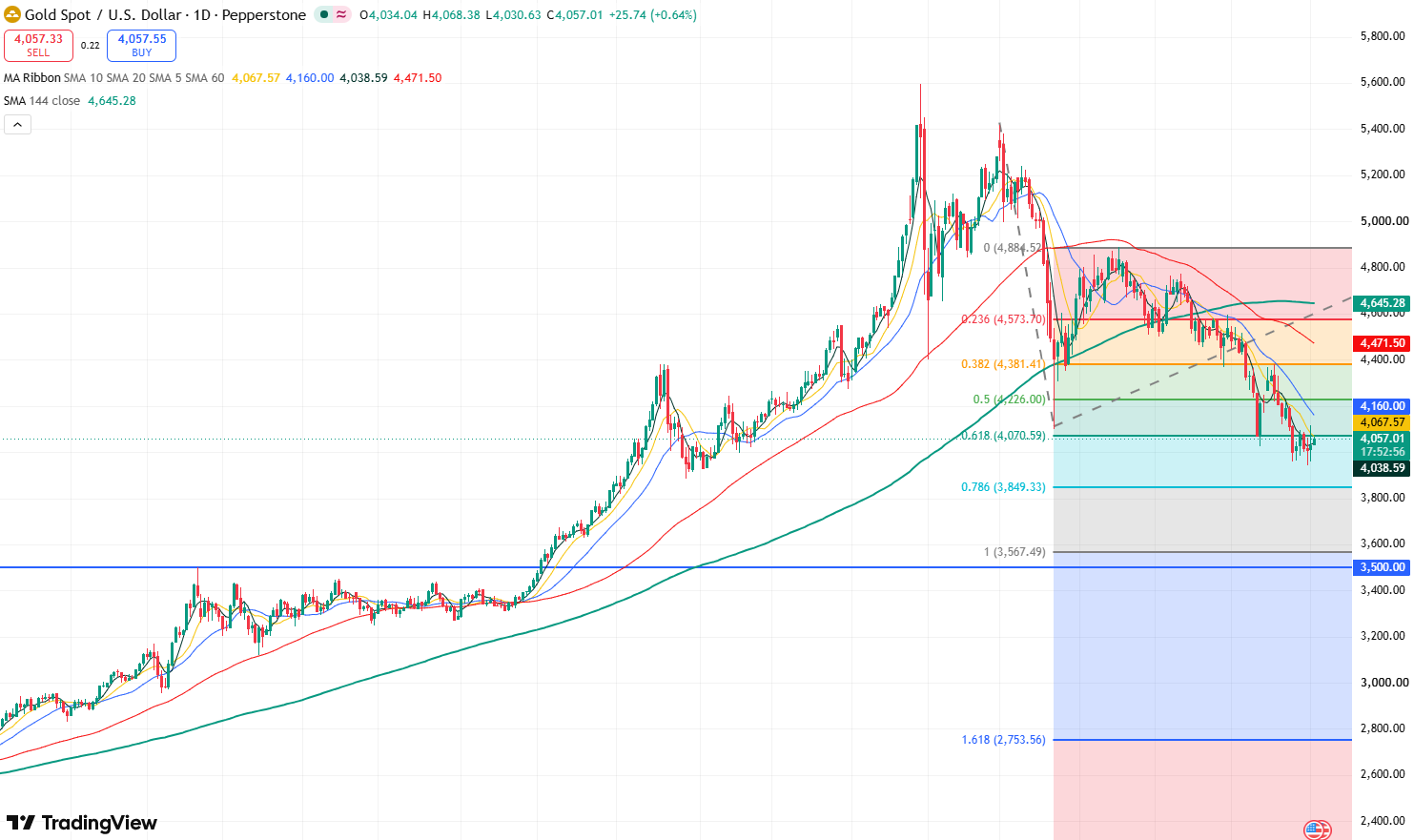
Gold Price Daily Chart, Source: TradingView
Looking at the daily chart of gold, the gold price has been fluctuating around $4,000 in recent trading sessions. Although it briefly dipped below $4,000 intraday, the closing price remained firmly above $4,000, indicating that buy-on-dip demand from market bulls is providing support. In the short term, the gold price may continue to rebound.
In terms of the overall trend, the recent candlestick pattern for gold shows a continuous series of lower highs and lower lows, indicating that the overall trend is downward. Furthermore, the moving average system exhibits a bearish alignment, which further underscores the strong persistence of this downtrend.
Currently, the daily chart of gold faces a resistance zone of $4,070–$4,120. If the gold price can successfully break out and establish a firm foothold above $4,120, it could further rebound toward the resistance level of $4,200–$4,230. Conversely, if it remains under pressure below $4,120, the gold price is likely to extend its downtrend and further test the support level at $3,900.
In terms of trading strategy, it is recommended to wait for the gold price to rebound near the resistance level and show signs of weakness, with a primary focus on shorting on rallies.
This content was translated using AI and reviewed for clarity. It is for informational purposes only.
Recommended Articles










Comments (0)
Click the $ button, enter the symbol, and select to link a stock, ETF, or other ticker.