


US-Iran Rift Persists, Will Gold Rise or Fall Next?



AI Podcast


US-Iran tensions drive gold volatility, with $4,400 the critical support level. Inconsistent narratives on negotiations, coupled with Brent crude exceeding $100/barrel, create headline-driven price swings. Elevated oil prices heighten inflation concerns, but the market interprets this as a signal for prolonged higher interest rates, suppressing gold's appeal despite its inflation-hedging properties. Technically, gold is retesting the $4,400-$4,380 support zone. A break below this could target $4,099, while holding above it may lead to retesting $4,650. Gold's short-term performance remains news-dependent, while long-term allocation logic persists.

TradingKey - US-Iran tensions persist; $4,400 becomes the gold ( XAUUSD) bulls' make-or-break level.
During the European session on March 26, as of press time, spot gold retreated 1.5% to $4,436.42 per ounce.
The core conflict in the market remains the same old issue: Trump claims Iran is eager to reach a deal, while the Iranian Foreign Minister explicitly denies that ceasefire negotiations are underway, causing the market to continue re-pricing based on Middle East developments.
Fundamentals
From a fundamental perspective, gold's volatility today is essentially driven by three factors acting simultaneously: geopolitical news, oil prices, and interest rate expectations.
While the market monitors the progress of ceasefire negotiations in the Middle East, it has found that the narratives from the U.S. and Iran are completely inconsistent. The U.S. emphasizes that Iran is "eager to reach a deal," while Iran states it has merely received and is evaluating the U.S. proposal without agreeing to direct talks. This situation is delicate—there is news but no consensus—resulting in a market that reacts solely to headlines, leading to short-term fluctuations in gold prices.
Meanwhile, Brent crude has climbed back above $100 per barrel. Concerns are growing that if energy transport through the Strait of Hormuz is obstructed, oil prices will continue to rise, which in turn would push up inflationary pressures.
In theory, rising oil prices should strengthen gold's inflation-hedging properties. In reality, however, the market is primarily trading on the premise that "rising inflation means it will be harder to cut interest rates." This explains why gold remains suppressed by high yields and a strong dollar despite safe-haven buying.
Currently, higher oil prices do not necessarily translate to a stronger gold price; at this stage, elevated oil prices are doing more to heighten gold's volatility than to drive a direct unilateral rally.
Regarding interest rate expectations, the Federal Reserve's latest policy decision kept rates unchanged while maintaining a cautious stance on inflation. Traders have almost entirely priced out the possibility of a "rate cut this year"; whereas before the conflict erupted, the market had anticipated at least two cuts.
For gold, this shift is critical because it is a non-yielding asset; higher rates for a longer duration weaken its relative appeal. Consequently, every recent gold rally has been suppressed by the "higher for longer" narrative.
Gold is no longer a simple safe-haven asset. As long as Brent remains near $100 and the market remains skeptical of imminent Fed rate cuts, gold will struggle to rally as smoothly as it did in previous months. However, should Middle East tensions escalate further or fears of runaway inflation and policy failure intensify, gold prices will immediately regain their elasticity.
In the short term, gold is best understood as a high-volatility, news-driven instrument. In the medium term, as long as global fiscal pressures and reserve diversification trends remain unchanged, the logic for its long-term allocation remains intact.
Technical Analysis
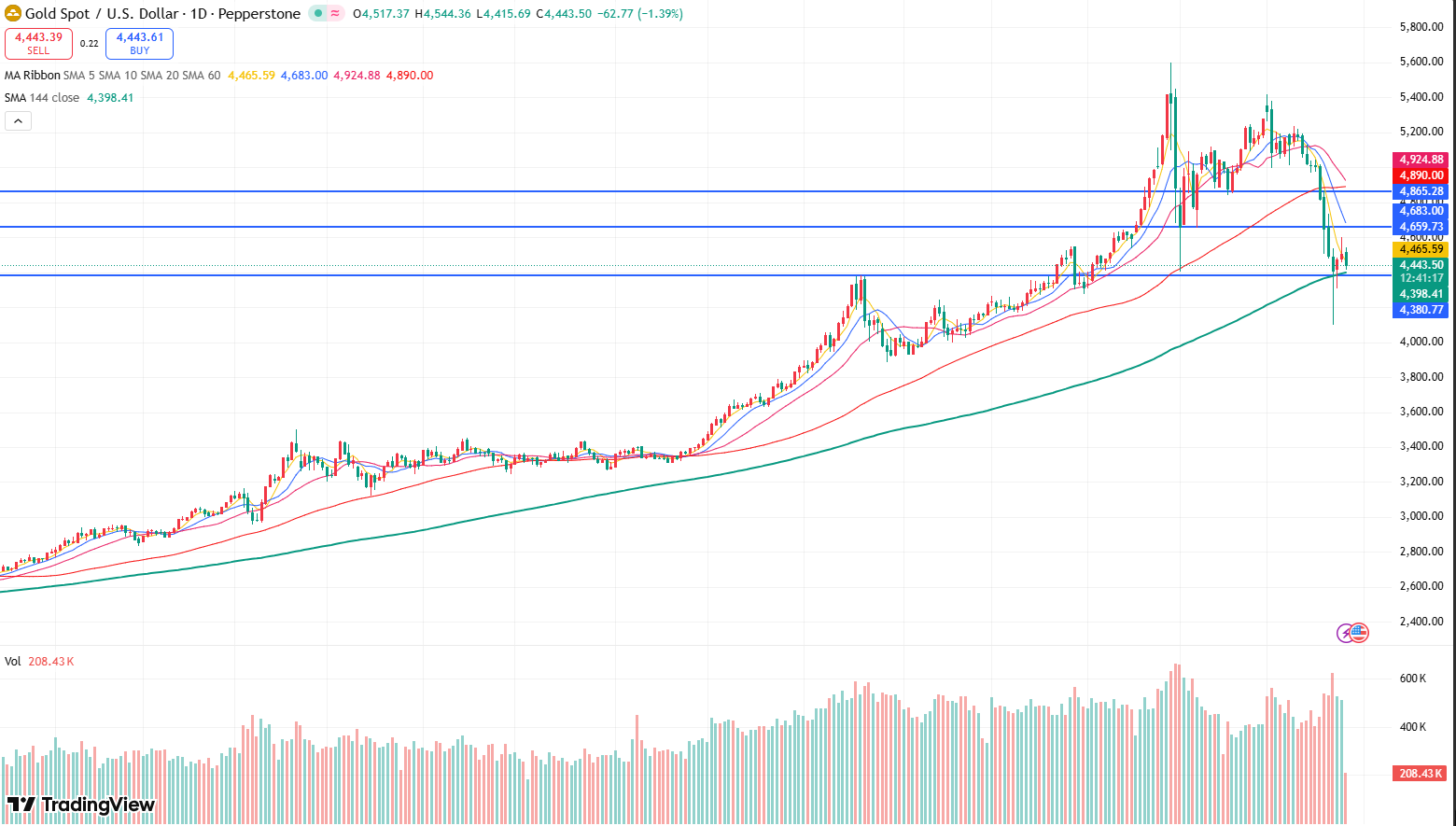
From a technical perspective, gold is currently in a technical recovery phase following a significant pullback from its highs. After a sharp drop on March 23, gold rebounded quickly, with the daily close holding above the key support level of $4,380 and the 144-day moving average, suggesting that the overall uptrend remains intact. Subsequently, gold maintained its rebound for two consecutive trading days, further confirming the importance of the $4,380 support level.
After rebounding to the $4,600 mark yesterday, gold encountered pressure and fell back. It has maintained a weak downward trend today, retesting the $4,400-$4,380 support zone.
Source: TradingView
On the chart, the $4,400-$4,380 range has become a highly sensitive psychological level. If prices repeatedly fail to hold this level, the market will continue to view it as a weak bounce, potentially opening up room for deeper declines. Conversely, if the price repeatedly tests the $4,400-$4,380 zone in the short term but continues to close above it, the market may conclude that a short-term bottom has been successfully formed and that selling pressure has been fully absorbed.
To the downside, if gold's daily close falls below $4,380, it may continue to test the March 23 low of $4,099.02 in the short term. A break below this level could lead to a test of the $4,000 psychological mark, and potentially even the $3,900 support level.
To the upside, if gold's daily close holds steady above $4,380, it will continue to test the $4,650 resistance level, followed by the $4,860 resistance level.
Support Levels: 4,400, 4,380
Resistance Levels: 4,650, 4,860
Recommended Articles







Comments (0)
Click the $ button, enter the symbol, and select to link a stock, ETF, or other ticker.