


Today’s Market Recap: Mideast Conflict Ignites Oil Crisis as Tech Pivots to AI and Buybacks



Track the Market Trend
TradingKey - Market performance was mixed on Tuesday as major indices diverged. The S&P 500 slipped 0.22% to settle at 6,781, while the Nasdaq Composite managed a fractional gain of 0.01%, closing at 22,697.
The airline sector faced downward pressure as investors grappled with rising fuel costs and potential risks to travel demand. Delta Air Lines (DAL) dropped 2.16% to $59.27, and United Airlines (UAL) fell 3.68% to $91.05. American Airlines Group (AAL) also declined, shedding 2.88% to close at $11.11 following analyst price target cuts. Trading volume for AAL was heavy, reaching 128.7 million shares — 108% above its three-month average. Notably, since its 2005 IPO, American Airlines has seen its value decrease by 42%.
In the technology sector, Oracle (ORCL) ended the regular session down 1.43% at $149.40 but surged in after-hours trading after reporting a Q3 revenue beat and an optimistic outlook. Memory-related stocks remained a bright spot; Micron Technology (MU) gained momentum following the announcement of a strategic partnership with Applied Materials (AMAT). Conversely, Salesforce (CRM) declined on reports from Bloomberg that the company intends to raise $25 billion to fund share buybacks.
The biotech sector saw a significant sell-off in BioNTech (BNTX), which plunged 17.88% to $83.89. The sharp decline followed disappointing earnings and the news that its two co-founders will step down at the end of 2026.
Nvidia (NVDA) provided a boost to the tech sector, rising 1.16% to close at $184.77. Investor sentiment remained positive regarding its enterprise AI software platform and the highly anticipated updates expected at the GTC 2026 conference next week. The stock saw a trading volume of 177.6 million shares. Since its 1999 IPO, Nvidia has delivered a staggering lifetime return of 450,373%.
In the electric vehicle space, China-based Nio (NIO) soared 15.38% to $5.70. The rally was fueled by a strong fiscal Q4 2025 earnings report (ending Dec. 31, 2025), which featured Nio’s first-ever quarterly net profit alongside significant beats on revenue and EPS. Volume spiked to 145.1 million shares, roughly 233% above its three-month average. Despite the recent surge, the stock remains 14% below its 2018 IPO price.
Market Headline
Tehran has declared its military operations have entered a "completely new stage," asserting it has deployed hypersonic missiles and will no longer trust any American promises. In response, Donald Trump warned Iran against mining the Strait of Hormuz, stating such actions would carry severe consequences. While the U.S. Energy Secretary briefly claimed the U.S. military successfully escorted a tanker through the strait — a post that was quickly deleted and dismissed by Iran as a lie — the White House confirmed no such escort took place. However, the U.S. military reported striking 16 Iranian minelaying vessels near the strait. Meanwhile, the U.S. has reportedly urged Israel to cease attacks on Iranian energy infrastructure.
Diplomatically, the leaders of the UK, Germany, and Italy held a call, agreeing that keeping the Strait of Hormuz open is critical and pledging close cooperation against Iranian threats. Concurrently, G7 officials requested that the IEA update its reserve data to study potential oil release details, though an IEA special meeting reportedly failed to reach a consensus on a coordinated release.
Conflicting signals regarding negotiations and escalation emerged as Donald Trump noted that while Iranian leaders are eager to talk, any potential negotiation remains strictly conditional. Conversely, U.S. Defense Secretary Pete Hegseth announced that the U.S. would launch the "highest intensity" strikes of the current campaign against Iran. Iran’s Parliament Speaker maintained a defiant stance, stating the country is not seeking a ceasefire and intends to deliver a decisive blow to deter future aggression.
The energy crisis has intensified as a "production shutdown" spreads across the Middle East. Four nations — Saudi Arabia, Iraq, the UAE, and Kuwait — have slashed their combined crude output by as much as 6.7 million barrels per day (bpd). This includes a massive 2.9 million bpd reduction from Iraq and 2 to 2.5 million bpd from Saudi Arabia. Total cuts represent roughly one-third of their collective capacity and approximately 6% of global supply.
In the corporate sector, Samsung Electronics and SK Hynix are set to cancel over $14 billion in treasury shares, marking one of the largest buyback cancellations in South Korean history. Samsung will cancel 87 million shares in the first half of the year, while SK plans to cancel approximately 4.8 trillion won worth of treasury shares, representing 20% of its outstanding capital.
Oracle saw its shares jump 10% in after-hours trading following a stellar third-quarter report fueled by surging AI demand. For the first time in 15 years, both revenue and EPS grew by over 20% in a single quarter. Cloud revenue rose 44%, led by an 84% spike in IaaS revenue, while Remaining Performance Obligations (RPO) surged 325% to $553 billion. Oracle raised its fiscal 2027 revenue guidance to $90 billion and expects no further debt issuance in the 2026 calendar year.
SpaceX is reportedly leaning toward a Nasdaq IPO with a potential valuation of $1.75 trillion, contingent on being fast-tracked into the Nasdaq 100 index. A new proposal by Nasdaq could allow the company to join the index in as little as one month if its market cap ranks within the top 40 components, a move designed to trigger massive passive fund inflows to support the stock price.
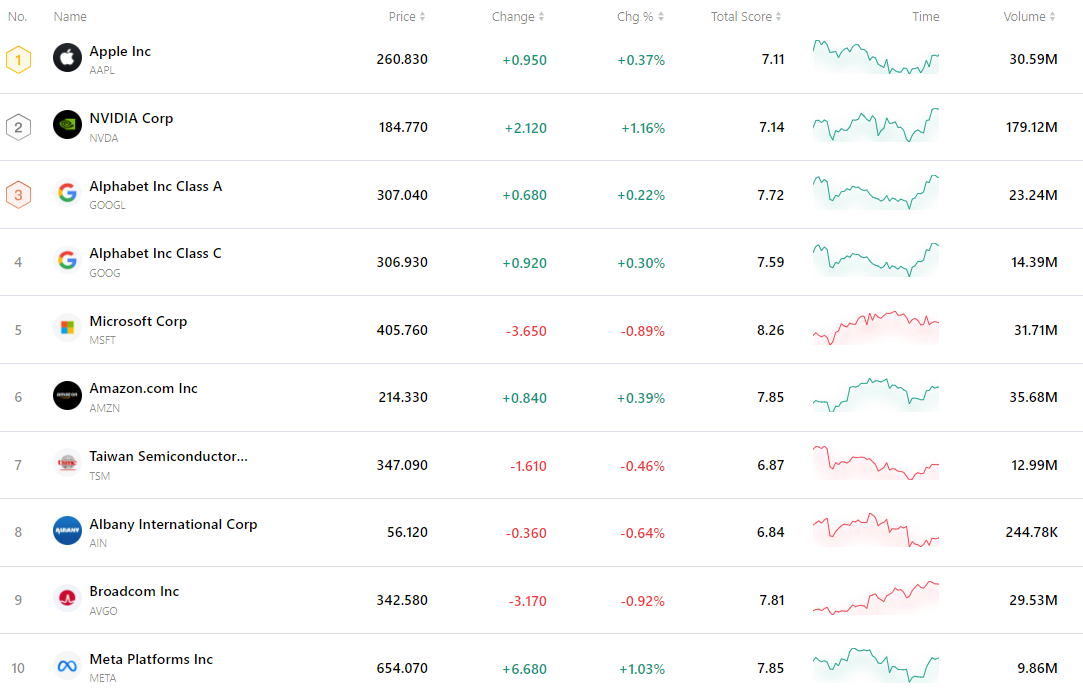
Top 10 Most Traded Stocks
The chart below lists the ten most actively traded stocks in the market. Due to their massive trading volumes and high liquidity, these stocks serve as critical benchmarks for tracking global market dynamics.
Recommended Articles








Comments (0)
Click the $ button, enter the symbol, and select to link a stock, ETF, or other ticker.