


Today’s Market Recap: Tech Bulls Retreat on AI Risks, Precious Metals and Energy Prices Spike



Track the Market Trend
TradingKey - On February 3, 2026, the S&P 500 retreated 0.85% to finish at 6,917, while the Nasdaq Composite saw a steeper 1.43% decline to 23,255. Within the software infrastructure sector, Microsoft (MSFT) ended the day at $411.21, down 2.87%, and Oracle (ORCL) slipped 3.41% to $154.6, as the market evaluated the rising costs associated with AI development.
Shares of Palantir Technologies (PLTR), a specialist in data analytics and integration for public and private sectors, jumped 6.85% to close at $157.88. This surge followed a strong quarterly report and positive analyst feedback regarding record Q4 performance and robust AI demand. The focus for investors remains on whether the company’s 2026 outlook indicates a period of long-term revenue growth.
Global payments provider PayPal (PYPL) plummeted 20.31% to $41.70 during Tuesday's session. The sell-off was triggered by disappointing Q4 2025 results and weak profit projections for 2026. Market participants are now observing how the current management team and upcoming capital-return strategies will impact future margins and expansion.
Rocket Companies (RKT), which operates a digital real estate and mortgage platform, rose 8.42% to $20.35. The stock's climb came after its CEO noted an increase in mortgage loan activity, providing a signal that the housing sector may be entering a recovery phase.
The cryptocurrency market experienced a sharp downturn, with Bitcoin at one point sliding over 7% to hit a new low since last April. Ethereum also tumbled nearly 9%, nearing the $2,100 mark. Although both major tokens saw a significant recovery before the session ended, they both finished the day lower.
Spot gold surged by 6.2%, momentarily nearing the $5,000 threshold. Silver experienced a 12% intraday peak before pulling back to finish with a gain of over 7%. Meanwhile, crude oil climbed over 2% following news that an Iranian drone was downed by the U.S. military in the Arabian Sea.
Market Headline
Anthropic's latest AI breakthroughs triggered a widespread sell-off across the software sector as investors weighed the threat of technological disruption. Shares of Reuters (TRI) witnessed a dramatic intraday plunge exceeding 20%, with legal and data service providers feeling the most significant pressure. Morgan Stanley analysts noted that Anthropic’s entry into the legal tech space has heightened competitive fears. A trader at Jefferies described the SaaS market environment as a "doomsday" scenario where positions were liquidated regardless of price. The consensus remains that if industry leaders like Microsoft are struggling, the outlook for smaller, more vulnerable firms is increasingly grim.
AMD (AMD) shares dipped more than 7% in after-hours trading as a cautious first-quarter forecast overshadowed record-breaking fourth-quarter results. The company reported a historic revenue milestone of $10 billion, fueled by its data center segment which surged 40% to reach $5.4 billion. While earnings per share exceeded consensus by 16%, the projected Q1 revenue of $9.8 billion fell short of high-end market expectations. Furthermore, while the MI308 chip saw strong demand in China, export restrictions are expected to cost the company $440 million by 2025. Despite these hurdles, the CEO reaffirmed a long-term goal of 60% annual growth in the data center business.
Nvidia (NVDA) CEO Jensen Huang dismissed rumors of a rift with OpenAI, confirming the company’s participation in what he called the largest private funding round in history. Rebutting claims that their massive collaborative deal had stalled, Huang reiterated that the partnership is progressing as planned. This follows Sam Altman’s recent praise for Nvidia’s hardware, which he described as the premier choice for AI development. Nevertheless, Nvidia's stock faced downward pressure, sliding over 4% on Tuesday as the market continued to react to earlier reports of potential friction between the two tech giants.
SpaceX formally merged with xAI to integrate artificial intelligence with aerospace exploration, positioning the combined entity for a potential $1.5 trillion valuation. An internal memo confirmed the consolidation of Elon Musk’s AI and space ventures, a move intended to streamline assets ahead of a public listing. For Google, this development is particularly lucrative; its 7.4% stake, born from an initial $900 million investment, is now projected to reach a value of $111 billion. This 120-fold return highlights how Alphabet has quietly secured a dominant position in future infrastructure while capturing massive unrealized gains from the xAI-driven valuation surge.
Novo Nordisk (NVO) shares plummeted over 10% after the company projected its first annual revenue decline in nine years for 2026. The pharmaceutical giant expects sales to drop by 13% that year, significantly worse than the 1.4% decline analysts had modeled. While current demand for the weight-loss drug Wegovy remains high, the company cited increasing pricing pressure in the United States as a major headwind. Although the global market for GLP-1 medications is still growing, Novo Nordisk anticipates that a rise in sales volume will be unable to offset the impact of lower net selling prices.
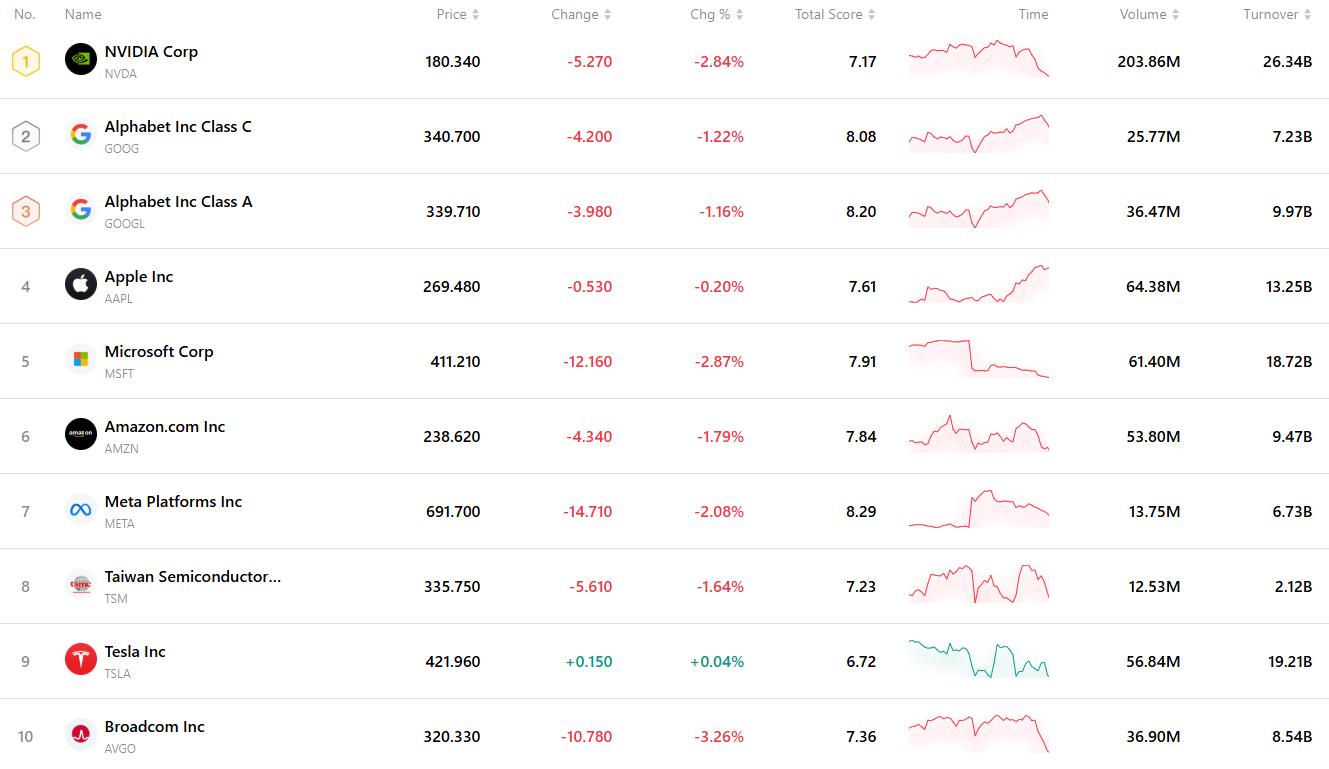
Top 10 Most Traded Stocks
The chart below highlights the ten most actively traded stocks in the current market. With their substantial trading volumes and high liquidity, these names serve as key benchmarks for tracking global market dynamics.
Recommended Articles





Comments (0)
Click the $ button, enter the symbol, and select to link a stock, ETF, or other ticker.