


NZD/USD (NZDUSD) Drops 0.54% on Jun 24: What You Need to Watch



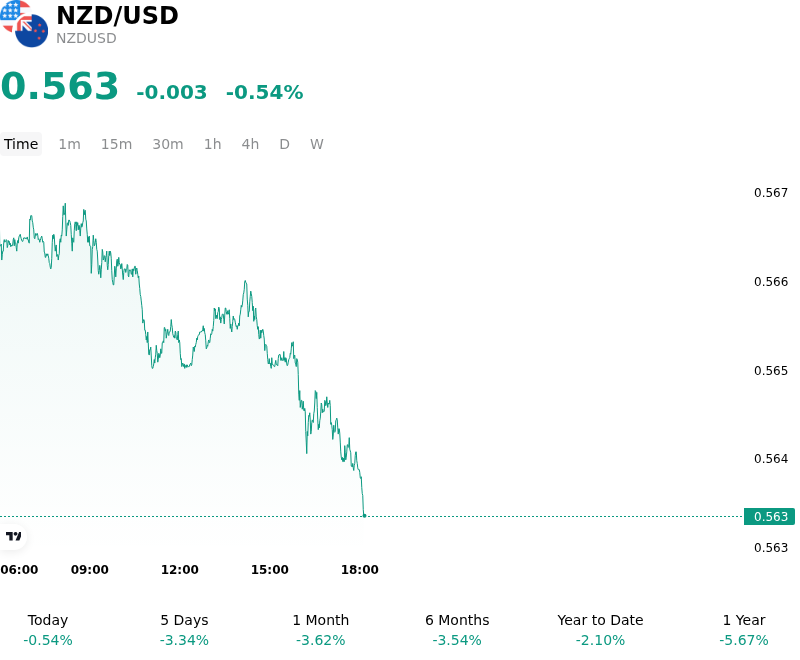
NZD/USD (NZDUSD) is down 0.54% at Jun 24 06:10(ET), now at $0.56342, with a 7-day down of 2.30%.
What is driving NZD/USD (NZDUSD)’s stock price down today?
The New Zealand Dollar depreciated against the US Dollar as a combination of a hawkish repricing of Federal Reserve rate expectations, rising risk-off sentiment driven by geopolitical tensions, and technical breakdowns weighed on the high-beta currency.
The primary catalyst behind the broad-based strength of the US Dollar was the market’s ongoing digestion of the Federal Reserve’s hawkish stance from its June policy meeting. In the wake of the nomination of Kevin Warsh to lead the central bank, policymakers maintained a restrictive posture, with Warsh reaffirming a strong commitment to returning inflation to the two percent target. Investors have significantly adjusted their rate projections, with futures markets now pricing in an eighty-six percent probability of an interest-rate hike in December, up from sixty-one percent prior to the meeting. This hawkish shift has driven US Treasury yields higher and widened the interest-rate differential in favor of the greenback, particularly given that the Reserve Bank of New Zealand has kept its official cash rate steady at two point twenty-five percent.
Geopolitical developments in the Middle East have further depressed demand for cyclical, commodity-linked currencies like the New Zealand Dollar. Conflicting headlines regarding potential Iranian nuclear inspections and warnings over maritime activity in the Strait of Hormuz have triggered a wave of risk aversion across global markets. As risk-off sentiment dominated the trading session, institutional capital flowed out of sensitive growth currencies and into safe-haven assets, with the US Dollar being the primary beneficiary.
Additionally, weakening commodity dynamics are compounding the pressure on the Kiwi. A growing market consensus that global inflation has peaked has dampened the outlook for New Zealand’s key commodity exports, eroding the currency’s terms of trade.
From a technical perspective, the pair's decline accelerated after breaking through a key support level near zero point fifty-six eighty-five. This technical breakdown triggered automated sell stops, fueling downward momentum and pushing the pair toward major multi-month lows as the bearish trend continues to dominate short-term price action.
Technical Analysis of NZD/USD (NZDUSD)
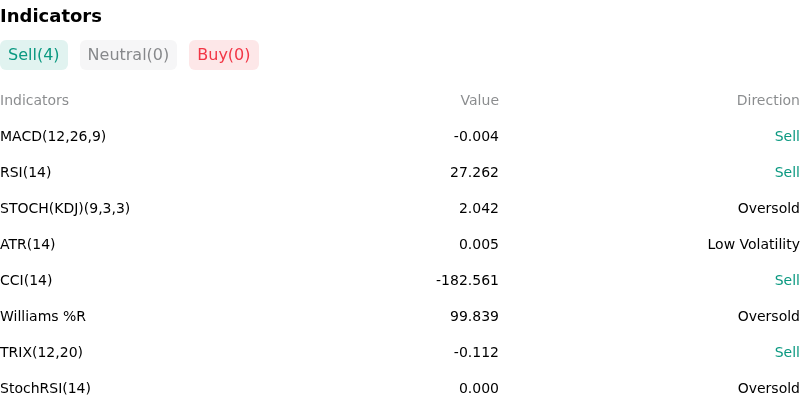
Technically, NZD/USD (NZDUSD) shows a MACD (12,26,9) value of -0.004, indicating a sell signal. The RSI at 27.262 suggests sell condition and the Williams %R at 99.839 suggests oversold condition. Please monitor closely.
More details about NZD/USD (NZDUSD)
Recent Events and Risks:
- Hawkish FOMC Outlook and Surging US Yields: Following the June Federal Open Market Committee meeting under the leadership of Fed Chair nominee Kevin Warsh, aggressive hawkish repricing has pushed the probability of a December US rate hike to over 86%. The resulting rise in US Treasury yields has driven the US Dollar Index (DXY) to its highest levels in over a year, exerting severe downward pressure on NZD/USD and dragging the pair down for six consecutive sessions to test multi-month lows near 0.5650.
- Fading RBNZ Tightening Expectations on Macro Misses: Bets on a near-term July rate hike by the Reserve Bank of New Zealand (RBNZ) have collapsed following New Zealand's Q1 GDP growth print of 0.8% quarter-on-quarter, which fell short of market expectations. Combined with softer-than-expected domestic inflation indicators, the lack of growth momentum has prompted institutional strategists to price out near-term RBNZ tightening, eroding the yield support that previously backed the Kiwi.
- NZIER Growth Downgrade and Severe Stagflation Risks: On June 23, the New Zealand Institute of Economic Research (NZIER) sharply downgraded New Zealand's GDP growth forecast to 0.6% for the year ending March 2026. This downbeat revision underscores intense stagflationary risks, further corroborated by New Zealand consumer confidence plunging to its lowest level since 2023 (80.4) under the weight of high energy and living costs.
- Geopolitical Friction and Broad Risk-Off Capital Flight: Risk-sensitive and high-beta currencies like the NZD are being punished by a shift toward safe-haven assets amid ongoing Middle East tensions. S&P 500 futures fell over 1.3% as negotiators' comments that the Strait of Hormuz will not return to pre-war conditions reignited global energy and supply concerns, capping any near-term upside potential for the Kiwi.
This article may include AI-generated content that is human-reviewed, which is for reference and general information purposes only and does not constitute investment advice.
Recommended Articles








Comments (0)
Click the $ button, enter the symbol, and select to link a stock, ETF, or other ticker.