


Alibaba Group Holding Ltd Stock (BABA) Opened Down by 3.87% on May 21: What Investors Need To Know



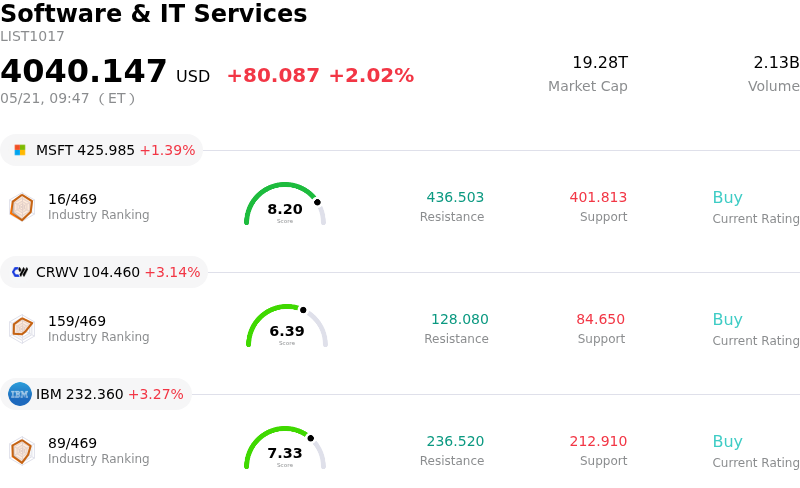
Alibaba Group Holding Ltd (BABA) opened down by 3.87%. The Software & IT Services sector is up by 2.02%. The company underperformed the industry. Top 3 stocks by turnover in the sector: Microsoft Corp (MSFT) up 1.39%; CoreWeave Inc (CRWV) up 3.14%; International Business Machines Corp (IBM) up 3.27%.
What is driving Alibaba Group Holding Ltd (BABA)’s stock price down today?
Alibaba's share price experienced notable downward pressure and significant intraday volatility, primarily stemming from recent financial performance and evolving market sentiment. The company's recent earnings report for the first quarter of fiscal year 2026, released on May 13, 2026, indicated modest revenue growth but a substantial shortfall in earnings per share and an reported operating loss, the first in several years. This decline in profitability is largely attributed to aggressive strategic investments in artificial intelligence and the quick commerce segment, which have also resulted in negative free cash flow as capital expenditure increased.
While the Cloud Intelligence Group demonstrated strong revenue acceleration, particularly in AI-related products, contributing to a longer-term growth narrative, the immediate financial impact of these investments has raised investor concerns. On May 21, 2026, a report underscored a significant level of short interest in Alibaba, indicating that a segment of the market maintains a bearish outlook on the stock. This report further suggested that the stock might be perceived as overvalued according to certain valuation metrics.
The broader environment for Chinese technology companies also contributes to market caution. China's government is actively pursuing comprehensive legislation for artificial intelligence, and new measures for data protection and AI interaction services were recently announced. These regulatory developments, while aimed at guiding industry growth, can introduce uncertainty regarding future operational frameworks and compliance costs. Additionally, ongoing geopolitical considerations, including discussions around tech export restrictions and US-China relations, continue to influence investor confidence in the sector. These combined factors likely fueled the intraday fluctuations and the downward movement in Alibaba's stock.
Technical Analysis of Alibaba Group Holding Ltd (BABA)
Technically, Alibaba Group Holding Ltd (BABA) shows a MACD (12,26,9) value of [1.19], indicating a neutral signal. The RSI at 49.03 suggests neutral condition and the Williams %R at -74.97 suggests oversold condition. Please monitor closely.
Fundamental Analysis of Alibaba Group Holding Ltd (BABA)
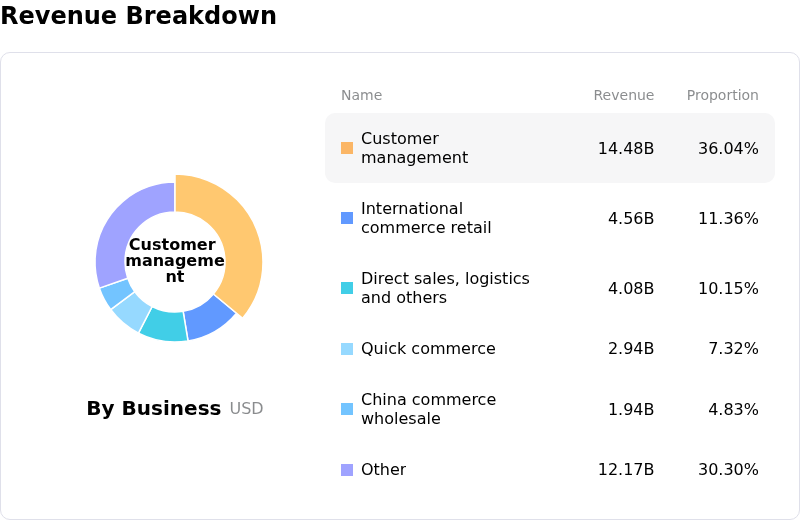
Alibaba Group Holding Ltd (BABA) is in the Software & IT Services industry. Its latest annual revenue is $144.14B, ranking 5 in the industry. The net profit is $14.91B, ranking 7 in the industry. Company Profile
Over the past month, multiple analysts have rated the company as Buy, with an average price target of $189.15, a high of $256.87, and a low of $112.00.
More details about Alibaba Group Holding Ltd (BABA)
Company Specific Risks:
- Alibaba reported its first operating loss since 2021 in Q4 fiscal 2026, with an 848 million yuan operating loss and a 74% year-over-year plunge in operating income, primarily driven by massive investments in AI infrastructure and aggressive spending in new business initiatives.
- Aggressive capital expenditures for AI infrastructure and quick-commerce expansion resulted in a significant negative free cash flow of 17.3 billion yuan in Q4 fiscal 2026, indicating a substantial liquidity strain from high investment needs.
- The company faces sustained margin compression as sales and marketing costs, along with the cost of revenues, surged in Q3 fiscal 2026, reflecting ongoing aggressive spending to compete in the e-commerce landscape and fund AI/cloud infrastructure.
- Intensified competitive pressure in the core e-commerce segment from rivals such as PDD Holdings and ByteDance (Douyin E-commerce) continues to necessitate heavy subsidies and investments, contributing to a 40% year-over-year decline in China commerce adjusted EBITA.
This article may include AI-generated content that is human-reviewed, which is for reference and general information purposes only and does not constitute investment advice.
Recommended Articles









Comments (0)
Click the $ button, enter the symbol, and select to link a stock, ETF, or other ticker.