


Seagate Technology Holdings PLC Stock (STX) Opened Down by 3.05% on May 7: What Investors Need To Know



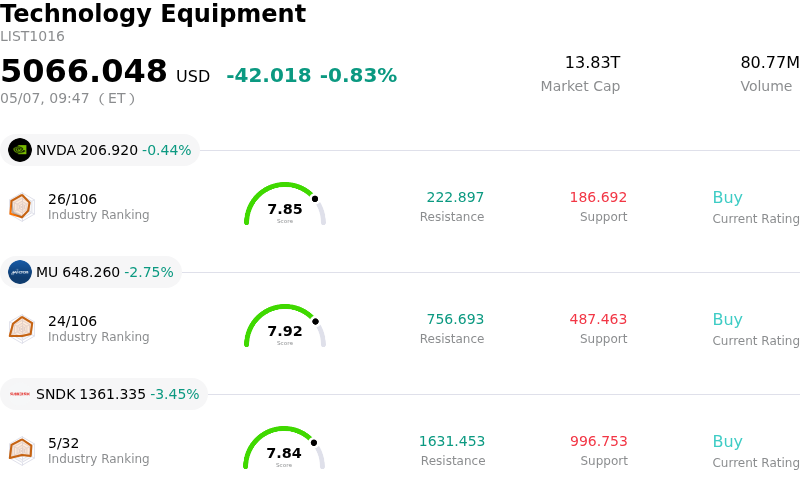
Seagate Technology Holdings PLC (STX) opened down by 3.05%. The Technology Equipment sector is down by 0.83%. The company underperformed the industry. Top 3 stocks by turnover in the sector: NVIDIA Corp (NVDA) down 0.44%; Micron Technology Inc (MU) down 2.75%; SanDisk Corporation (SNDK) down 3.45%.
What is driving Seagate Technology Holdings PLC (STX)’s stock price down today?
Seagate Technology (STX) experienced downward price movement today, which appears to be a response to several factors, including recent insider selling and ongoing market concerns regarding valuation and the sustainability of industry growth. This decline follows a period of strong performance for the company, largely driven by robust financial results and positive market sentiment surrounding its role in the artificial intelligence (AI) infrastructure buildout.
Recently, an executive vice president and a director of Seagate Technology executed sales of company shares on May 4th and May 5th, respectively. While these transactions were conducted under pre-arranged Rule 10b5-1 trading plans, which are designed to allow insiders to sell shares at pre-determined times to avoid accusations of insider trading, such sales can sometimes be interpreted by the market as a signal from company leadership that the stock has reached an attractive selling point. This can lead to increased selling pressure from other investors.
Furthermore, despite Seagate's impressive fiscal third-quarter 2026 earnings reported on April 28th, which surpassed analyst expectations for both revenue and earnings per share, and an upbeat guidance for the fiscal fourth quarter, some analysts and market commentators have raised concerns about the stock's valuation. Reports have indicated potential overvaluation and expressed caution regarding the long-term sustainability of the current hyperscaler capital expenditure cycle, which has been a significant driver of Seagate's recent growth. The argument is that while AI demand is strong, the intensive capital spending by hyperscalers may peak by fiscal year 2026 or 2027, potentially impacting future revenues.
It is also worth noting that Seagate has seen an increase in its outstanding shares due to dilution over the past year, which can affect earnings per share. This factor, combined with the perception of high valuation and the recent insider sales, likely contributed to today's negative sentiment and profit-taking among investors.
Technical Analysis of Seagate Technology Holdings PLC (STX)
Technically, Seagate Technology Holdings PLC (STX) shows a MACD (12,26,9) value of [60.79], indicating a buy signal. The RSI at 87.03 suggests overbought condition and the Williams %R at -2.15 suggests oversold condition. Please monitor closely.
Fundamental Analysis of Seagate Technology Holdings PLC (STX)
Seagate Technology Holdings PLC (STX) is in the Technology Equipment industry. Its latest annual revenue is $9.10B, ranking 9 in the industry. The net profit is $1.47B, ranking 6 in the industry. Company Profile
Over the past month, multiple analysts have rated the company as Buy, with an average price target of $760.26, a high of $1000.00, and a low of $381.42.
More details about Seagate Technology Holdings PLC (STX)
Company Specific Risks:
- Analysts express concerns that Seagate's current valuation may reflect peak earnings expectations from an unsustainable hyperscaler capital expenditure cycle, potentially leading to future revenue decline and excess capacity by fiscal year 2026 or 2027.
- Seagate maintains a high debt-to-equity ratio, with some reports indicating figures as high as 7.63 and a debt-to-capital ratio of 90.7%, which increases its financial vulnerability despite recent improvements in cash flow.
- Multiple significant insider sales, including transactions by an EVP and a director on May 4th and May 5th, have occurred recently, which, even if pre-planned, can be perceived as a negative signal to the market.
- The company faces customer concentration risk, with data center customers accounting for a substantial portion of its business, which could pose a structural vulnerability.
This article may include AI-generated content that is human-reviewed, which is for reference and general information purposes only and does not constitute investment advice.
Recommended Articles








Comments (0)
Click the $ button, enter the symbol, and select to link a stock, ETF, or other ticker.