


Oil Surges 6% as Massive US Reserve Release Fails to Cool Market



TradingKey - U.S. strategy to release strategic petroleum reserves fails as crude oil prices continue to surge.
During early trading on March 12 (GMT+8), international crude oil prices reversed their downward trend and rallied once again. WTI crude ( USOIL) surged 6.58%, breaking the $90 per barrel mark to trade at $92.83 per barrel.
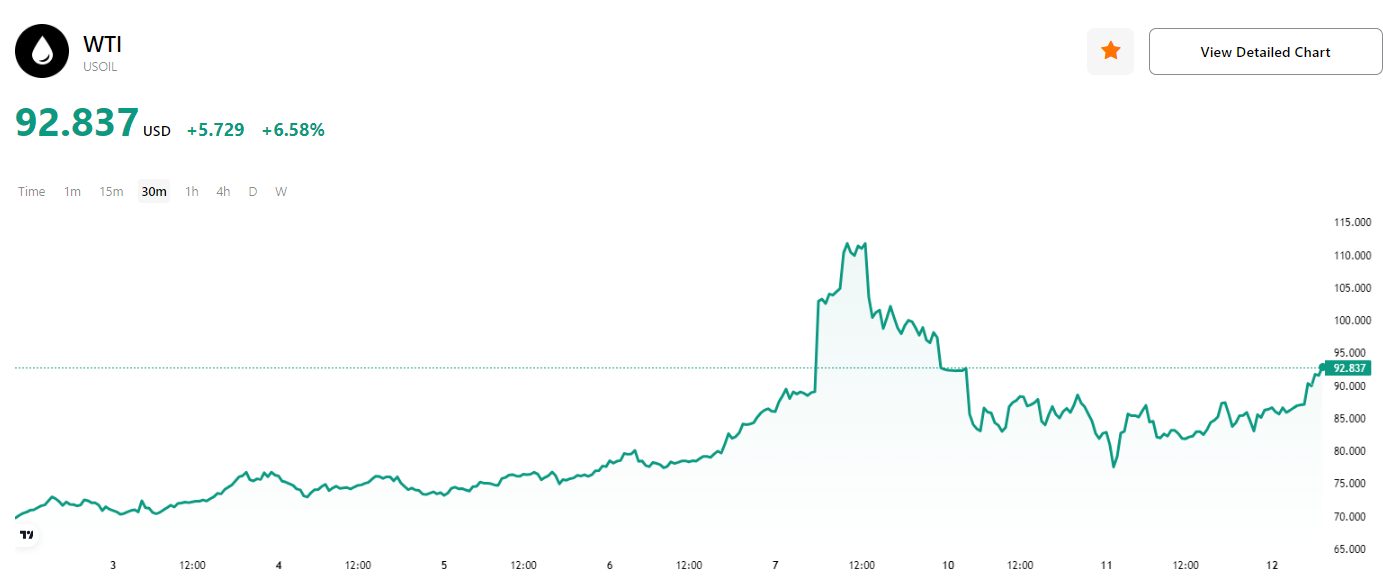 WTI Crude Oil Price Chart, Source: TradingView
On March 11, ET, U.S. Energy Secretary Wright issued a statement stating that Trump authorized the Department of Energy to release 172 million barrels of strategic petroleum reserves starting next week, with delivery expected to be completed in 120 days. In an interview, Trump said, "We're going to do it, and then we're going to fill it back up. Right now, we’re going to cut it a little bit, and that will bring down the price of oil."
In addition, Germany also released nearly 20 million barrels of strategic petroleum reserves. German Federal Minister for Economic Affairs and Energy Katharina Reiche stated, "Due to the global energy price surge caused by U.S. and Israeli military strikes against Iran, Germany will release 19.51 million barrels of strategic oil reserves to alleviate the pressure of rising oil prices."
However, after a brief dip yesterday, crude oil prices strengthened again today. The fundamental reason is that tensions between the U.S. and Iran remain high; Iran launched the 40th wave of its "True Promise 4" operation this morning. The immediate trigger was an attack on two tankers in the northern Gulf near Iraq and Kuwait, which renewed concerns about the safety of commercial shipping in the region.
The current crude oil market is as Jeff Currie—former head of commodities research at Goldman Sachs and current Chief Strategy Officer of the Energy Pathways department at Carlyle Group LP—put it: no policy can stop oil prices from rising. On March 11, Jeff Currie wrote, "Even if there is a ceasefire in the Middle East, no policy measures can stop the rise of crude oil. Supply chain disruptions—including vessel dispatch chaos, insurance cancellations, and production slowdowns in Saudi Arabia, Iraq, and the UAE—will take months to repair."
This content was translated using AI and reviewed for clarity. It is for informational purposes only.
Recommended Articles








Comments (0)
Click the $ button, enter the symbol, and select to link a stock, ETF, or other ticker.