


Gold rises past $5,100 as Middle East war fuels haven demand



- Gold rebounds after a 4.4% drop as DXY slips to 98.82.
- ISM Services PMI jumps to 56.1; ADP jobs beat estimates at 63K.
- Fed easing bets trimmed to 43 bps as geopolitical risks dominate sentiment.
Gold price (XAU/USD) advances during the North American session on Wednesday, up by more than 1% after registering losses of close to 4.40% courtesy of broad US Dollar strength. Nevertheless, tensions in the Middle East remain high, pushing the yellow metal near the $5,150 area at the time of writing.
Gold poised for additional gains on fragile risk appetite
Earlier, the New York Times reported that Iranian intelligence reached out indirectly to the CIA a day after the attacks to discuss terms for ending the war. Nevertheless, US officials remained skeptical that either the White House or Tehran is ready for a de-escalation. The headline improved risk appetite, which was dented by a headline that a US submarine sank an Iranian warship. Consequently, bullion prices could continue to edge higher, taking advantage of a weaker US Dollar.
The US Dollar Index (DXY), which tracks the buck’s value versus six currencies, posts losses of 0.25%, down to 98.82. Also, US Treasury yields are consolidating as depicted by the 10-year Treasury note, unchanged at 4.069%.
Strong PMI, jobs report reveals a strong US economy
US macroeconomic data reaffirmed that the economy remains positive. The ISM Non-Manufacturing PMI, also known as Services PMI, improved from 53.8 in January to 56.1 last month, reaching a three-and-a-half year high. The New Orders sub-component rose to its highest level since September 2024.
Earlier, the ADP Employment Change in February showed that private companies hired more people than the 50K estimated. The number came at 63K, almost six times January’s 11K downward revised print.
Traders shrugged off the positive US data, setting their sights on geopolitical risks and Friday’s Nonfarm Payrolls report.
Recently, some countries in the Middle East halted Oil and Gas production, as the conflict continues to escalate, reaching its fifth straight day of hostilities.
On Thursday, the US economic docket will feature the release of Challenger Job Cuts for February and Initial Jobless Claims data. Alongside this, focus will turn to Federal Reserve (Fed) Governor Michelle Bowman's speech.
Investors pricing in a less dovish Fed
Money markets had priced in 43 basis points of Fed easing towards the year’s end, according to Prime Market Terminal data.
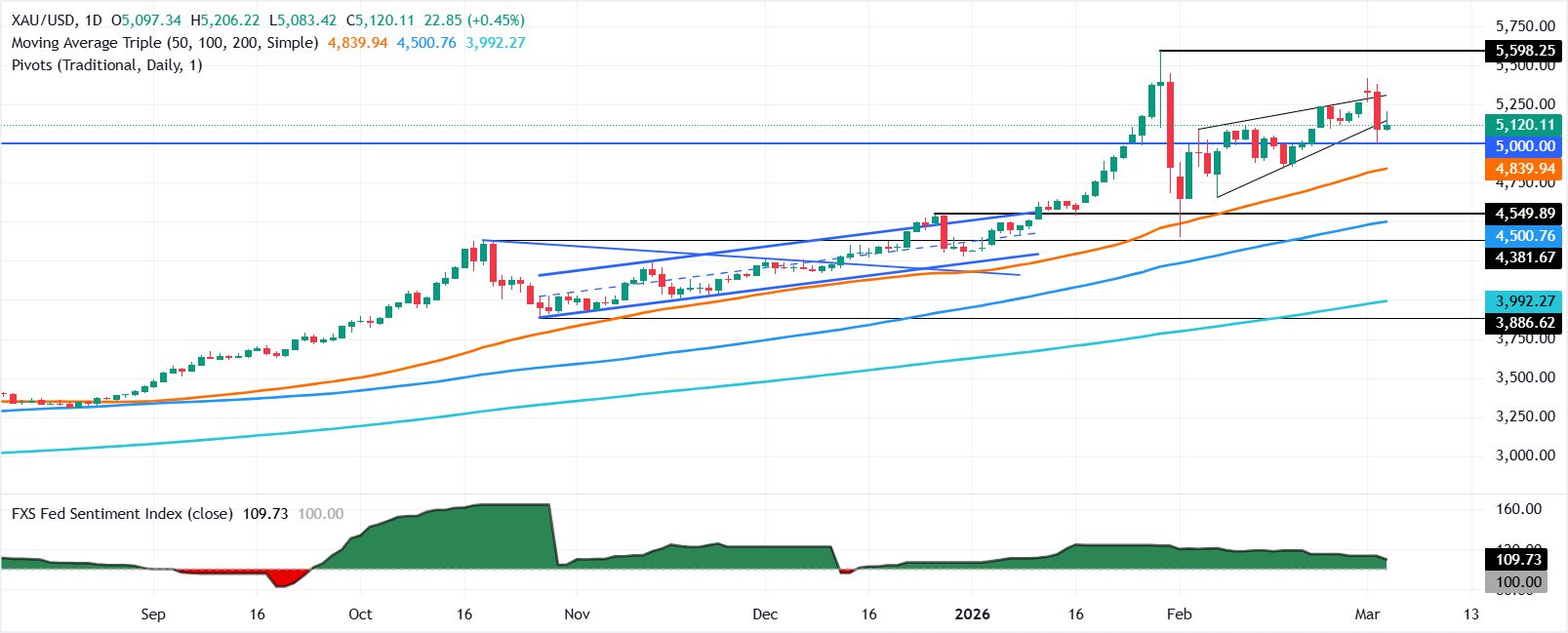
XAU/USD technical outlook: Gold bulls face stir resistance at $5,150
Gold’s price action remains constructive, with further upside seen in the near term. Traders reclaiming $5,100 opened the door for a recovery, but bulls seem hesitant, as depicted by the Relative Strength Index (RSI). The RSI has ticked higher but shows buyers’ lack of strength to extend the uptrend.
Buyers will need to clear $5,200. A breach of it exposes the February 24 high at $5,249 and then $5,300. Further gains may target the March 3 peak at $5,379 ahead of $5,419. On the downside, a move below $5,000 would expose support at $4,950, followed by the February 17 cycle low at $4,841 and the 50-day SMA near $4,810.
Gold FAQs
Gold has played a key role in human’s history as it has been widely used as a store of value and medium of exchange. Currently, apart from its shine and usage for jewelry, the precious metal is widely seen as a safe-haven asset, meaning that it is considered a good investment during turbulent times. Gold is also widely seen as a hedge against inflation and against depreciating currencies as it doesn’t rely on any specific issuer or government.
Central banks are the biggest Gold holders. In their aim to support their currencies in turbulent times, central banks tend to diversify their reserves and buy Gold to improve the perceived strength of the economy and the currency. High Gold reserves can be a source of trust for a country’s solvency. Central banks added 1,136 tonnes of Gold worth around $70 billion to their reserves in 2022, according to data from the World Gold Council. This is the highest yearly purchase since records began. Central banks from emerging economies such as China, India and Turkey are quickly increasing their Gold reserves.
Gold has an inverse correlation with the US Dollar and US Treasuries, which are both major reserve and safe-haven assets. When the Dollar depreciates, Gold tends to rise, enabling investors and central banks to diversify their assets in turbulent times. Gold is also inversely correlated with risk assets. A rally in the stock market tends to weaken Gold price, while sell-offs in riskier markets tend to favor the precious metal.
The price can move due to a wide range of factors. Geopolitical instability or fears of a deep recession can quickly make Gold price escalate due to its safe-haven status. As a yield-less asset, Gold tends to rise with lower interest rates, while higher cost of money usually weighs down on the yellow metal. Still, most moves depend on how the US Dollar (USD) behaves as the asset is priced in dollars (XAU/USD). A strong Dollar tends to keep the price of Gold controlled, whereas a weaker Dollar is likely to push Gold prices up.
Recommended Articles







Comments (0)
Click the $ button, enter the symbol, and select to link a stock, ETF, or other ticker.