


Gold edges higher as USD rally pauses, US-Iran conflict supports demand



- Gold rebounds on Wednesday after a 4.4% drop the previous day as the US Dollar pauses following a two-day rally.
- US-Iran conflict supports safe-haven demand, limiting downside in Gold.
- Technically, XAU/USD holds above key support near $5,100 with resistance emerging around $5,200.
Gold (XAU/USD) edges higher on Wednesday, recovering part of the previous day’s sharp decline as the US Dollar (USD) takes a breather after two days of solid gains. Meanwhile, ongoing geopolitical tensions surrounding the US-Iran war keep safe-haven demand in play, helping cushion the downside.
At the time of writing, XAU/USD trades around $5,180, up about 1.65% on the day.
Gold steadies as USD rally pauses amid Middle East tensions
Gold tumbled 4.4% on Tuesday, while Silver (XAG/USD) slid about 8.4%, as a stronger USD weighed on metals. The decline accelerated after prices slipped below key technical support levels, triggering stop-loss orders and broad liquidation. The sell-off, however, proved short-lived as rising global and economic uncertainty kept investors’ risk appetite subdued.
The Middle East conflict enters its fifth day, with the US and Israel stepping up air and missile strikes across Iran. Tehran has responded with missile and drone attacks on US bases and allied facilities in the Gulf.
As the war escalates, disruptions to Oil flows through the Strait of Hormuz are pushing energy prices higher, raising concerns about the inflationary impact on the global economy.
US President Donald Trump tried to calm markets, saying the US “will begin escorting tankers through the Strait of Hormuz as soon as possible” if necessary. In a post on Truth Social on Tuesday, he added that Washington would provide political risk insurance for ships traveling through the Gulf to “ensure the FREE FLOW of ENERGY to the WORLD.”
Fed rate-cut bets slip below 50 basis points by year-end
Growing inflation concerns are also prompting traders to reassess the Federal Reserve’s (Fed) monetary policy outlook. Markets now price in at least 50 basis points (bps) of interest rate cuts by December, according to the CME FedWatch tool, which could act as a headwind for non-yielding assets such as Gold.
Looking ahead, attention turns to key US economic data due this week. The ADP Employment Change report and ISM Services Purchasing Managers' Index (PMI) are scheduled for release on Wednesday, followed by the Nonfarm Payrolls (NFP) report on Friday.
Technical analysis: XAU/USD stabilizes near $5,100 after pullback from recent highs
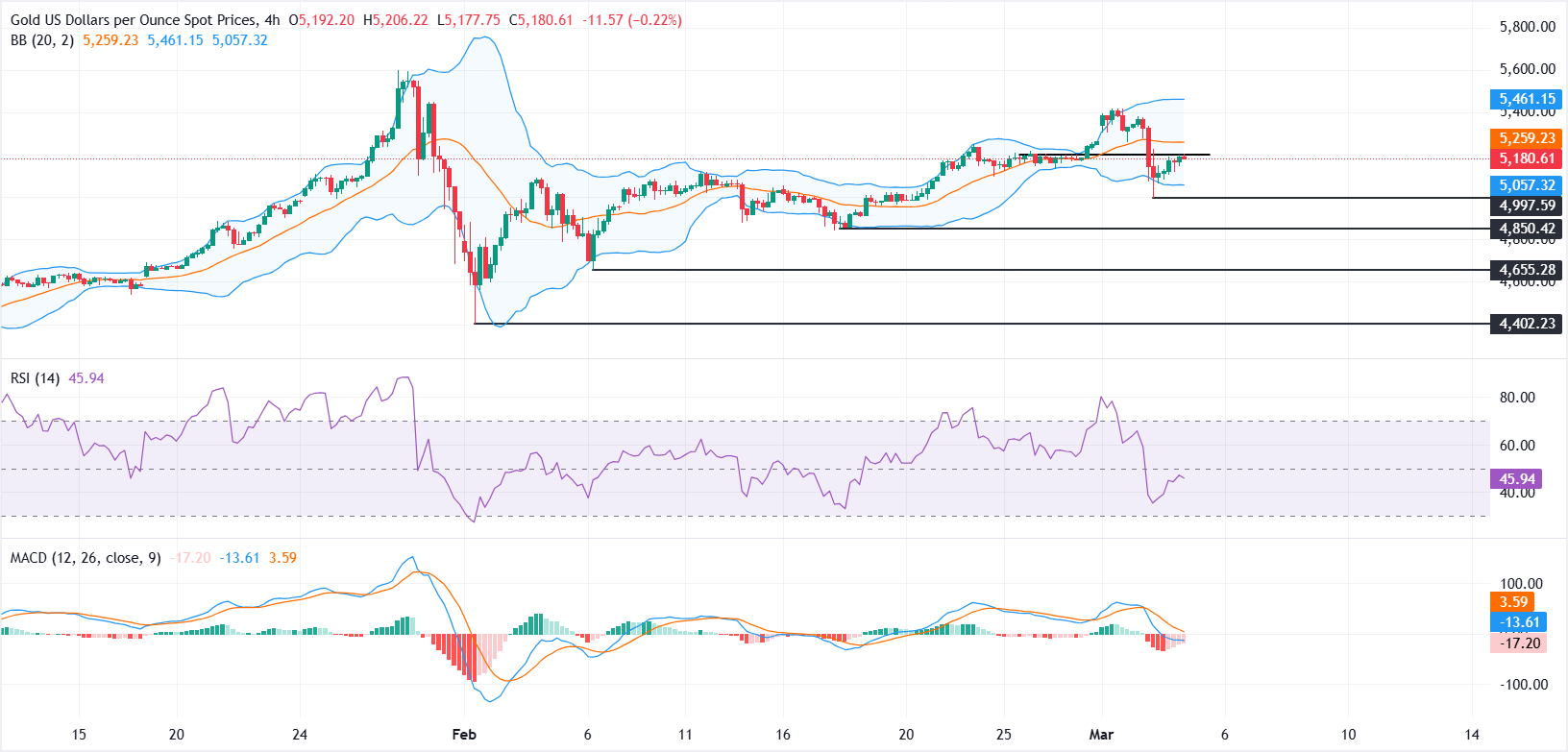
XAU/USD’s near-term outlook appears neutral to mildly bearish after prices retreated from the upper Bollinger Band on the 4-hour chart and are now oscillating just below the mid-band. However, the downside remains limited as prices found support near the lower Bollinger Band around $5,057.
The RSI (14) is stabilizing after approaching oversold territory and is now moving higher at 45, suggesting that selling momentum may be easing.
The Moving Average Convergence Divergence (MACD) line flattens below the signal line, with the negative histogram contracting, which suggests waning bearish pressure.
On the upside, immediate resistance is seen near $5,200, ahead of the mid-Bollinger Band around $5,259, followed by the upper Bollinger Band near $5,461.
On the downside, initial support lies in the $5,100-$5,000 zone. A decisive break below this range could expose the next support levels near $4,850 and $4,650.
Gold FAQs
Gold has played a key role in human’s history as it has been widely used as a store of value and medium of exchange. Currently, apart from its shine and usage for jewelry, the precious metal is widely seen as a safe-haven asset, meaning that it is considered a good investment during turbulent times. Gold is also widely seen as a hedge against inflation and against depreciating currencies as it doesn’t rely on any specific issuer or government.
Central banks are the biggest Gold holders. In their aim to support their currencies in turbulent times, central banks tend to diversify their reserves and buy Gold to improve the perceived strength of the economy and the currency. High Gold reserves can be a source of trust for a country’s solvency. Central banks added 1,136 tonnes of Gold worth around $70 billion to their reserves in 2022, according to data from the World Gold Council. This is the highest yearly purchase since records began. Central banks from emerging economies such as China, India and Turkey are quickly increasing their Gold reserves.
Gold has an inverse correlation with the US Dollar and US Treasuries, which are both major reserve and safe-haven assets. When the Dollar depreciates, Gold tends to rise, enabling investors and central banks to diversify their assets in turbulent times. Gold is also inversely correlated with risk assets. A rally in the stock market tends to weaken Gold price, while sell-offs in riskier markets tend to favor the precious metal.
The price can move due to a wide range of factors. Geopolitical instability or fears of a deep recession can quickly make Gold price escalate due to its safe-haven status. As a yield-less asset, Gold tends to rise with lower interest rates, while higher cost of money usually weighs down on the yellow metal. Still, most moves depend on how the US Dollar (USD) behaves as the asset is priced in dollars (XAU/USD). A strong Dollar tends to keep the price of Gold controlled, whereas a weaker Dollar is likely to push Gold prices up.
Recommended Articles







Comments (0)
Click the $ button, enter the symbol, and select to link a stock, ETF, or other ticker.