SAP SE Stock (SAP) Moved Down by 4.66% on Apr 9: What Investors Need To Know



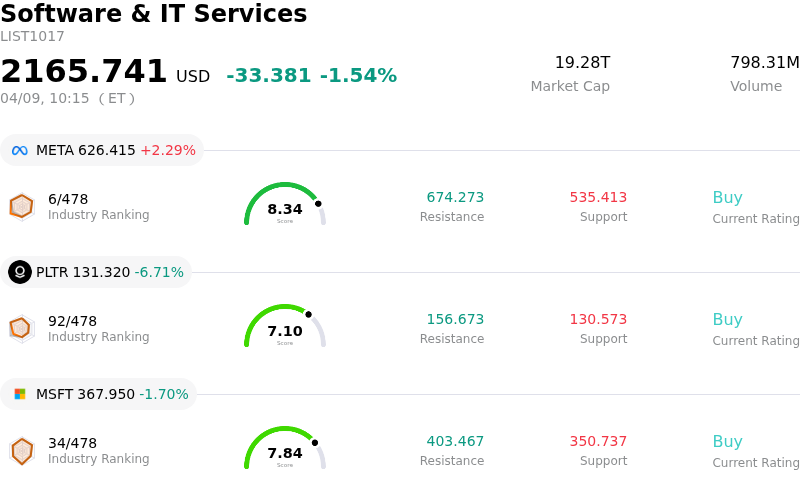
SAP SE (SAP) moved down by 4.66%. The Software & IT Services sector is down by 1.54%. The company underperformed the industry. Top 3 stocks by turnover in the sector: Meta Platforms Inc (META) up 2.29%; Palantir Technologies Inc (PLTR) down 6.71%; Microsoft Corp (MSFT) down 1.70%.
What is driving SAP SE (SAP)’s stock price down today?
SAP experienced a notable decline on April 9, 2026, primarily driven by investor concerns surrounding its strategic shift towards an AI-driven consumption-based pricing model. The company recently announced a transition from traditional per-user and subscription-based pricing to a model where costs are determined by usage, influenced by the increasing automation of enterprise workflows by AI agents. This change, while aimed at aligning with industry evolution, has raised questions about future revenue predictability and profitability in the short term. SAP's CEO has acknowledged that this transformation could lead to "short-term pain" for the company, echoing challenges experienced during its earlier cloud migration.
This strategic pricing overhaul occurs within a broader environment of investor apprehension regarding the disruptive impact of artificial intelligence on the software sector. The market is sensitive to how AI will reshape traditional enterprise software business models, leading to headwinds for many companies in the industry. Persistent investor doubts about the pace and cost-effectiveness of SAP's ongoing migration strategy, particularly from ECC to S/4HANA, further contribute to a cautious sentiment, as a significant portion of its customer base is projected to remain on older platforms for several more years.
While SAP has made moves to bolster its AI strategy, including the planned acquisition of Reltio to enhance its data architecture for AI applications, and recently announced a higher dividend for fiscal year 2025, these positive developments appear to have been overshadowed by the uncertainties linked to its core business model transformation. The market's reaction suggests that the immediate implications of the pricing model shift and the ongoing industry-wide reevaluation of software valuations in the AI era are weighing heavily on the stock.
Technical Analysis of SAP SE (SAP)
Technically, SAP SE (SAP) shows a MACD (12,26,9) value of [-8.47], indicating a neutral signal. The RSI at 32.65 suggests neutral condition and the Williams %R at -76.52 suggests oversold condition. Please monitor closely.
Fundamental Analysis of SAP SE (SAP)
SAP SE (SAP) is in the Software & IT Services industry. Its latest annual revenue is $41.49B, ranking 14 in the industry. The net profit is $8.07B, ranking 13 in the industry. Company Profile
Over the past month, multiple analysts have rated the company as Buy, with an average price target of $300.92, a high of $367.98, and a low of $178.44.
More details about SAP SE (SAP)
Company Specific Risks:
- Slowing current cloud backlog (CCB) growth raises concerns about SAP's near-term outlook and was a primary factor in recent analyst downgrades, indicating potential deceleration in future revenue predictability.
- Intensifying competition within the AI agent layer from major Large Language Model providers threatens to compress margins and necessitate increased investment intensity for SAP to maintain its competitive position.
- SAP's strategic shift to a consumption-based pricing model for AI agents introduces unpredictability in customer costs and revenue recognition, potentially creating challenges for both customer budget management and SAP's financial forecasting.
- Persistent customer challenges with S/4HANA migrations, including poor data quality, process complexity, and resistance to moving away from extensive customizations, pose risks to adoption rates, customer satisfaction, and timely project completion ahead of the 2027 deadline.
Recommended Articles