BHP Group Ltd Stock (BHP) Moved Down by 3.03% on Mar 20: Drivers Behind the Movement

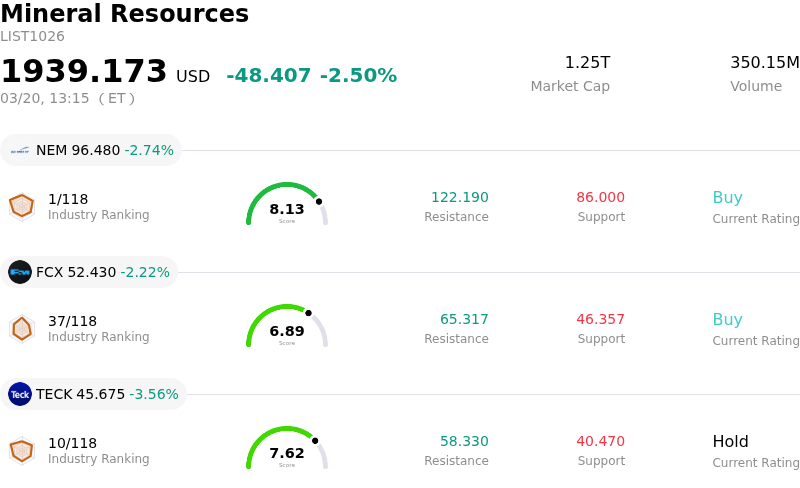
BHP Group Ltd (BHP) moved down by 3.03%. The Mineral Resources sector is down by 2.50%. The company underperformed the industry. Top 3 stocks by turnover in the sector: Newmont Corporation (NEM) down 2.74%; Freeport-McMoRan Inc (FCX) down 2.22%; Teck Resources Ltd (TECK) down 3.56%.
What is driving BHP Group Ltd (BHP)’s stock price down today?
The decline in BHP's share price today can be attributed to a confluence of factors spanning major company events, macroeconomic concerns, and commodity price movements.
A significant event contributing to the downturn is the announcement of a leadership transition at BHP. The company disclosed that Brandon Craig is slated to assume the role of Chief Executive Officer on July 1, 2026, succeeding Mike Henry. While such changes can be viewed as an orderly succession, the market's immediate reaction often involves some uncertainty, leading to negative price adjustments. This news comes after a period of weaker share price performance for BHP in recent weeks.
Adding to the pressure are broader macroeconomic and geopolitical headwinds. Heightened geopolitical tensions, particularly in the Middle East, have fostered economic instability, prompting investors to pull away from cyclical sectors such as mining. This environment has also contributed to elevated freight costs, impacting the profitability outlook for miners. Furthermore, a hawkish stance from central banks, including the Federal Reserve and the Reserve Bank of Australia, suggesting sustained interest rates without clear signs of inflation cooling, has amplified market anxiety.
Commodity price fluctuations are another key driver. Copper prices experienced a notable decline today, falling from the previous day's levels and continuing a downward trend observed over the past month. This weakness in copper is partly due to a strong U.S. dollar and concerns that high energy costs will suppress manufacturing demand, alongside elevated inventory levels. While iron ore prices showed some regional increases and a broader rebound in March, earlier weak iron ore futures and spot prices, coupled with Chinese import restrictions on certain BHP products, have created a mixed but often challenging environment for this key commodity. Concerns about demand for raw materials from China are also present, as the official Manufacturing Purchasing Managers' Index for February remained in contraction territory for the second consecutive month, despite expectations of a rebound.
Technical Analysis of BHP Group Ltd (BHP)
Technically, BHP Group Ltd (BHP) shows a MACD (12,26,9) value of [0.21], indicating a neutral signal. The RSI at 36.88 suggests neutral condition and the Williams %R at -86.56 suggests oversold condition. Please monitor closely.
Fundamental Analysis of BHP Group Ltd (BHP)
BHP Group Ltd (BHP) is in the Mineral Resources industry. Its latest annual revenue is $51.26B, ranking 3 in the industry. The net profit is $9.02B, ranking 2 in the industry. Company Profile
Over the past month, multiple analysts have rated the company as Hold, with an average price target of $64.12, a high of $88.00, and a low of $49.50.
More details about BHP Group Ltd (BHP)
Company Specific Risks:
- Delays and increased cost estimates for the Jansen Stage 1 potash project pose significant execution risks and are expected to negatively impact free cash flow projections for fiscal years 2026 and 2027.
- The company faces considerable legal and reputational risks stemming from an ongoing class action lawsuit in Australia alleging sexual harassment and sex discrimination, alongside continuing litigation related to the 2015 Brazil dam collapse.
- Slowing construction and industrial growth in China, a primary market, combined with sensitive negotiations over iron ore contracts, creates uncertainty for a major revenue stream.
- Disruptions within the Australian domestic fuel supply chain are introducing operational challenges and cost pressures for mining activities, affecting the broader sector including major wholesalers like BHP.