


Nvidia Adds $150 Billion Buyback Authorization, Raising Remaining Total to $235 Billion; Can NVDA Stock Keep Rising?



AI Podcast


On September 28 ET, Nvidia announced a record $150 billion share buyback authorization increase, bringing its remaining capacity to $235 billion. Supported by robust Q2 revenue of $96.2 billion and mass production of Vera Rubin, this capital allocation underscores strong cash flow. However, buyback impact depends on execution pace, free cash flow, and equity dilution. Key risks include reduced AI capital expenditures, export restrictions, and customer concentration. Technically, the stock faces primary support at $223–$224 and resistance at $233.71–$236.54. A breakout above $236.54 targets $245, while a close below $223 exposes lower support at $217–$218.
TradingKey - On September 28 ET, Nvidia (NVDA)'s board of directors announced an additional $150 billion share buyback authorization, boosting the remaining capacity under its existing program to $235 billion, setting a record for the largest single buyback authorization increase by a U.S. company. The company expects to execute the remaining program through fiscal year 2028, with the actual size and timing yet to be determined.
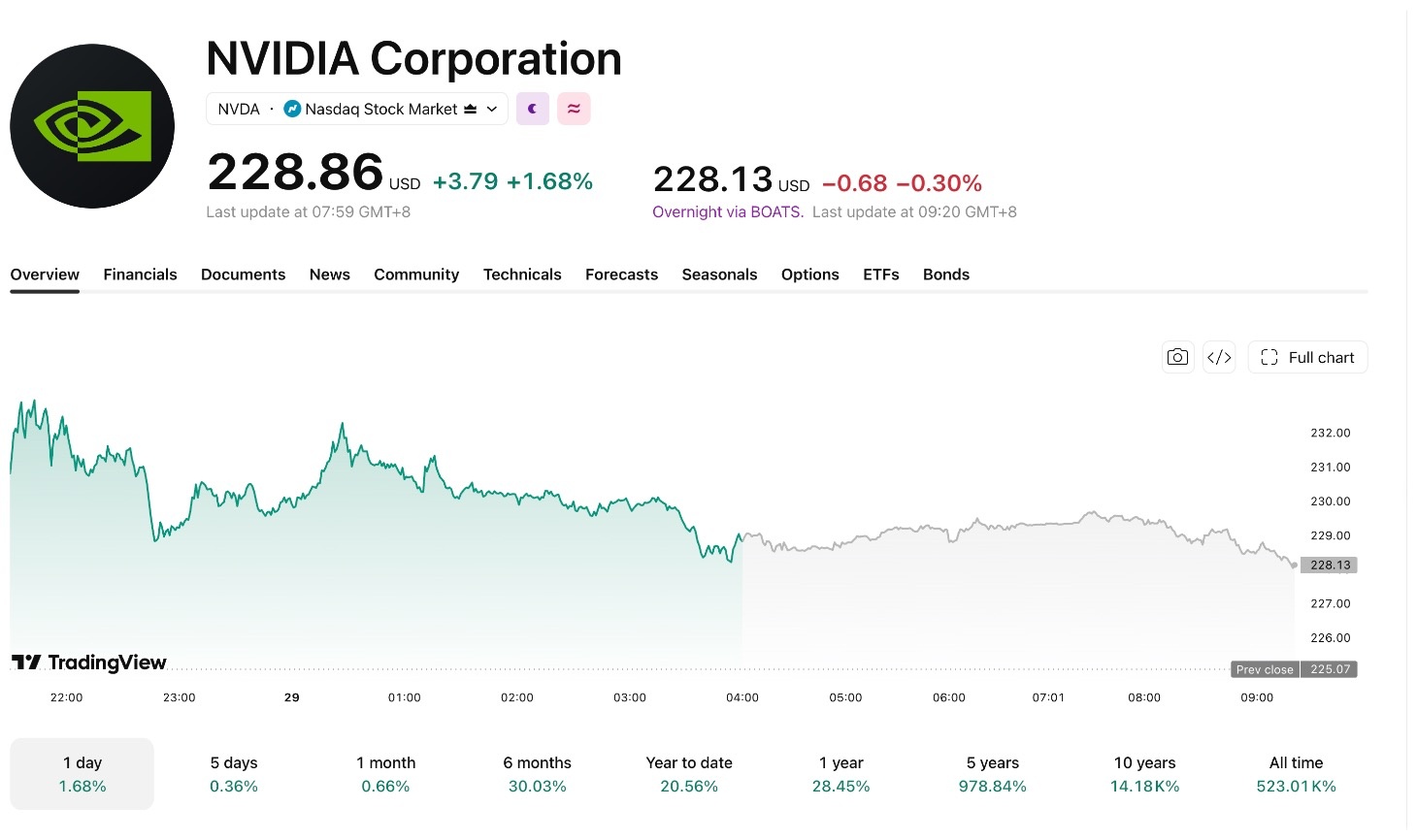
Nvidia rose 1.68% on the day to close at $228.86, after reaching an intraday high of around $233.20; over the same period, the S&P 500 Index fell 0.77%.
[Source: TradingView]
Can Nvidia Buybacks Continue to Support NVDA Stock Price?
Based on Nvidia's market capitalization of approximately $5.56 trillion as of September 28, its remaining share repurchase authorization of $235 billion accounts for about 4.2% of its market value. If repurchased shares exceed new shares issued due to equity incentives and other factors, the number of outstanding shares will decrease, boosting earnings per share assuming net income remains unchanged.
In the second quarter of fiscal 2027, Nvidia returned $26 billion to shareholders through share repurchases and dividends, of which approximately $20 billion was used for buybacks and $6 billion for dividends.
As of the end of the quarter, the company's remaining buyback authorization was approximately $99 billion. Following an additional $150 billion authorization on September 28, the latest remaining amount rose to $235 billion.
A buyback authorization does not mean the company has spent an equivalent amount. The impact of buybacks on outstanding shares and earnings per share depends on the execution scale, repurchase prices, and the number of newly issued shares; stock price performance will also be influenced by earnings growth, valuation, and market conditions. Compared with the total authorized amount, the actual buyback amount and net changes in outstanding shares warrant closer attention.
Can AI Business Growth Support Continued Buybacks?
Nvidia's revenue for the second quarter of fiscal 2027 reached $96.2 billion, up 106% year-over-year; Data Center revenue was $89.0 billion, up 117% year-over-year. Vera Rubin has entered full mass production and will begin production shipments in the third quarter of fiscal 2027.
Strong revenue and cash flow provide a financial foundation for share buybacks, but Nvidia still needs to continuously invest in chip R&D, supply chains, and strategic projects. Going forward, key focus should be placed on AI infrastructure demand, Vera Rubin shipments, gross margin, and free cash flow, as these metrics will impact the company's ability to sustain stock repurchases.
Major risks include large customers cutting AI capital expenditure, restrictions on advanced chip exports, competition from custom AI chips, and customer concentration. If revenue growth or profit margins decline, the market may downgrade earnings expectations, and the support of buybacks for the stock price will also weaken.
Technical Analysis: NVDA Tests $236.54, Next Target at $245
[Source: TradingView]
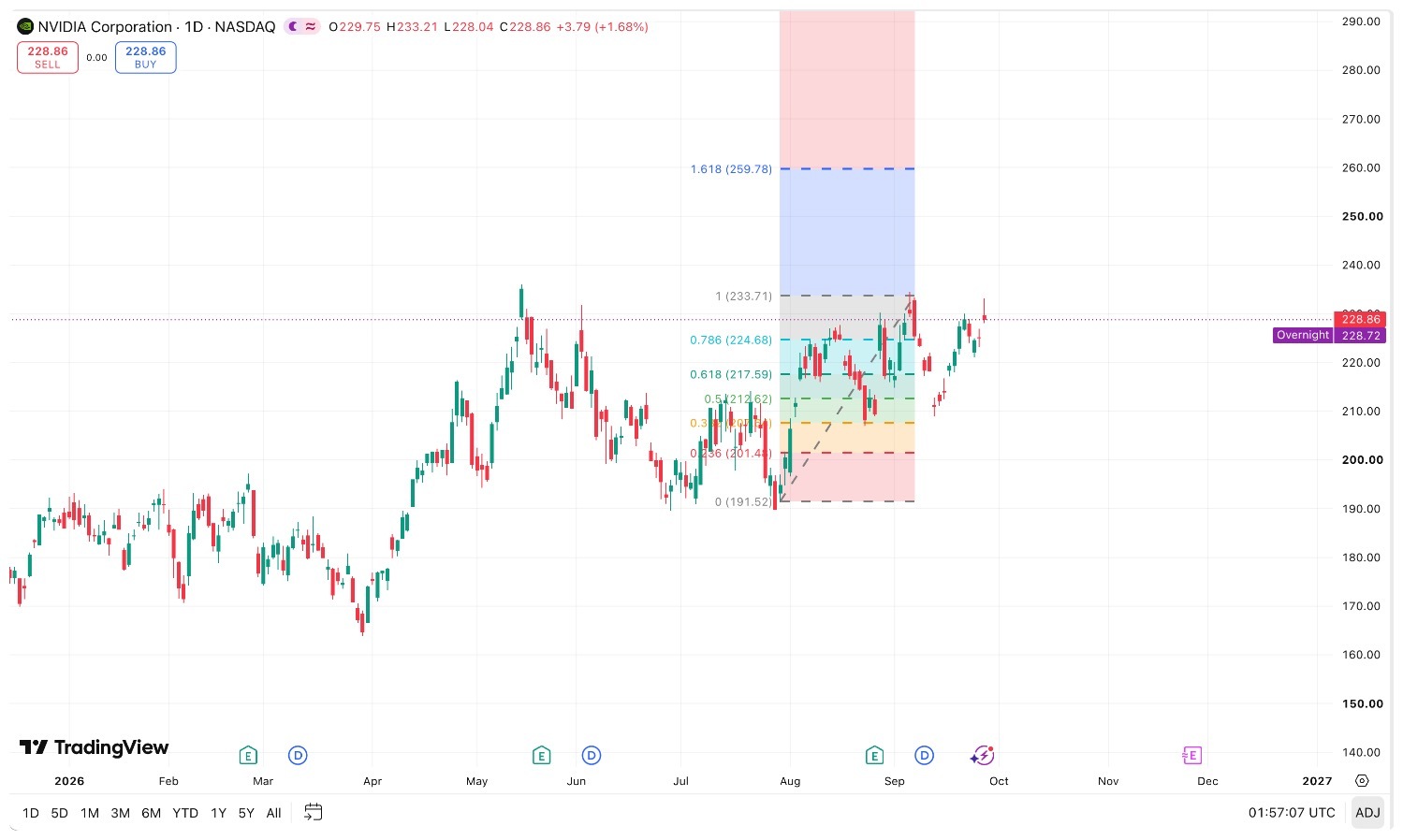
Based on the calculation from the intraday low of $191.52 on July 30 to the intraday high of $233.71 on September 8, the 0.236, 0.382, 0.500, and 0.618 Fibonacci retracement levels are $224.68, $217.59, $212.62, and $207.64, respectively.
On the downside, $223–$224 is the primary support zone. On September 28, the stock touched an intraday low of $222.86 but rebounded to close at $228.86. If a subsequent close breaks below $223, the next support levels to watch are $217–$218, $212–$213, and $207–$208, respectively.
On the upside, $233.71–$236.54 is the main resistance zone, with $236.54 being the 52-week intraday high. If the stock breaks through $236.54 on heavy volume and holds above it, the next level to watch is $245.19, corresponding to the 1.272 extension level; after a further breakout, focus can shift to the 1.618 extension level at $259.78.
Nvidia's remaining buyback authorization has increased to $235 billion, providing potential capital support for the stock price, though the actual impact still depends on the pace of buybacks, free cash flow, and the scale of new share issuances. Investors need to dynamically evaluate the strength of this support based on the company's quarterly buyback execution and changes in free cash flow.
Overall, after holding above $236.54, watch for $245 and $259–$260 in sequence; if the closing price breaks below $223, attention should be directed to the $217–$218 support.
This content was translated using AI and reviewed for clarity. It is for informational purposes only.
Recommended Articles










Comments (0)
Click the $ button, enter the symbol, and select to link a stock, ETF, or other ticker.