


US Stocks Fall as Dow Drops Nearly 350 Points; AI Hardware Stocks Sold Off, Memory and Chip Shares Lead Losses; Nvidia Bucks Trend to Gain 1.6%



AI Podcast


U.S. stocks declined broadly on Monday, pressured by rising Treasury yields and reports of slowed OpenAI model training, which triggered a sell-off in AI hardware stocks. Conversely, Nvidia shares rose following a record $150 billion buyback authorization. In the tech sector, Anthropic launched the cost-efficient Claude Sonnet 5.5, while SpaceX successfully placed its Starship rocket into Earth orbit. On the macroeconomic front, Federal Reserve Governor Lisa Cook warned that AI demand and rising oil prices will sustain inflationary pressures, and U.S. President Donald Trump signaled openness to Iran sanctions relief contingent on nuclear progress.

TradingKey - U.S. stocks fell across the board on Monday, impacted by news that OpenAI is slowing model training, as well as a sharp rise in U.S. Treasury yields. AI hardware stocks faced a sell-off, with memory stocks, chip stocks, and optical communication stocks leading the decline.
At the close, the Dow Jones Industrial Average fell 0.67% to 51,481.51; the Nasdaq Composite Index dropped 0.92% to 26,820.38; and the S&P 500 Index fell 0.77% to 7,683.69.
Tech Stock Performance
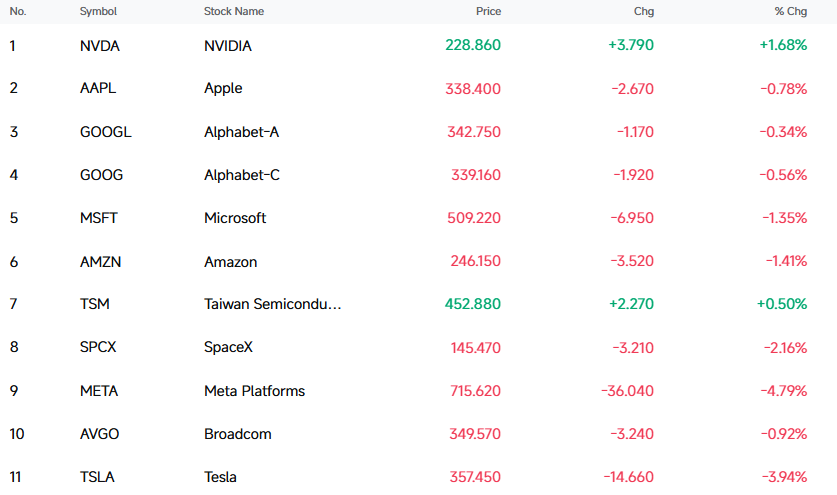
Nvidia (NVDA) rose 1.68% to close at $228.86.
Nvidia announced an additional $150 billion buyback, bringing its total share repurchase authorization to $235 billion. This marks the largest single increase in repurchase authorization in US corporate history. The company expects to complete all remaining share repurchases within fiscal year 2028.
Among mega-cap tech stocks, Nvidia (NVDA) rose 1.68% and TSMC (TSM) gained 0.50%. On the downside, Meta Platforms (META) fell 4.79%, Tesla (TSLA) dropped 3.94%, SpaceX (SPCX) slid 2.16%, Amazon (AMZN) declined 1.41%, Microsoft (MSFT) fell 1.35%, Broadcom (AVGO) slipped 0.92%, Apple (AAPL) dipped 0.78%, and Google (GOOGL) lost 0.34%.
[Source: FutuBull]
The Philadelphia Semiconductor Index fell 1.61% to 12,465.24 points. Among its 30 constituents, 9 advanced and 21 declined.
Among memory stocks, SK Hynix (SKHY) fell 5.03%, SanDisk (SNDK) dropped 3.65%, Micron Technology (MU) lost 2.61%, and Western Digital (WDC) slid 0.78%.
Among chip stocks, Arm Holdings (ARM) fell 8.70%, Qualcomm (QCOM) dropped 7.17%, Intel (INTC) lost 5.67%, and AMD (AMD) slid 3.61%.
Among optical communication stocks, Marvell Technology (MRVL) fell 3.83%, Astera Labs (ALAB) dropped 3.65%, Corning (GLW) lost 3.29%, and Lumentum (LITE) slid 2.16%.
Company News
AI Researchers at OpenAI and Anthropic Call for Regulation of Self-Improving AI
According to The Wall Street Journal, research heads from OpenAI, Anthropic, Meta Platforms, and Microsoft are calling on policymakers to examine their respective companies' progress in automating artificial intelligence research, responding to industry-wide calls for stricter regulation of AI technology. In a paper published on Monday, researchers including OpenAI Chief Scientist Jakub Pachocki, Anthropic co-founder Jack Clark, Microsoft Chief Scientific Officer Eric Horvitz, and Meta VP of AI Research Dawn Song wrote that the automation of AI research could trigger an "intelligence explosion." Such a trajectory could compress progress that originally required years into months or even less time, leading to a pace of technological evolution beyond human comprehension.
Anthropic Releases Claude Sonnet 5.5, Lowering Single-Task Costs by Up to 30%
Anthropic announced the launch of its new model, Claude Sonnet 5.5. As the second product in the Claude 5.5 series, it offers over 30% faster output speeds compared to the previous-generation Sonnet 5, requires fewer tokens to complete the same tasks, and reduces single-task costs by up to 30%. Positioned for tasks such as daily programming, software debugging, and creating documents, presentations, and spreadsheets, Sonnet 5.5 serves as a lower-cost complement to the higher-tier Opus 5.5. Anthropic stated that Opus 5.5 is better suited for open-ended tasks requiring continuous judgment and complex reasoning, whereas Sonnet 5.5 places greater emphasis on speed, efficiency, and rapid iteration.
SpaceX's Flagship Starship Rocket Successfully Enters Earth Orbit for the First Time
SpaceX's flagship Starship rocket successfully entered Earth orbit for the first time, completing the commercial space company's most ambitious mission to date. This marks a critical step for the giant rocket—which cost over $15 billion and underwent nearly a decade of development—moving from suborbital testing to orbital flight. According to Reuters, Starship launched from Starbase on Monday morning local time. Despite an early engine shutdown during flight, the spacecraft proceeded with key ignition maneuvers following real-time evaluations by engineers and successfully entered its intended orbit. The mission also marked the first deployment of SpaceX's next-generation V3 Starlink satellites, with each satellite offering approximately 10 times the download capacity of active V2 satellites.
Industry & Macro News
Trump Willing to Offer Iran Sanctions Relief for 'Substantial Progress' on Nuclear Issue
According to Al Jazeera, U.S. President Donald Trump is willing to consider easing sanctions on Iran and unfreezing blocked funds provided there is "concrete progress" on the Iranian nuclear issue. U.S. officials said the U.S. and Iran are holding "active and constructive" discussions through intermediaries, but no agreement will be reached unless the nuclear issue is resolved. The official noted that Iran has indicated some flexibility on the nuclear issue, but the two sides have not yet agreed on a timeline for implementing relevant commitments. Trump previously rejected an Iranian proposal to reopen the Strait of Hormuz, calling the plan "unacceptable." Trump stated that more talks with Iran are expected to take place this week.
Fed's Cook: AI Demand and Rising Oil Prices Will Continue to Fuel Inflationary Pressures
Federal Reserve Governor Lisa Cook said U.S. inflation will remain under pressure in the coming months, driven mainly by growing demand related to artificial intelligence, rising oil prices, and supply chain disruptions caused by the Middle East conflict, though she stopped short of explicitly stating that further rate hikes are needed. Cook noted that the labor market is currently "well-positioned to absorb higher interest rates" and that the size and frequency of future monetary policy adjustments will depend on how the economy responds to policy actions, as well as inflation and employment data in the coming months. She added that as of August, the U.S. 12-month headline inflation rate stood at about 3.8%, still significantly above the Fed's 2% target.
Cook pointed out that demand driven by AI infrastructure construction will continue to add to inflationary pressures in the short term, and while AI-driven productivity gains may have a disinflationary effect in the medium term, it will not happen fast enough this year to offset current inflationary pressures. She stated that there is currently no clear evidence that AI is reshaping the labor market, but the Fed is closely monitoring the risk that it could lead to a temporary rise in unemployment. Cook also noted that if the job market is impacted by AI in the future, the Fed would have limited room to respond, as cutting interest rates to support employment could further push up inflation.
This content was translated using AI and reviewed for clarity. It is for informational purposes only.
Recommended Articles








Comments (0)
Click the $ button, enter the symbol, and select to link a stock, ETF, or other ticker.