


SpaceX Stock Price Forecast: Shares Slump Over 50% After Listing; Will They Hit New Lows This Year?



AI Podcast


Since its June 2026 IPO, SpaceX (SPCX) has declined 53% from its $225.64 peak. This downturn stems from excessive initial valuations, broader tech sector cooling, and significant cash burn from AI infrastructure investments. Q2 earnings further pressured the stock via high capital expenditures and IPO lock-up expirations. Near-term volatility persists, with the stock testing the $100 support level. Future recovery depends on Starlink revenue growth, Starship efficiency, and tangible AI returns. Wall Street price targets remain highly divergent, reflecting uncertainty in valuing SpaceX’s cutting-edge aerospace and AI computing segments.
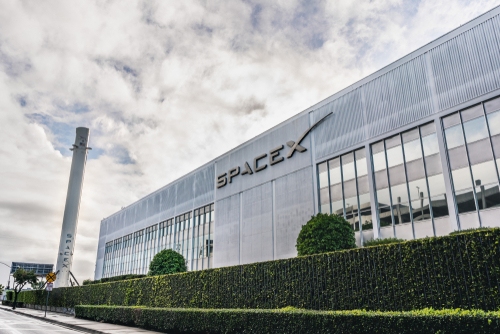
TradingKey - Since its historic IPO in June 2026, space technology and AI computing giant SpaceX ( SPCX) has seen its stock price undergo a dramatic roller-coaster ride. From an initial post-listing frenzy that propelled the shares to a high of $225.64 and pushed its market capitalization past $2 trillion, the stock subsequently entered a steady decline, recently nearing the $100 mark, representing a cumulative drop of 53%.
So, why has SpaceX's stock price continued to plummet? Will it hit new lows this year? What is Wall Street's stance on SpaceX's future prospects? We will conduct a detailed, step-by-step analysis of these questions.
Three Main Reasons for SpaceX Stock Price Decline
SpaceX's listing ushered in a three-day rally, followed by a continuous downward trend. This process can be subdivided into three stages, each corresponding to different reasons: excessive valuation overstretch in the early post-IPO period, an overall cooling of the tech sector alongside concerns over AI ROI, and pressure from earnings reports and the expiration of IPO lock-up periods.
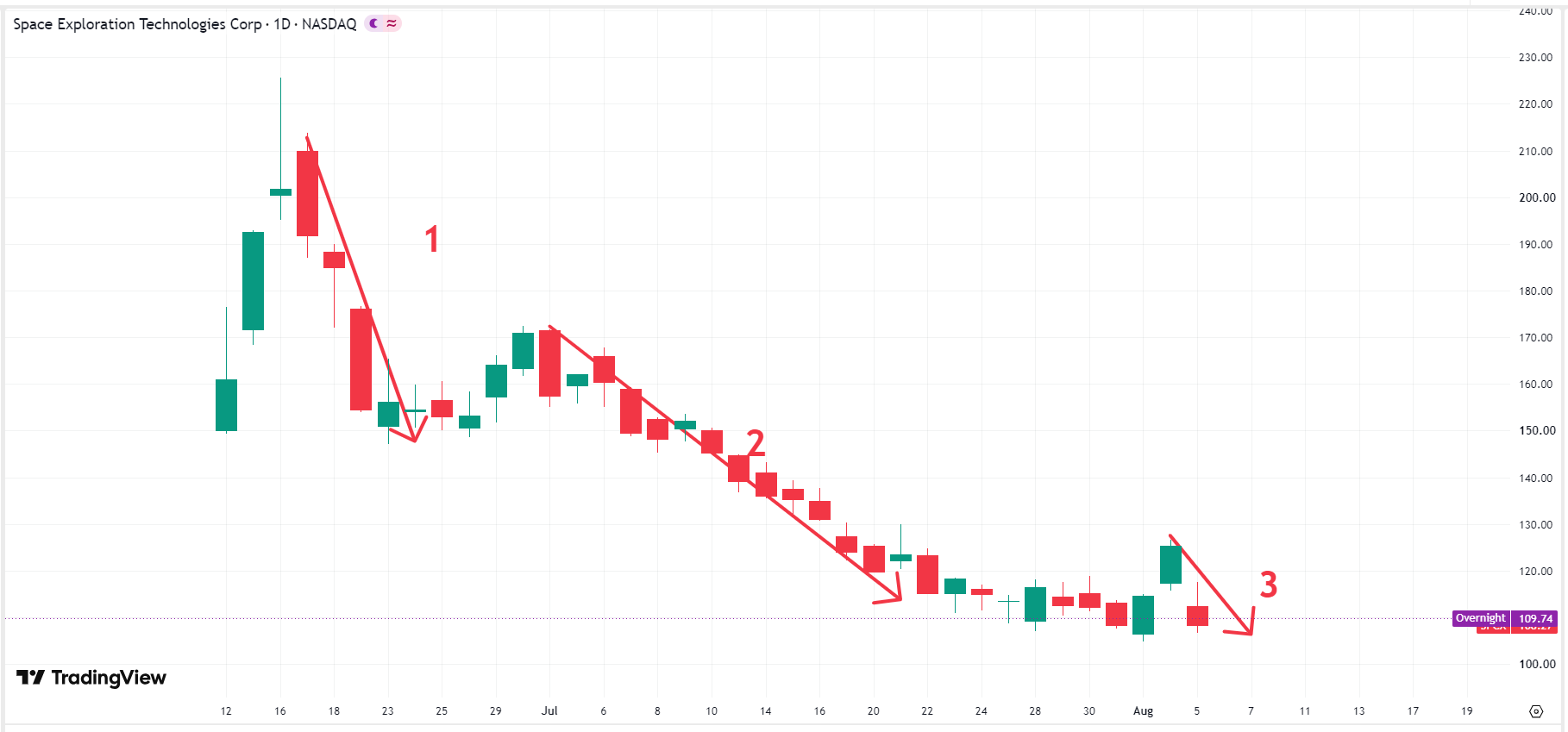 SpaceX stock price chart, Source: TradingView
On June 12, SpaceX's market capitalization surged to $2.1 trillion on its first day of listing. Based on this, its trailing price-to-sales (P/S) ratio reached over 110 times, far exceeding Nvidia ( NVDA ), Microsoft ( MSFT) and other U.S. tech giants, whose P/S ratios generally fall within the 15-35x range. This implies that SpaceX effectively priced in and exhausted its ultimate revenue growth for the next 5 to 10 years on its very first day of trading. Furthermore, SpaceX's prospectus outlined a massive total addressable market (TAM) of up to $28.5 trillion, of which approximately 90% ($25.6 trillion) was attributed to the newly integrated xAI/space AI computing infrastructure—a segment that contributed less than $3 billion in the second quarter.
Since July 2026, affected by concerns over Federal Reserve monetary policy and pullbacks in semiconductor stocks (such as Micron, AMD, Nvidia, and SK Hynix), the market's standard for examining the AI return on investment (ROI) of tech stocks has risen significantly, leading to a sell-off in high-beta SpaceX as well. In August, SpaceX released its first earnings report and entered its first IPO lock-up expiration period, delivering two major shocks to the market—staggering capital expenditures severely eroding free cash flow, and an expected addition of over 900 million shares to the public float, triggering another wave of investor selling.
Will SpaceX Stock Price Continue to Fall?
Currently, SpaceX still faces pressures such as valuation corrections in the tech and AI sectors, the cash-burn rate of AI squeezing free cash flow, and a wave of IPO lock-up expirations. This keeps it under downside and highly volatile pressure over the next 1–3 months, with the stock price continuing to repeatedly test the low at the $100 mark. If tech stocks as a whole weaken, a break below this level cannot be ruled out, which could lead to further declines to new lows.
Entering 2027, if SpaceX can prove these three key points, it will help provide intrinsic support for its stock price, enabling SPCX to stop falling and rebound. These include: 1. Starlink revenue maintains high double-digit growth, with its user base continuously expanding, providing a solid foundational cash flow for high R&D expenses; 2. Falcon 9 maintains a high market share in commercial launches, and Starship progresses smoothly, further reducing orbit insertion costs and maintaining technological barriers in the aerospace sector; 3. AI investments begin to yield returns, potentially prompting the market to assign a higher valuation once again.
SpaceX Stock Price Forecast: Wall Street Price Targets Diverge Sharply
SpaceX's Starship and space AI computing power are highly cutting-edge, and the market lacks reference standards, leading to extreme divergence among institutions regarding its future prospects and target prices, ranging from a low of about $60 to a high of $800, as detailed below:
Investment Bank / Research Institution | 12-Month Price Target | Core Valuation Logic |
Raymond James | $800.00 | Bullish on the long-term ultimate monopoly value of space networks and global AI infrastructure |
Morgan Stanley | $300.00 | The current stock price already values the AI business at zero, presenting an excellent entry point; Starship's progress is a key catalyst |
UBS | $210.00 | Scale effects in satellite communications are emerging, with strong long-term earnings growth potential |
CFRA | $115.00 | AI cash burn is too rapid, and the market is granting an excessively high forward premium |
Morningstar | $63.00 | Fair value calculated using a rigorous DCF probability model after deducting xAI losses |
Conclusion
Following its listing, SpaceX's stock price has plummeted by over 50% from its peak, primarily due to overextended initial valuations, an overall pullback in the semiconductor and AI sectors, as well as second-quarter earnings showing massive CapEx depressing cash flow and selling pressure from the lock-up expiration of 900 million shares. In the short term, the stock price may continue to test the $100 level, and could even break below it. However, it is expected to stabilize and rebound next year, depending specifically on Starlink's growth, Starship cost reductions, and AI returns.
This content was translated using AI and reviewed for clarity. It is for informational purposes only.
Recommended Articles








Comments (0)
Click the $ button, enter the symbol, and select to link a stock, ETF, or other ticker.