


SpaceX Stock Price Forecast: Cooling Tesla Merger Expectations Ease Premium Acquisition Concerns, May Support Rebound Above $140



AI Podcast


Following the Democratic sweep of the U.S. Congress, GLJ Research notes that a potential SpaceX-Tesla merger faces higher costs and a lower probability. While acquisition premiums of 20% to 35% previously concerned SpaceX shareholders regarding equity dilution, a stalled deal reduces transaction burdens, allowing focus on Starlink's profitability. Technically, SpaceX remains in a rebound phase capped at the $132.35–$132.79 resistance zone. Reclaiming this area is essential for further recovery toward $140.76–$142.58, whereas a breakdown risks retesting previous lows, increasing downside exposure amid ongoing regulatory and congressional scrutiny.
TradingKey - After Democrats won both houses of the U.S. Congress, GLJ Research believes that a potential merger between SpaceX (SPCX) and Tesla (TSLA) would become slower, more costly, and less likely.
For existing SpaceX shareholders, if the transaction originally required paying a high premium, a slowdown in progress could alleviate concerns about relinquishing too much equity and provide some support for its valuation.
The acquisition price is key to understanding this rationale. According to Reuters, RBC Capital Markets and JPMorgan previously estimated that Tesla shareholders could demand an acquisition premium of 20% to 35%. Ross Gerber, CEO of Gerber Kawasaki, which holds shares in both companies, noted that with SpaceX's expenses continuing to rise, paying an acquisition premium would dilute its shareholder equity.
In an all-stock transaction, all else being equal, the higher the premium, the more shares SpaceX would need to issue to Tesla shareholders. Whether existing shareholders can benefit depends on whether the acquired business and synergy value can compensate for the equity surrendered. If investors perceive the acquisition price as too high, a lower probability of a deal helps ease this valuation pressure.
Piper Sandler analyst Alexander Potter also noted on November 2 that the acquisition premium, synergies, and deal risks are key variables affecting both companies' stock prices, and investors may question whether the synergy value can reach hundreds of billions of dollars. A higher premium thus raises the hurdle for existing SpaceX shareholders to achieve positive returns.
Currently, policy pressures regarding congressional oversight and land transfers persist. However, if the likelihood of a high-premium acquisition diminishes while Starlink continues to expand profitability, existing SpaceX shareholders could see potential deal burdens reduced and retain more upside from the standalone business's growth.
From a technical perspective, SpaceX is currently in a gap-up rebound phase following a sharp decline, with prices still capped by the 0.618 Fibonacci retracement level ($132.35) and yet to restore its prior consolidation structure.
The current pivot is the $132.35–$132.79 zone formed by the aforementioned retracement level and the 5-day exponential moving average. Until it firmly reclaims this area, the recent advance should still be viewed as a post-breakdown rebound, which is insufficient to confirm that the trend is strengthening.
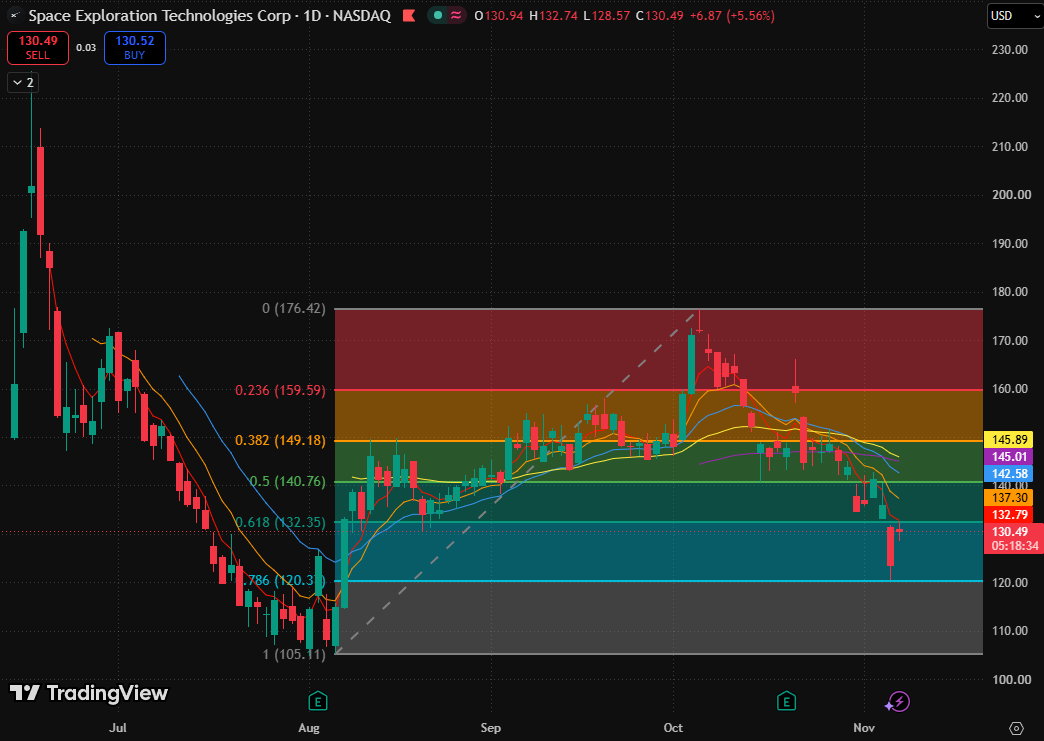
SpaceX stock chart, Source: TradingView
Going forward, only if the stock reclaims and consolidates above the $132.35–$132.79 confluence zone, finding buying support on pullbacks, will the rebound have the conditions to continue its recovery. The next target zone is the $140.76–$142.58 area formed by the 0.5 Fibonacci retracement level and the 20-day exponential moving average.
The greatest risk is that, after facing resistance during the rebound, the stock retests and decisively breaks below the area adjacent to the previous day's low and the 0.786 Fibonacci retracement level. In that case, recent support would fail, prices would form a lower low, and the risk of extending further toward the early August all-time low would increase.
This content was translated using AI and reviewed for clarity. It is for informational purposes only.
Recommended Articles











Comments (0)
Click the $ button, enter the symbol, and select to link a stock, ETF, or other ticker.