


Nasdaq Drops Over 5%, Philadelphia Semiconductor Index Plunges 12% as Chip and AI Infrastructure Stocks Are Sold Off; Micron Falls 17%, Nvidia Drops 9%



AI Podcast


On Thursday, November 5, Eastern Time, U.S. stocks suffered their sharpest single-day decline since April 2025, driven by a tech selloff. The S&P 500 fell 4.36% and the Nasdaq dropped 5.52%. Mounting concerns over tighter data center regulations following the Democratic victory—impacting roughly 45% of planned U.S. capacity—weighed heavily on chip and AI infrastructure stocks. Meanwhile, Federal Reserve officials signaled that policy rates must enter restrictive territory via small, frequent hikes to curb persistent inflation. Corporate developments included Micron pausing a $4.5 billion plant, Google announcing a $17 billion data center investment, and Apple securing massive demand for a bond sale.

TradingKey - On Thursday, November 5, Eastern Time, U.S. stocks fell sharply, giving back the previous day's post-election rally gains. Mounting concerns over a slowdown in data center construction prompted investors to accelerate their reduction of tech holdings, with chip and AI infrastructure-related stocks bearing the brunt of the selloff.
At the close, the Dow Jones Industrial Average fell 3.44% to 51,523.06; the Nasdaq Composite Index dropped 5.52% to 24,315.00; and the S&P 500 dropped 4.36% to 7,353.73, marking its largest single-day decline since April 2025.
Tech Stock Performance
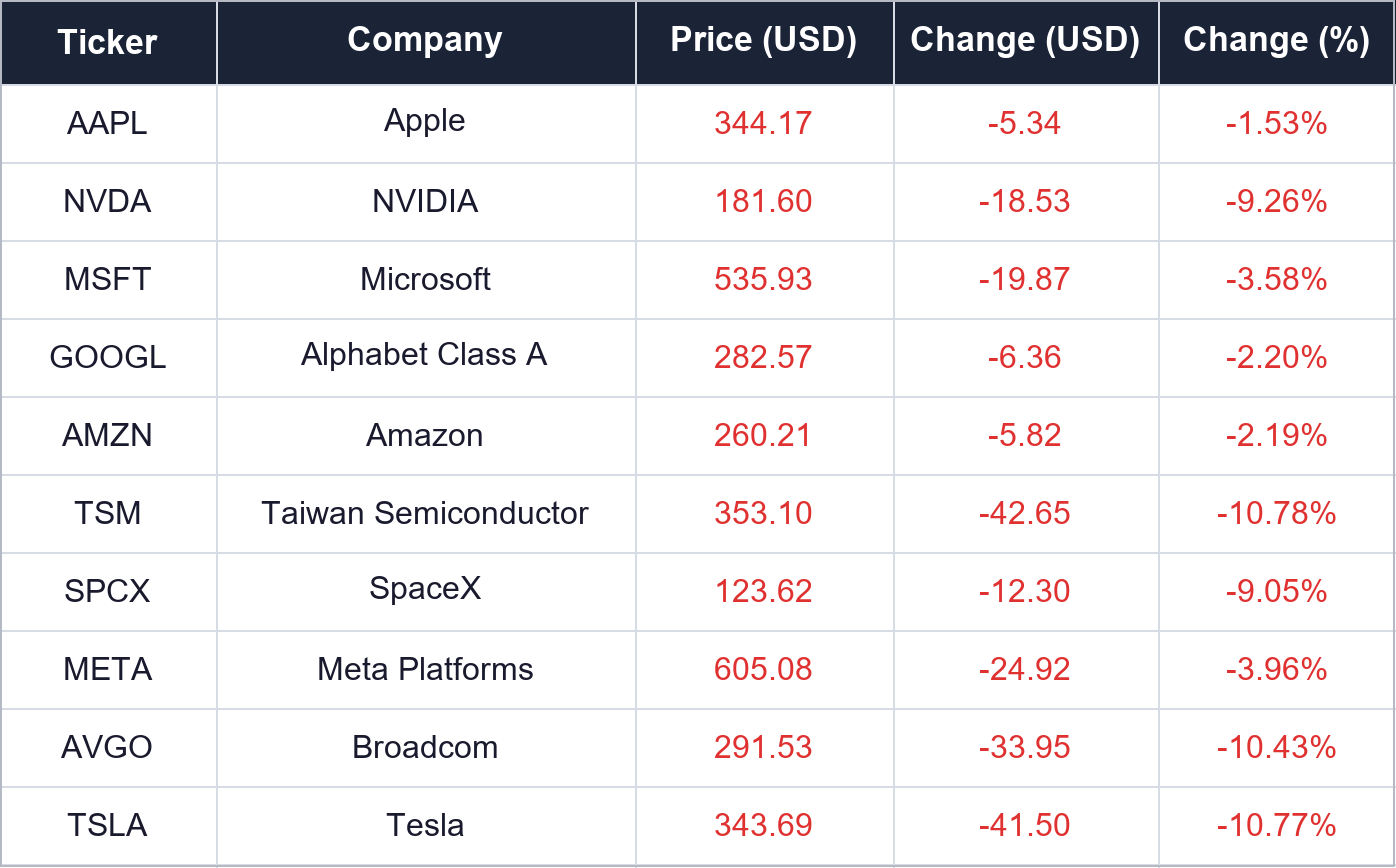
SpaceX (SPCX) dropped more than 9%, while Tesla (TSLA) fell over 10%. Following the Democratic victory, SpaceX's government and defense contracts as well as Tesla's autonomous driving business may face tighter scrutiny, which could drive up compliance costs and increase uncertainty surrounding contract procurement and business expansion.
Today's performance of mega-cap tech stocks is shown in the chart below:
The Philadelphia Semiconductor Index fell 12.25% to 9,011.14 points, with all 30 constituent stocks declining across the board.
Memory chip stocks suffered heavy losses: SanDisk (SNDK) plunged 22.26%, Micron Technology (MU) tumbled 17.46%, Western Digital (WDC) fell 17.35%, Seagate Technology (STX) dropped 16.25%, and SK Hynix (SKHY) declined 13.40%.
The Democrats' sweeping victory in the U.S. midterm elections sparked investor concerns over tightening data center regulations. For memory chip stocks, potential construction pauses could delay the delivery of servers and storage equipment, introducing fresh timing uncertainties to revenue growth supported by AI demand. Goldman Sachs estimates that states likely to tighten data center oversight account for about 45% of planned new U.S. capacity, with Texas alone representing roughly a quarter of the national total. The affected regions may pause approvals for new projects pending fresh legislation regarding power, water usage, and tax incentives.
Company News
Micron Reportedly Pauses Construction of $4.5 Billion Taoyuan Plant as Labor Dispute Impacts Expansion Plans
Micron Technology (MU) has paused construction of an approximately $4.5 billion memory chip plant in Taoyuan, Taiwan, due to an ongoing local labor dispute, Bloomberg reported, citing people familiar with the matter. The report said management's concerns over project uncertainties have grown, including the potential overturning of a previously reached agreement with the labor union. At a time when AI is driving surging memory demand, the project's suspension introduces new variables to Micron's local expansion timeline.
Google Plans $17 Billion Investment in Wyoming, Combining Fuel Cells and Carbon Capture for Power
Google announced a $17 billion long-term investment in Wyoming, U.S., to build the state's first data center. Located in Laramie County, the project's partners include Tallgrass Energy, Black Hills Energy, American Electric Power (AEP), and Related Digital. The project plans to use fuel cells for electricity generation combined with carbon capture and storage technology. Google stated that it will cover all electricity costs as well as infrastructure expenses directly resulting from the project's growth, avoiding shifting related burdens onto the local community and other utility customers. Google estimates that the project will generate hundreds of millions of dollars in property tax revenue for Laramie County and the local School District No. 1, while supporting education, workforce training, and economic development.
Apple Plans $7 Billion Bond Sale, Draws Roughly $310 Billion in Orders
According to people familiar with the matter, Apple's (AAPL) planned investment-grade bond offering of about $7 billion attracted approximately $310 billion in orders, roughly 4.4 times the target issuance size. Strong demand drove issuance spreads tighter, helping the company lower its financing costs.
The transaction follows a recent flurry of debt issuance by major U.S. tech companies. Apple plans to use the proceeds for general corporate purposes, including share buybacks and debt repayments, though the final deal size could still be adjusted depending on demand.
OpenAI Releases GPT-6 Cyber, Boosting Vulnerability Research and Task Boundary Control
OpenAI has introduced GPT-6 Cyber for cybersecurity research. According to evaluations published by the company, the model scored 48.5% on the ExploitGym exploit evaluation, up 16.4 percentage points from GPT-5.6 Cyber's 32.1%. In another authorization boundary evaluation, when deployment prompts were not enabled, the model avoided exploiting vulnerabilities in out-of-scope services 99.93% of the time; with prompts enabled, that rate reached 100%. All of the above figures are derived from specific tests released by OpenAI.
Industry & Macro News
The New York Times: US and Israel Have Drafted Strike Plans Against Iran, Action Still Hinges on Trump's Decision
According to The New York Times, citing US officials and people familiar with the discussions, the US and Israeli militaries have drawn up plans for a short, intensive military campaign against Iran, with potential targets including energy infrastructure, nuclear facilities, and missile and drone arsenals. The report noted that US personnel deployed on warships and at relevant bases are prepared, but whether to resume large-scale operations still hinges on an order from Trump. Although Trump has signaled he is in no rush to resume bombing, military options have not been ruled out, and the Middle East continues to face uncertainty.
Hammack: Rates Need to Enter Restrictive Territory, Favors Small, Frequent Hikes
Cleveland Fed President Beth Hammack said on November 5 in Zurich that the Federal Reserve needs to push its policy rate into restrictive territory to bring inflation back to 2% in a timely manner. She favored achieving this through more frequent, smaller adjustments to reduce the risk of a lagging policy response while softening the impact on households, businesses, and financial markets. Hammack pointed out that inflation has been above target for nearly six consecutive years, and price pressures remain relatively broad-based. In September, headline and core PCE inflation were 3.6% and 3.1%, respectively, both well above the 2% target.
This content was translated using AI and reviewed for clarity. It is for informational purposes only.
Recommended Articles









Comments (0)
Click the $ button, enter the symbol, and select to link a stock, ETF, or other ticker.