


Today’s Market Recap: AMD Microsoft Partnership Boosts Semiconductor Sector, AMD, Intel, Micron Collectively Rebound



AI Podcast


On July 20, Eastern Time, major U.S. indices closed lower as investors weighed Middle East geopolitical tensions, high oil prices, and upcoming mega-cap earnings. Despite broader market caution, semiconductor stocks rebounded, supported by AMD’s expanded partnership with Microsoft and news of Google’s specialized "Frozen v2" inference chip development. Crude oil prices remained elevated due to Houthi-related supply risks in maritime shipping lanes. While chip sector recovery suggests tactical buying, valuation pressures and rising Treasury yields continue to constrain upside potential as the market awaits further evidence of AI capital expenditure and earnings sustainability.

Tracking Market Trends
TradingKey - On July 20, Eastern Time, the three major U.S. stock indexes closed slightly lower. Investors continued to weigh the escalation of the Middle East situation, high oil prices, and the impact of this week's mega-cap tech earnings. Although the semiconductor sector rebounded after last week's sharp drop, the strengthening of the U.S. dollar and Treasury yields, coupled with the fact that valuation pressures on AI trades have not yet been fully released, capped the market's rebound space.
At the close, the Dow Jones Industrial Average fell 0.59% to 51,839.26 points; the S&P 500 Index declined 0.19% to 7,443.28 points; and the Nasdaq Composite Index slipped 0.05% to 25,508.07 points.
In terms of sectors, semiconductor stocks rebounded from last week's sharp decline. The Philadelphia Semiconductor Index rose 0.6%. Among individual stocks, Nvidia ( NVDA) rose 0.23%, AMD ( AMD) rose 1.58%, Micron Technology ( MU) rose 1.94%, Intel ( INTC) rose 2.13%, Marvell ( MRVL) rose 3.32%, SanDisk ( SNDK) rose 2.67%. The recovery in chip stocks indicates that some capital is beginning to buy back AI hardware assets that had suffered large losses earlier, but the overall market is still waiting for mega-cap tech earnings reports to validate AI capital expenditure and earnings performance.
In commodities, crude oil continued to maintain its high level. Brent crude ( UKOIL) closed higher at $88.80, and WTI ( USOIL) crude oil closed higher at $82.41. The rise in oil prices was primarily driven by the situation in the Middle East, where Houthi forces threatened a naval blockade on Saudi Arabia, while conflicts between the U.S. and Iran showed no obvious signs of cooling. The market continued to price in supply risks in the Strait of Hormuz, the Bab el-Mandeb Strait, and Saudi export channels. Gold ( XAUUSD) fell slightly to around $4,007.
Market News
Houthis threaten to block Saudi maritime shipping lanes, further escalating energy risks. Yemen's Houthi rebels stated they will implement a maritime blockade on Saudi Arabia, fueling market fears of further disruptions to Middle Eastern energy transport. The crude oil market is currently focusing not only on the Strait of Hormuz but is also repricing potential supply risks in the Bab-el-Mandeb Strait, the Red Sea, and Saudi export routes. Both WTI and Brent crude remain near recent highs, as energy prices continue to be a crucial variable affecting inflation expectations and equity market sentiment.
AMD expands AI partnership with Microsoft ( MSFT) AI partnership, repairing short-term sentiment for chip stocks. Market sources indicate that Microsoft will expand its use of AMD's Helios AI infrastructure solutions to support Azure AI services and customer applications. The news drove AMD's stock price higher, also lifting some semiconductor stocks in a rebound from last week's selloff. For the market, the Microsoft-AMD partnership demonstrates that cloud giants are still expanding their AI computing supply chains and seeking more hardware alternatives beyond Nvidia.
Google ( GOOGL) reportedly developing dedicated Gemini inference chip, shifting AI chip competition toward specialization. Market sources report that Google is developing "Frozen v2," a next-generation AI inference chip for its Gemini models, with plans to write the Gemini model architecture directly onto the silicon to boost inference efficiency and lower operating costs. Reports suggest the chip's inference efficiency could be 6 to 10 times higher than current TPUs. Compared to general-purpose AI accelerators, this design sacrifices some flexibility in exchange for higher performance and lower costs, signaling that AI chip competition is shifting from "general-purpose computing expansion" to "specialized inference optimization."
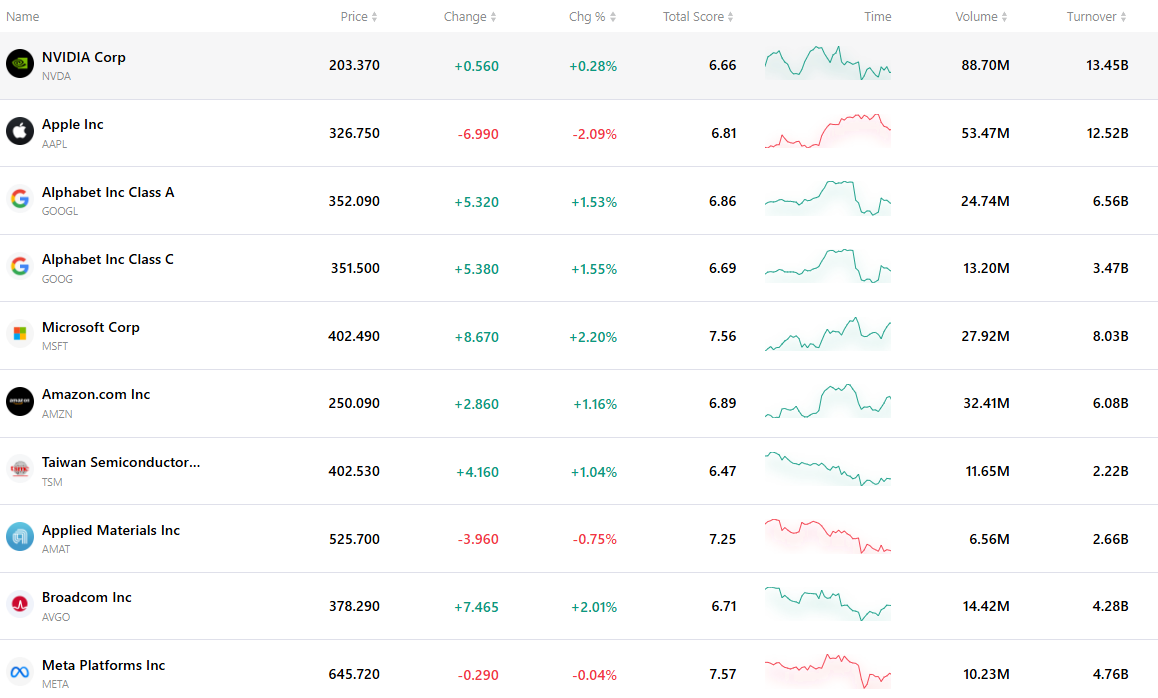
Top 10 Most Active Stocks
The table below lists the ten most actively traded stocks in the current market. Supported by massive trading volumes and excellent liquidity, these assets have become key benchmarks for tracking global market dynamics.
This content was translated using AI and reviewed for clarity. It is for informational purposes only.
Recommended Articles









Comments (0)
Click the $ button, enter the symbol, and select to link a stock, ETF, or other ticker.