


SpaceX Stock Price Forecast: As Stock Lockups Intensify, Can SPCX Peak at $225 by 2027?



AI Podcast


SpaceX utilizes a phased, rolling lock-up expiration mechanism spanning from late July 2026 to June 2027 to prevent market destabilization. Despite initial concerns regarding massive insider share releases, strong earnings reports and robust buying demand have effectively absorbed potential selling pressure, stabilizing the stock. While completing these unlocks will eliminate the share overhang by mid-2027, achieving a sustained rally back to its all-time high of $225 heavily relies on fundamental catalysts, including Starlink profitability and Starship commercialization progress.
What Is the SpaceX Lockup Expiry Wave?
TradingKey - The SpaceX lock-up expiration wave refers to the event where, following SpaceX's initial public offering (IPO), transfer restrictions on locked-up shares held by insider employees, early investors, and the founding team are officially lifted, allowing them to be sold in the open market.
To prevent a stock price collapse caused by a massive dump of insider shares shortly after listing, lock-up expirations usually occur in tranches rather than all at once. In addition, given SpaceX's massive valuation and unique capital structure, it utilizes a special phased lock-up expiration mechanism, including staggered releases, performance-based dynamic triggers, longer lock-up periods for founders, and other measures.
How Is the SpaceX Stock Lockup Expiration Progressing?
SpaceX's share unlocks are mainly divided into three stages: employees/ordinary former shareholders, long-term strategic investors, and Elon Musk's personal holdings. Currently, Stage 1 is underway, as detailed below:
Stage | Timing | Target Group | Unlock Scale |
Stage 1 | Late July / Early August 2026 | Employees and pre-IPO shareholders | 20% of the 180-day lock-up |
August 20, 2026 – October 24, 2026 | Employees and ordinary shareholders (Regular rolling unlock) | 7% released per tranche, approximately 300 million shares (Tranches set at 70 days, 90 days, 105 days, 120 days, and 135 days) | |
Stage 2 | Late October / Early November 2026 | Employees and pre-IPO shareholders | 28% of the 180-day lock-up block (approx. 1.3 billion shares, one of the largest single unlocks) |
December 8, 2026 – December 9, 2026 | Employees and ordinary former shareholders (Full 180-day unlock)
| All remaining shares in this pool (300–700 million shares) | |
February 2027 – August 2027 (Released in tranches after Q4'26, Q1'27, and Q2'27 earnings reports) | Major institutional and strategic investors (Extended lock-up expiry) | Approx. 1.4 billion shares | |
Stage 3 | June 12, 2027 – June 13, 2027 | Elon Musk and a select few core members | Approx. 6.4 billion shares |
As shown in the table above, share unlocks for SpaceX are relatively frequent in the current stage, but the scale of each individual unlock is not particularly large before gradually increasing, with the largest single tranche occurring after the Q3 earnings report. In addition, completing the unlocks by June next year means that potential selling pressure will be largely eliminated in the second half of the year.
How Will SpaceX’s Stock Price Trend in 2027?
SpaceX's stock price surged to $225 three days after listing, setting an all-time high. Subsequently, SpaceX's stock price continued to pull back, approaching the $100 mark at the end of July this year, forming a bottoming pattern technically. Notably, this phase coincided with the first lockup expiration after SpaceX's listing. However, on the actual day of the lockup expiration, the stock price rebounded instead of falling, and thereafter continued to bounce back and strengthen, returning to fluctuate within the $140–$150 range.
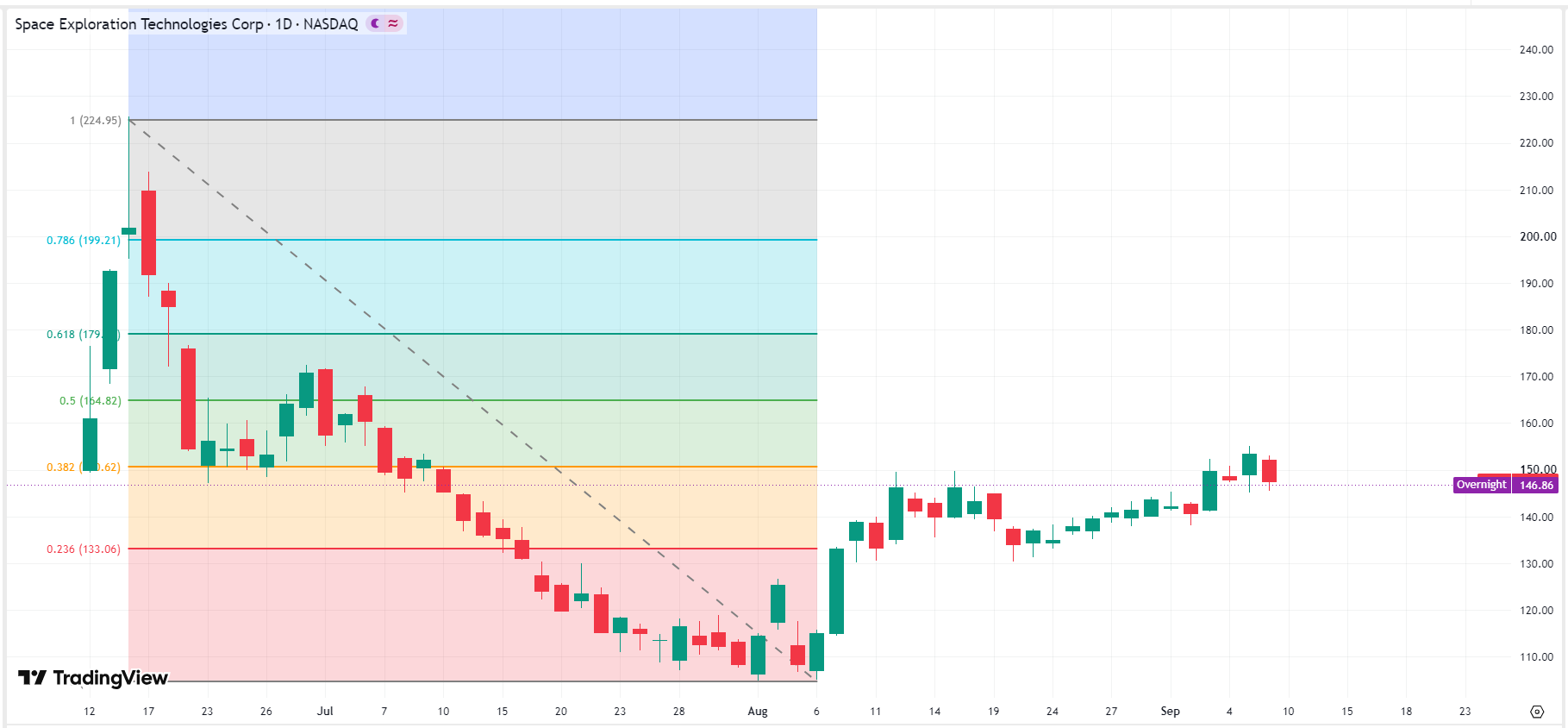 SpaceX stock price chart, Source: TradingView
Although SpaceX's lockup expiration released a large number of floating shares, its stellar first earnings report also attracted buying interest to absorb potential selling pressure, so a lockup expiration does not necessarily drive the stock price down. Furthermore, relying solely on the supply-side factor of lockup completion makes it difficult to directly drive SpaceX's stock price back to its all-time high of $225, as the lockup expiration itself primarily affects share supply and demand and market trading dynamics.
Over the next year, as SpaceX's lockup expirations continue to progress, potential selling pressure will become increasingly heavy, but earnings reports will also be released at the same time. For the stock price to experience a rally of over 50% to return to its all-time high, it will still require the alignment of core catalysts such as company revenue fundamentals, Starlink profitability, and Starship commercial progress.
Conclusion
SpaceX employs a phased, rolling lockup release mechanism. Although frequent share releases create potential selling pressure, stellar financial results and strong buying demand have successfully absorbed the sell-off. As the lockup releases conclude in mid-2027, the share overhang will be eliminated, and SpaceX is expected to revisit its high of $225. However, this still requires supporting fundamental catalysts such as Starlink profitability and Starship commercialization.
This content was translated using AI and reviewed for clarity. It is for informational purposes only.
Recommended Articles










Comments (0)
Click the $ button, enter the symbol, and select to link a stock, ETF, or other ticker.