


QQQ Rises More Than 1% as ASML and TSMC Prepare to Report, Goldman Sachs Expects Another Strong Earnings Season for US Stocks



AI Podcast


On June 30, Eastern Time, US indices rose, led by a semiconductor surge. Major investment banks, including Goldman Sachs and Citigroup, have raised their 2026 S&P 500 year-end targets to between 7,500 and 8,100, citing robust corporate earnings and the AI capital expenditure supercycle. This rally is underpinned by tangible demand for AI infrastructure rather than mere valuation expansion. Investors should monitor upcoming earnings from ASML, TSMC, and others to verify if AI investments are translating into financial performance, as AI-related stocks are expected to drive nearly 60% of S&P 500 EPS growth this quarter.
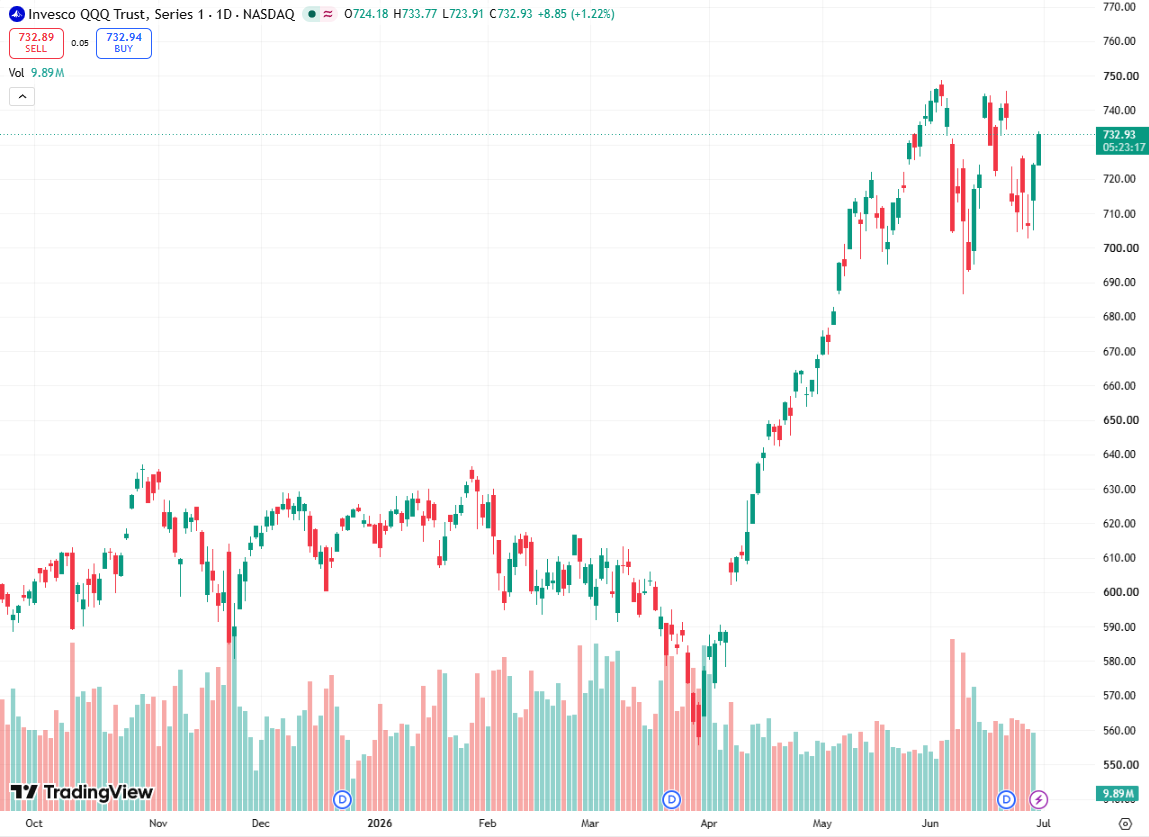
TradingKey - Early in the trading session on June 30, Eastern Time, the three major US stock indices all strengthened, with the Nasdaq 100 Index ETF (QQQ), which tracks tech stocks, rising over 1%, and the Philadelphia Semiconductor Index jumping more than 3%.
Specifically, KLA (KLAC) rose 5.94%, Lam Research (LRCX) gained 4.91%, Marvell Technology (MRVL) climbed 4.76%, Intel (INTC) went up 4.62%, SanDisk (SNDK) rose 4.47%, Arm Holdings (ARM) gained 4.47%, ASML (ASML) advanced 4.44%, and Applied Materials (AMAT) ticked up 4.09%.
[Source: TradingView]
As corporate earnings continue to materialize and geopolitical risks subside, major Wall Street institutions have released their mid-year outlooks, unanimously raising their S&P 500 year-end 2026 target prices. The latest data shows that current institutional target forecasts are heavily clustered in the 7,500 to 8,000 range.
Among them, Citigroup and Oppenheimer set their targets at 8,100, with BCA Research also raising its target to this high; subsequently, Goldman Sachs, Deutsche Bank, and Morgan Stanley anchored their targets at the 8,000 threshold. In addition, Wells Fargo raised its target to 7,950, UBS and RBC raised theirs to 7,900, JPMorgan and Barclays lifted theirs to 7,800, HSBC raised its target to 7,650, and Jefferies hiked its target to 7,500, all joining the bullish camp.
The core driver behind major investment banks collectively raising their S&P 500 targets comes from the strong improvement in actual corporate earnings and the AI capital expenditure "supercycle." They generally believe this rally does not rely solely on valuation premiums, but is supported by real profit growth driven by demand for AI infrastructure, such as semiconductors and data centers. Meanwhile, the temporary easing of geopolitical risks, coupled with the recent correction resetting overheated market sentiment back to neutral, has carved out further upside potential for the market.
On the other hand, with the US earnings season approaching, the market needs to monitor the performance of companies across the AI value chain to find reliable proof of AI demand and profitability.
Earnings Release Date | Company Name | Position in the AI Value Chain |
July 15 | ASML (ASML) | The absolute monopoly in global high-end lithography machines and an essential equipment supplier for advanced-process AI chip production. Positioned at the absolute upstream of the AI computing power value chain, its orders and shipment guidance serve as the core bellwether for the entire industry's health. |
July 16 | TSMC (TSM) | The undisputed leader in global foundry services, manufacturing mainstream cloud-based AI chips. It is a core manufacturing hub for implementing AI computing hardware, with its advanced process capacity and capital expenditure guidance directly determining the pace of global AI computing power supply. |
July 22 | IBM (IBM) | A global leader in enterprise AI and IT services, focusing on industry-specific large language models, enterprise AI solutions, and hybrid cloud AI deployment. It serves as a key observation target for the progress of B2B AI commercialization. |
July 29 | ARM Holdings (ARM) | The absolute leader in global chip IP and the core licensor of AI chip architecture. It is the standard-setter for the underlying architecture of edge and cloud full-scenario AI computing power, covering the architectural foundation of the vast majority of AI chips. |
Qualcomm (QCOM) | A global leader in mobile and device chips, and a key supplier of on-device AI computing power for consumer electronics. It dominates the technological iteration and widespread adoption of terminal AI chips within the Android ecosystem. | |
August 13 | Applied Materials (AMAT) | A global leader in semiconductor equipment, covering core wafer manufacturing processes such as thin-film deposition, etching, and metrology. It is a key upstream equipment supplier for AI chip capacity expansion, with its orders and shipment data directly reflecting the health of global AI chip production expansion. |
Goldman Sachs stated that with the dual drivers of the AI investment boom and rising oil prices, US stocks will sustain their high-growth momentum in the second quarter. Since this rally is entirely driven by the earnings side, this earnings season will serve as a core juncture to verify market sustainability. The market's focus has shifted from the AI expenditures of leading tech giants to whether broader industrial AI investments can bear fruit and translate into actual financial performance.
During this earnings season, the core question for investors will be the AI spending of non-Big Tech companies and whether these investments are beginning to show returns—especially for AI infrastructure stocks, which are expected to contribute nearly 60% of the S&P 500's EPS growth this quarter. Among them, Micron Technology, Inc. and Nvidia Corporation alone could contribute more than 40% of that growth.
This content was translated using AI and reviewed for clarity. It is for informational purposes only.
Recommended Articles








Comments (1)
Click the $ button, enter the symbol, and select to link a stock, ETF, or other ticker.