


Iridium Stock Outlook: Can Subscriber Growth and Spectrum Value Lift IRDM After the EPS Miss?



AI Podcast


Iridium Communications (NASDAQ: IRDM) remains bullish despite a Q1 2026 EPS miss, which stemmed from a pre-announced shift to cash-based incentive compensation rather than operational weakness. Subscriber growth continues, specifically in commercial IoT, rising 5% year-over-year to 2.56 million. Management reaffirmed full-year EBITDA guidance, and analyst sentiment is strengthening due to L-band spectrum value. Technically, the stock is testing an ascending trendline at $54.55. With no bearish divergence, a breakout above $55.20 targets $57.20. Key risks include RSI levels in overbought territory, while investors await Q2 results on July 23, 2026.
TradingKey - Iridium Communications (NASDAQ: IRDM) is trading at $54.55 after testing the top of an uptrend black line on the four-hour timeframe. While its RSI (77.58) is in overbought territory, bullish momentum continues and there is no bearish divergence at the moment.
Iridium reported a Q1 2026 top-line of $219.1 million, which matches the consensus expectation of $219.18 million and is up 1.9% year-over-year. While EPS of $0.20 missed estimates by 28.57% (consensus is at $0.28), this is a one-time event. In fact, total billable subscribers are now up 5% year-over-year at 2.56 million and continue to be driven by growth in commercial IoT. The EPS miss comes as a result of a previously announced change that makes all annual incentive compensation purely cash rather than a combination of cash and equity. On June 3, Oppenheimer raised the stock target to $60 and maintains an Outperform on the name.
Why the EPS Miss Was a Compensation Decision, Not a Demand Problem
The full EPS miss in Q1 2026 can be traced to one factor: SG&A expenses were $45.78 million, more than $10 million more than the $35.75 million level seen in the year-ago period. Management explained the increase to reflect an annual incentive-compensation structure that was changed to be 100% cash rather than a mix of cash and equity that it had used previously.
Iridium had signaled in its Q4 2025 earnings call that it planned to make that shift, so it shouldn’t have been surprising. The only thing to really catch analysts off guard in this instance was how the market reacted to the headline EPS miss without fully digesting the disclosed factor. On the Q1 call, CFO Vincent O’Neill said the move will have an impact of $17 million on 2026 Operational EBITDA for the full year, noting that Iridium reconfirmed its full-year guidance for the year at $480 million to $490 million. That guidance would have been $497 million to $507 million without that decision by management. The Operational EBITDA result in Q1 2026 fell by 5% to $116.3 million as a result.
The difference is that the former reflects a temporary change in accounting and compensation structure, not a decline in performance for the business as a whole. In Q1 2026, service revenue, which accounts for 72% of the company’s revenue and is key for Iridium in terms of its economics for recurring high-margin services, was up 2% year-over-year to $158.0 million. Commercial service alone accounted for 60% of revenue.
Matt Desch, Iridium’s CEO, said on the earnings call the quarter got off to a solid start with continued service revenue growth as well as new product introductions including a next-generation IoT platform launching in the middle of the year. The stock was even up 2.5% in the first couple of days after the company released its Q1 2026 results, so it doesn’t appear that the fact that it was a compensation decision behind the EPS miss took all that long to register in the minds of market participants even though it wasn’t obvious in a cursory glance at the results.
Subscriber Growth and the Spectrum Optionality Story Driving Analyst Upgrades
Subscriber counts reached 2,555,000 for the quarter, an increase from 2,537,000 subscribers at the end of Q4 2025 and up 5% year-over-year from 2,443,000 a year earlier. That was an increase even as the company posted earnings of a miss for the quarter that was driven by an increase in SG&A. Growth in subscriber counts was led by the commercial IoT market, just like the rest of last year as Iridium positions itself as the satellite network provider of choice in the asset-tracking, remote equipment-monitoring, and logistics markets, especially in areas that can’t be served by traditional ground-based networks like ships at sea, the poles, or remote areas of landmass.
In addition, Iridium is among the handful of companies that has L-band spectrum in its portfolio, which it uses to provide services. That has better weather and foliage penetration than the higher-frequency spectrum used by some of the newer constellations in low-Earth orbit, giving it an edge over competitors in that regard as those new entrants develop their own direct-to-device offerings and as 5G non-terrestrial network services develop.
Even without any specific deal for spectrum monetization announced, that’s the forward-looking story that is now receiving more and more attention from analysts. Iridium’s L-band spectrum has become an attractive asset on its own, separate from the actual satellite network that it runs and the service that it provides, thanks in part to growing interest in direct-to-device capabilities and the need to own the spectrum to provide that service on a global basis, given the global satellite network required and the relative lack of available spectrum suitable for that application, a scenario that is likely to persist.
The 10-analyst average price target for Iridium stood at $37.88 as of late June, the target ranging from $16 to $60. On June 3, Oppenheimer’s Timothy Horan raised the target to $60 citing spectrum optionality. The $54.55 price for Iridium is significantly above the average price target but it shouldn’t come as much of a surprise considering that sentiment appears to have shifted considerably in the months since April.
IRDM Technical Setup — Trendline Defense Near Overbought, Target $57.20
In the 4H time frame, IRDM has been rebounding off the black ascending trendline with several touches, after getting repulsed several times on the descending trendlines that started at the $56+ tops, keeping price above the EMA200 (at $43.00) in higher lows formation. RSI currently at 77.58 is on the verge of getting overbought with good bullish momentum, and no bearish divergence forming which means bulls are still interested in buying and there is no reversal in sight.
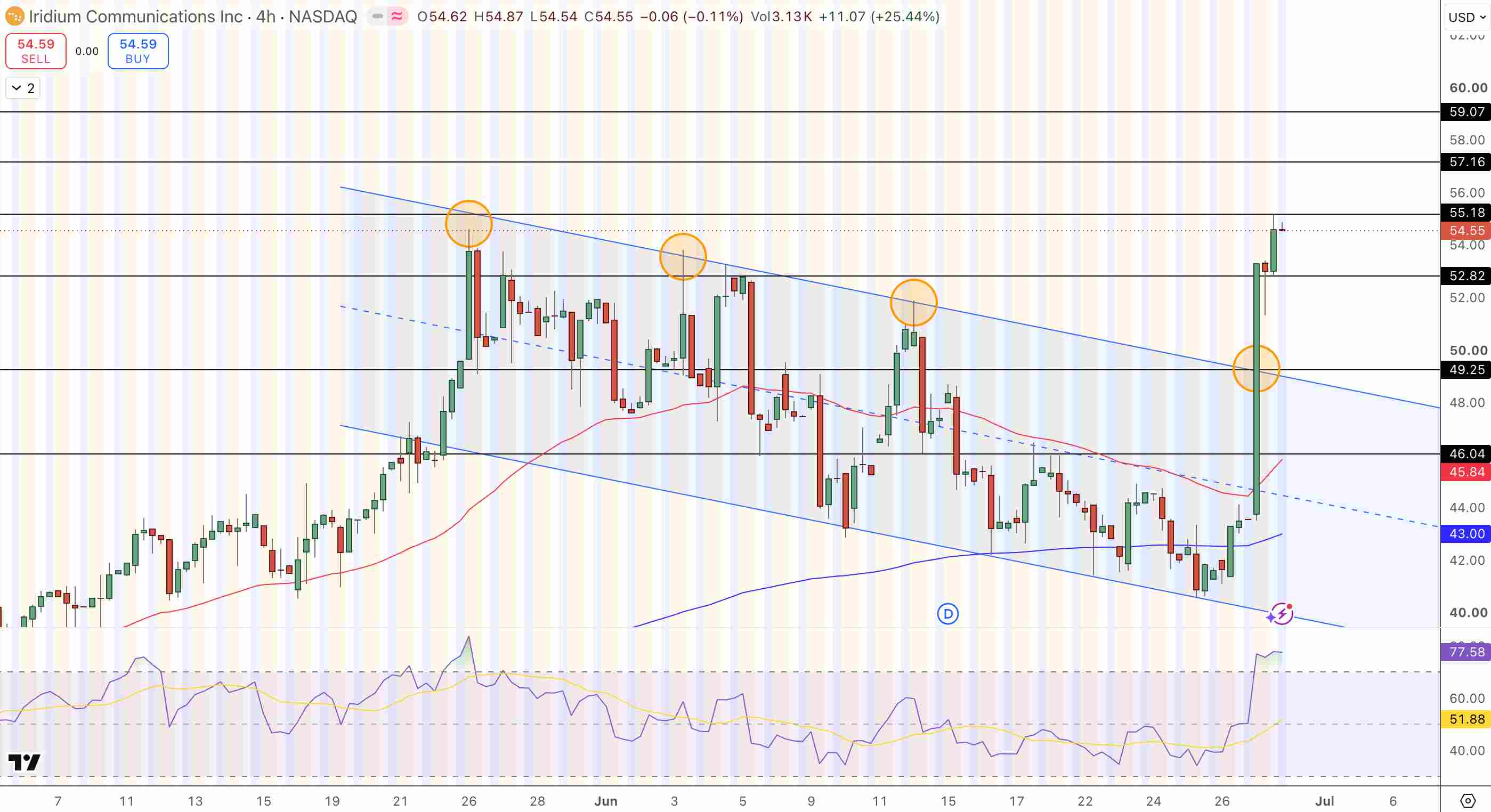
Iridium Stock Price Chart - Source: Tradingview
Resistance above is $55.18 to $57.16. If price holds at the trendline, then a bounce to $57.16 to $59.07 is possible; otherwise a drop to $49.25 to $45.84 is possible. A confirmed breakout at $55.20 has a target of $57.20 on the bounce to the trendline.
- Entry: Long above $55.20 — trendline and resistance cleared
- Target: $57.20 — trendline bounce extension
- Stop Loss: Close below $49.25 — ascending trendline fails
- Subscribers: 2.56M total billable, +5% YoY, led by commercial IoT
- Full-year OEBITDA guide: $480–490M (reiterated, reflects ~$17M comp impact)
- Next earnings: July 23, 2026
Bottom Line
Iridium's Q1 2026 Earnings miss was a function of how they structure their compensation, which was communicated prior to the reporting date, not an issue of demand or operations. They added subscribers 5% to reach 2.56M, service revenue added 2%, and they reaffirmed guidance for the full year in OEBITDA. The narrative around monetizing the spectrum and the recent $60 target from Oppenheimer shows more analysts believe Iridium's optionality is a key part of its value proposition outside of a traditional recurring revenue model.
IRDM is defending the ascending trendline in the 4H at $54.55, RSI at 77.58 is near but not quite in overbought conditions, and momentum is holding. A confirmed breakout above $55.20 has a target of $57.20, stop would be a close below $49.25. Q2 Earnings at July 23 is the next test as to whether the subscriber growth and service revenue growth will hold at the same pace.
Recommended Articles











Comments (0)
Click the $ button, enter the symbol, and select to link a stock, ETF, or other ticker.