


Nvidia China Revenue Only 5%, H200 Zero Sales, Can Jensen Huang Turn the Tide Accompanying Trump to China?



NVIDIA CEO Jensen Huang's presence on Air Force One aimed to mitigate concerns following his initial omission from a delegation to China, but analysts deem it a PR maneuver. U.S. export controls continue to pressure NVIDIA's China market share, which has fallen to approximately 5%. Domestic AI chip shipments now account for 41% of the Chinese market, with Huawei leading. An antitrust investigation poses further risk, potentially leading to behavioral restrictions. While NVIDIA retains technical advantages, its market position is challenged by domestic substitution and U.S. policy. Investors should monitor antitrust developments, new orders, and investment commitments for future outlook.
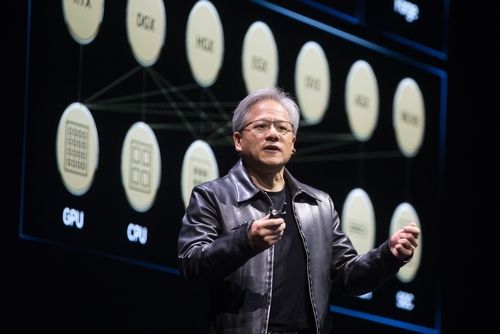
TradingKey - In the early hours of May 13, Eastern Time, Nvidia ( NVDA) CEO Jensen Huang boarded the U.S. presidential aircraft "Air Force One" in Alaska to accompany Trump on his visit to China.
Just 24 hours earlier, Jensen Huang was missing from the 16-member business delegation list released by the White House, sparking concerns that "Nvidia was being marginalized." Trump subsequently extended a personal phone invitation, prompting Huang to fly thousands of kilometers to catch the presidential aircraft. Trump later posted a high-profile message on Truth Social to debunk "fake news," emphasizing that Huang was on the same flight with him at that moment.
Following the news, Nvidia rose more than 1% in overnight trading. However, analysts believe this is primarily crisis management to rectify the omission from the list, as a single visit cannot shift the "red lines" of export controls. It might at best accelerate H200 approvals or clarify the compliance path for the B30, but the performance ceiling will not be eased, and Nvidia's market space in China will remain under pressure.
Notably, on May 14, Reuters cited three sources reporting that the U.S. has approved about 10 Chinese companies (including Alibaba, Tencent, ByteDance, and JD.com) and several distributors to purchase Nvidia's second-most powerful AI chip, the H200. However, no chips have been delivered so far, leaving a major tech deal in a deadlock as CEO Jensen Huang seeks a breakthrough in China this week.
NVIDIA’s China revenue drops to 5%; zero sales for H200 six months after approval.
Data indicates that NVIDIA's revenue contribution from China has fallen from 26% in fiscal 2022 to 13% in fiscal 2025, sliding further to approximately 5% by the third quarter of 2025. Jensen Huang has publicly noted that NVIDIA's market share in China's AI accelerator market has "fallen to near zero."
Every tightening of U.S. export controls has dealt a significant blow to the share price:
On October 17, 2023, the Biden administration released new AI chip export control rules for China, restricting the A800/H800; NVIDIA's stock dropped over 7% intraday and closed 4.7% lower, wiping out $53.5 billion in market capitalization.
On April 15, 2025, the U.S. government informed NVIDIA that H20 exports to China would require indefinite license applications; NVIDIA recorded a $5.5 billion loss, and the stock fell more than 6% in post-market trading.
On August 27, 2025, the fiscal second-quarter 2026 earnings confirmed zero H20 chip sales to Chinese customers during the period, sending the stock down approximately 5% after hours.
On December 8, 2025, the H200 received conditional approval for export to China, with requirements including a 25% revenue share for the U.S. government, sales limited to "specific approved customers," and individual license applications for every shipment; nonetheless, no revenue has been generated in the subsequent six months.
Sources stated that the reasons include slow U.S. approvals and, more critically, blocked procurement channels for Chinese customers, as more Chinese companies are hesitant to base their core computing power on U.S. chips over the long term.
Domestic Substitution Establishes Structural Competition: Shipments to Account for 41% by 2025
Domestic Chinese AI chips are rapidly filling the void. According to industry research data, shipments of China-made AI accelerator cards reached 1.65 million units in 2025, capturing a record-high market share of approximately 41% by shipment volume.
Of this total, Huawei's Ascend shipped 812,000 units, representing nearly 50% of domestic shipments and about 20% of the overall market. TrendForce predicts that the market share of domestic AI chips by shipment volume is expected to expand to approximately 50% by 2026.
It should be noted that the aforementioned market shares are based on shipment volume. Since the unit prices of domestic chips are generally lower than Nvidia's high-end products, the domestic market share by revenue remains significantly lower than its share by shipment volume.
Nevertheless, China's computing power supply is undergoing a shift: what was once a reliance on imported chips is becoming a model where 'domestic chips provide the foundation, supplemented by imports.' Nvidia is no longer the only viable supplier of computing power.
Antitrust investigation may be the key focal point of this visit.
An antitrust investigation may be the more pragmatic agenda for Jensen Huang's trip. China's State Administration for Market Regulation has launched a probe into Nvidia, which media reports say could lead to fines between RMB 9.8 billion and RMB 60.8 billion. While the actual imposition of such fines is considered unlikely, accompanying behavioral restrictions—such as prohibitions on tying and limits on exclusive partnerships—could prove more damaging.
Sources indicate that Huang may engage with Chinese authorities on matters such as compliance rectification and R&D investment. Market consensus suggests that if antitrust filings utilize phrasing like 'active communication' or 'submission of a rectification plan,' it would signal that substantive progress has been made.
Nvidia’s technological edge is irreplaceable, with limited room for political maneuvering.
Despite significant challenges, NVIDIA has not entirely lost the Chinese market. Its technical advantages remain distinct: the efficiency of large-scale cluster interconnects, the maturity of the CUDA software ecosystem, and developer inertia are difficult to fully replace in the short term, allowing the company to maintain high unit prices and profit margins for low-volume shipments in the high-end market.
Politically, Jensen Huang’s presence on the flight underscores his importance to the U.S. government. The Trump administration’s "transactional mindset" suggests that if NVIDIA can assist in brokering a broader trade agreement—such as a "chips-for-crops" arrangement—it may gain a degree of regulatory flexibility.
The condition requiring a 25% revenue remittance attached to the H200 approval in late 2025 essentially transforms chip exports into a fiscal contribution to the U.S. Treasury. If this model is expanded across more product lines, NVIDIA could transition from a passively restricted enterprise into a strategic lever in U.S. trade negotiations.
However, most current analysis suggests that the possibility of chip exports to China being viewed as a national security bottom line still outweighs the likelihood of them being used as a bargaining chip.
Three Metrics to Assess Whether Nvidia Can Break Through: Antitrust, Orders, and Investment
Investors should monitor the following three specific signals over the next 1-3 months:
Indicator | Bullish Scenario | Bearish Scenario |
Antitrust Investigation | The SAMR issues conciliatory language, with fines below 5 billion yuan | The investigation escalates, with fines approaching the upper limit or additional restrictions imposed |
New H200/B30 orders for China | At least one public or semi-public confirmed sale emerges (e.g., procurement by ByteDance or Alibaba) | Still no news of transactions |
Nvidia’s new investment in China | Announcement of a new R&D center, team expansion, or joint venture projects | No substantive investment commitments |
Jensen Huang’s visit was a high-profile political PR move that calmed public controversy and created an atmosphere for easing the antitrust investigation; however, several substantive issues remain: export control red lines remain unchanged, the logic of customers avoiding single-supply risk persists, the domestic substitution share continues to rise, and the downward trend in Nvidia’s revenue contribution from China has yet to stabilize.
For investors, what truly needs to be tracked is not the handshake on Air Force One, but the antitrust rhetoric, new orders, and investment commitments following the landing.
This content was translated using AI and reviewed for clarity. It is for informational purposes only.
Recommended Articles








Comments (0)
Click the $ button, enter the symbol, and select to link a stock, ETF, or other ticker.