


Copper Price Breaks Through $14,000. "Perfect Storm" Sweeps the Globe, Who Is Pushing Up This "Industrial Red"?



AI Podcast


Copper prices surged past $14,000 per ton, driven by recovering Chinese demand and escalating global supply risks. Tight sulfuric acid supply from the Middle East, exacerbated by shipping disruptions and Chinese export restrictions, is a key cost driver. Growing copper demand from AI infrastructure, particularly data centers, is strengthening the price correlation with tech stocks. Persistent supply constraints, including declining ore grades and long mine development cycles, limit capacity expansion. Analysts project a significant global copper deficit by 2027, supporting expectations for a "higher for longer" price environment due to unprecedented demand and rigid supply limitations.

TradingKey - Copper prices are currently on a continuous ascent, with multiple factors collectively driving this rally.
Supported by factors such as a recovery in demand in the Chinese market and intensifying global supply-side risks, London Metal Exchange (LME) copper prices breached the $14,000 per ton mark on Tuesday, approaching historical peaks. The most active July copper futures contract on COMEX reached $6.53 per pound.
According to Dow Jones Market Data, copper prices have gained a cumulative 7.8% since the outbreak of conflict in Iran, with the overall year-to-date increase approaching 15%.
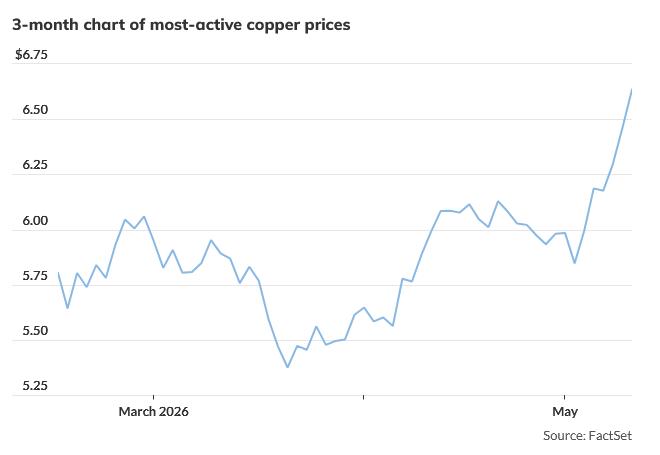
The rebound in Chinese manufacturing activity has driven a recovery in physical demand, alongside tightening sulfur supplies in the Middle East—sulfuric acid is a key auxiliary material in the copper smelting process, and its supply fluctuations directly impact capacity release.
Meanwhile, as AI-related stocks continue to climb, the price correlation between copper and the U.S. tech sector has strengthened significantly due to copper's extensive use in infrastructure such as electrical wiring for data centers.
Ewa Manthey, a commodities strategist at ING, stated: "Copper prices breaching the $14,000 mark highlights the current tight supply landscape in the global copper market. Outside the U.S., copper inventories in other regions are at low levels, which, coupled with ongoing supply constraints, makes copper prices extremely sensitive to any incremental demand."
Copper feedstock deficit continues to widen, supply tightens.
As a core raw material for copper refining, the tight supply of sulfuric acid is one of the key factors driving up copper costs. Nearly half of the world's seaborne sulfuric acid originates from the Middle East, while about a quarter of the sulfur required for sulfuric acid production is supplied by major Persian Gulf oil producers such as Iran, Saudi Arabia, and the UAE—sulfur being a byproduct of petroleum refining, these nations have become major sulfur producers by leveraging their oil industry dominance.
However, due to the conflict in Iran, the duration of shipping disruptions in the Strait of Hormuz has far exceeded market expectations. Seaborne transport of sulfuric acid has come to a standstill, while its highly corrosive nature makes land transport difficult to implement, causing the supply-demand gap to continue widening.
Marex analyst Edward Meir emphasized that the duration of transit restrictions in the Strait of Hormuz has exceeded expectations, further amplifying market concerns regarding alternative transportation routes for sulfuric acid.
Compounding the issue, China has also tightened restrictions on sulfuric acid exports since May, further exacerbating the global supply crunch.
Sulfur prices have recently broken through $1,200 per metric ton, hitting a record high, a trend confirmed by fertilizer giant Mosaic in its latest quarterly report.
At the same time, rumors regarding the restart of Freeport-McMoRan's Grasberg copper mine in Indonesia have also rattled the market. Reports suggested that the mine's restart would be delayed until early 2028; although the company subsequently denied the rumors and maintained its plan for a late-2027 restart, the news still boosted copper prices in the short term.
Furthermore, Jacob White, Director of ETF Product Management at Sprott Asset Management, pointed out that the copper industry was already facing the challenge of declining ore grades long before the current supply tightness emerged—lower copper content in ore directly results in a decline in production capacity. Simultaneously, issues such as long development cycles for new mines and restricted project approvals continue to constrain copper supply capacity.
Typically, rising metal prices stimulate capacity expansion, eventually easing supply pressures while curbing some demand. However, White noted that copper supply is limited by physical factors such as geological conditions, permitting processes, and infrastructure—constraints that are unlikely to be resolved in the short term.
AI Computing Power Surges, Copper Demand Reaches a New Level
The current rally in copper prices is both a result of intensifying supply shortages and the powerful support of sustained demand growth.
With its superior electrical and thermal conductivity, high-purity copper has become an indispensable core material in AI computing infrastructure. Whether in power supply modules and signal transmission systems for AI servers, or high-speed interconnect cables and liquid cooling components, high-purity copper is vital for stable operation under high-load scenarios, and its technical advantages are difficult for other materials to replace in the short term.
As global tech giants race to scale up computing infrastructure, the pace of hyperscale data center construction has accelerated significantly. A single data center housing tens to hundreds of thousands of AI servers, combined with high-speed interconnects and liquid cooling systems, can consume thousands of tons of copper, with some supercomputing-scale projects even exceeding the 10,000-ton mark.
Investor attention is gradually shifting beyond short-term geopolitical disruptions toward positioning for mid-to-long-term upside in copper prices. Bart Melek, Head of Global Commodity Strategy at TD Securities, noted that trading activity in the options market has surged recently, with substantial capital betting on further price gains through derivative instruments.
Meanwhile, the latest forecast from Scotiabank mining analyst Orest Wowkodaw indicates that the global copper market could see a supply deficit of 350,000 tons by 2027, whereas just two months ago, he expected the market to trend toward a supply-demand balance.
"This truly constitutes a 'perfect storm' for copper prices—even at elevated levels, the supply side remains subject to multiple rigid constraints," Wowkodaw stated at an industry event in Toronto. He further emphasized that the current strength of global copper demand is 'unprecedented,' providing a solid foundation for a 'higher for longer' price environment.
This content was translated using AI and reviewed for clarity. It is for informational purposes only.
Recommended Articles










Comments (0)
Click the $ button, enter the symbol, and select to link a stock, ETF, or other ticker.