


Seagate Technology Surges 18% Pre-Market to Hit New High, Semiconductor Stocks Broadly Rise, Can the Rally Still Be Chased?



Seagate Technology's stock surged over 18% pre-market on April 29, reaching a new all-time high of $684, driven by strong fiscal Q3 earnings and guidance exceeding Wall Street expectations. This rally, coupled with robust AI-driven data center storage demand, triggered broader gains across storage concept stocks like Western Digital and Silicon Motion. Seagate's fiscal Q3 revenue and EPS significantly beat estimates, and its Q4 projections were also higher than consensus. The company raised its annual revenue growth target to at least 20%, attributing it to the demand for its HAMR technology, which offers superior storage density for AI data centers and has secured bookings through fiscal year 2027.
TradingKey - On April 29 ET, storage chip leader Seagate Technology ( STX) saw its pre-market share price surge by over 18% to $684, hitting a new all-time high. Financial results and current-quarter guidance both beat Wall Street expectations; combined with the continued heating up of AI-driven data center storage demand, this triggered a broad rally across storage concept stocks.
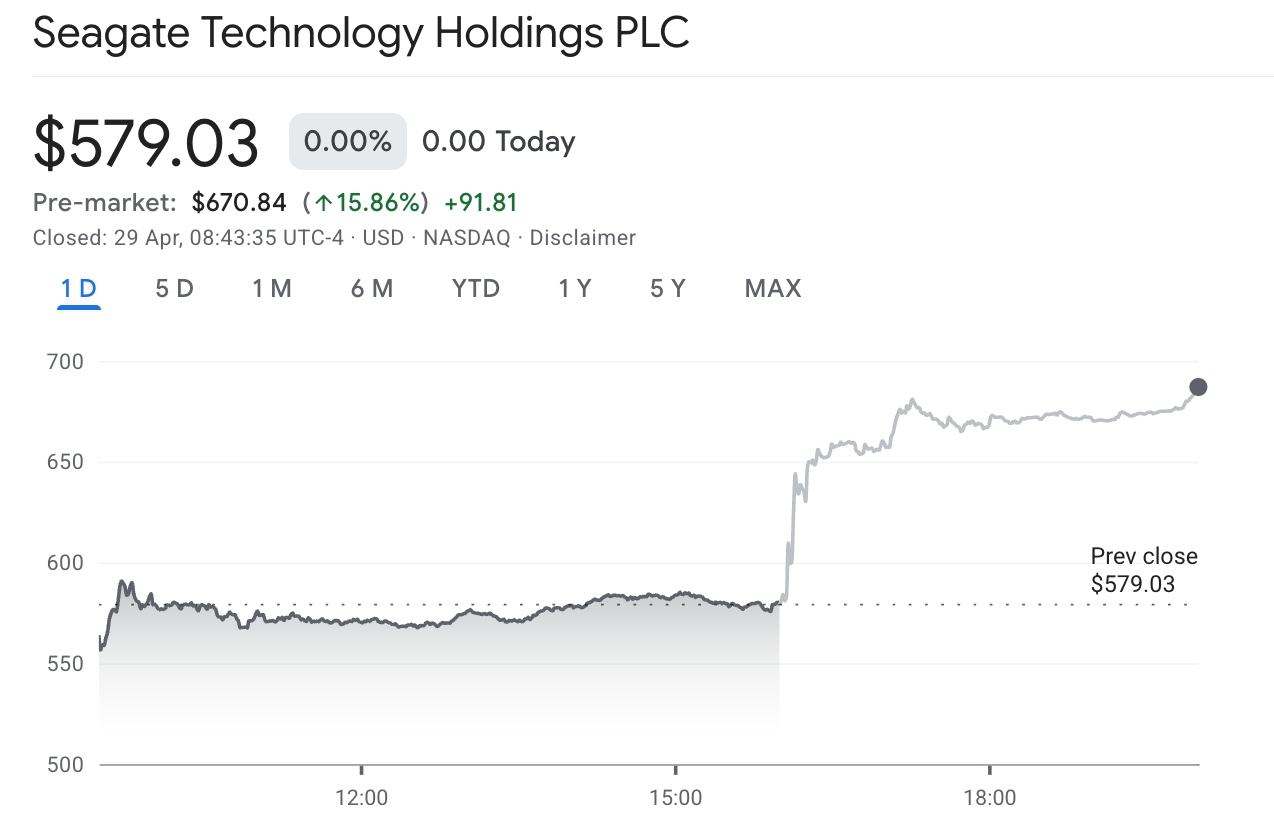
As of the pre-market on April 29, Seagate's share price has soared from a 52-week low of approximately $63 to around $680, a cumulative gain of over 978%, and has recorded positive returns for 24 consecutive trading days since March 17.
Boosted by its earnings, Western Digital ( WDC.US) rose over 10% in pre-market trading, while Silicon Motion ( SIMO) surged over 30% after its Q2 revenue guidance beat expectations. SanDisk ( SNDK.US) rose over 5%, and Micron Technology ( MU.US) gained nearly 4%. The storage sector saw almost universal gains, as the strong demand within the AI hardware supply chain was once again validated by the market.
Earnings and guidance significantly beat expectations; capacity crunch emerges as key signal.
Seagate reported fiscal third-quarter 2026 revenue of $3.11 billion, up 44% year-over-year and beating market expectations of $2.96 billion; adjusted earnings per share were $4.10, also significantly exceeding the anticipated $3.50. Even more encouraging for the market was the Q4 guidance: projected revenue of $3.45 billion and adjusted EPS of approximately $5.00, both of which topped analyst expectations of $3.97.
The company has raised its annual revenue growth target to at least 20%, driven by exponential expansion in demand for storage bandwidth from AI data centers. Management made a rare disclosure during the earnings call that its high-end storage capacity is almost entirely pre-booked through fiscal 2027.
HAMR technology has become the core of its valuation.
The core engine behind Seagate Technology's recent surge is its industry-leading HAMR (Heat-Assisted Magnetic Recording) technology. While traditional hard drives have hit a bottleneck as storage density approaches its physical limits, HAMR technology increases storage capacity per platter several-fold without sacrificing speed.
This characteristic perfectly addresses the rigid demand for high-capacity storage in AI data centers. As management explicitly pointed out in the latest earnings report, the cost-performance advantage provided by HAMR technology is steadily translating into market share gains within the AI data center space.
Are there still buying opportunities in the semiconductor sector?
Seagate's structural growth narrative continues to strengthen. The CEO officially announced during the earnings call that the annual revenue growth target for the coming years has been raised from the previous 'low-to-mid double digits' to 'at least 20%.' On the competitive front, Seagate's HAMR technology advantage is translating into excess profit margins. Non-GAAP gross margin reached 47%, surging 480 basis points from the previous quarter, with free cash flow nearing $1 billion.
Regarding the threat of SSDs replacing HDDs, current AI data center cost considerations ensure that hard disk drives remain in high demand. The cost per GB for HDDs is approximately one-tenth that of SSDs, making it difficult for mechanical hard drives to be replaced in bulk in the short term.
In a rating upgrade, Barclays analysts emphasized that since the explosion of AI demand, HDD shipment capacity growth has continued to accelerate, rising from approximately 10% in 2024 to 26% in 2025, with further acceleration expected in 2026.
Institutional ratings for Seagate are highly consistent, with most firms raising their price targets; notably, Citi was the most aggressive, hiking its target from $595 to $740. Nevertheless, Wall Street's highest target is only $740, while Seagate's pre-market price has already surged above $680. Even Citi's $740 target implies less than 10% upside.
For investors with a higher risk appetite, SanDisk offers a higher 'ceiling' in the storage sector, with analysts giving a future average price target of $1,100, representing over 20% upside from current levels. Furthermore, SanDisk focuses on the NAND flash storage sector, which has a supply-side substitution relationship with the HDD market.
For investors seeking a greater margin of safety, a more prudent strategy would be to place Seagate on a watch list and wait for a better entry point resulting from valuation normalization or a technical pullback.
Without chasing highs, Western Digital's 'laggard' attribute may instead provide a relatively better margin of safety: its gains have been more moderate, and its dual revenue structure of traditional HDD and NAND businesses follows a completely different market narrative cycle compared to Seagate.
This content was translated using AI and reviewed for clarity. It is for informational purposes only.
Recommended Articles









Comments (0)
Click the $ button, enter the symbol, and select to link a stock, ETF, or other ticker.