


Apple Q2 Preview: iPhone Sales Buck the Trend, but 'Sword of Damocles' of Costs Hangs High



Apple's fiscal Q2 2026 results, releasing after market close on April 30, ET, will be the first under news of Tim Cook's retirement plans. The company set a record $143.8 billion revenue in Q1 2026, driven by strong iPhone and Greater China sales. Wall Street anticipates Q2 revenue of $109.5 billion (15% YoY growth) and EPS of $1.95. iPhone is expected to remain the core driver, with services maintaining growth. Despite strong demand in China and the US, cost pressures on memory could impact gross margins, though some analysts view these concerns as overly pessimistic. Apple's AI strategy includes a partnership with Google's Gemini model for Siri. The WWDC event will be critical for demonstrating AI implementation and its impact on device upgrades. John Ternus will succeed Cook as CEO on September 1.
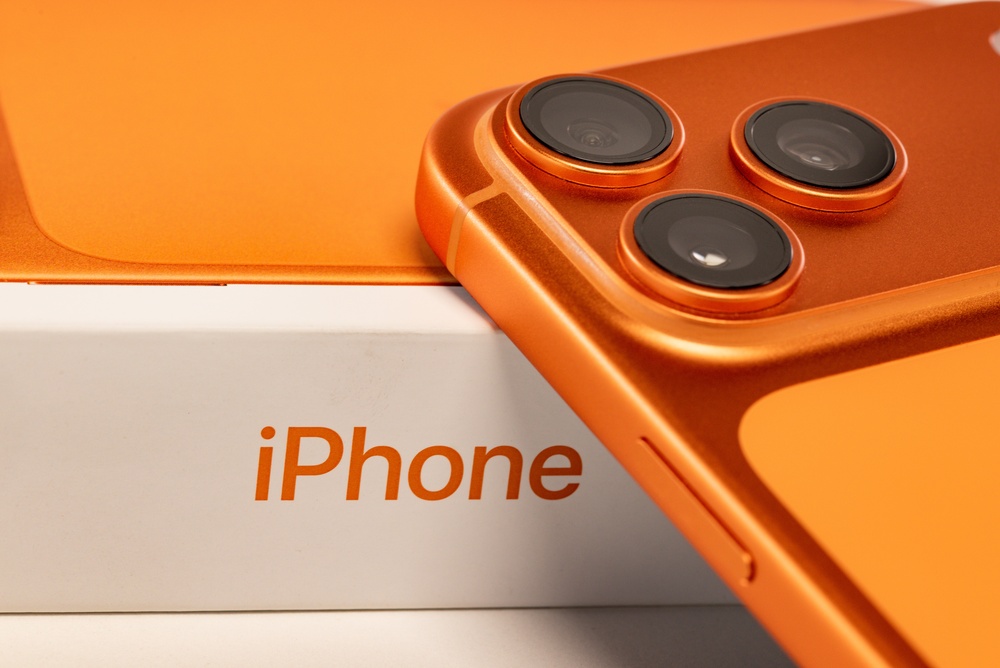
TradingKey - After the market close on April 30, ET, Apple (AAPL.US) will release its second-quarter financial results for fiscal year 2026. This marks the first earnings report since Tim Cook announced his retirement plan.
Return to Steady Growth
In the first quarter of fiscal 2026 Apple recently set an all-time revenue record of $143.8 billion. iPhone revenue rose 23% year-over-year to $85.3 billion, and Greater China revenue climbed 38% year-over-year to over $25.5 billion, surpassing market expectations by $4.7 billion and becoming the strongest engine driving Apple's record-breaking growth.
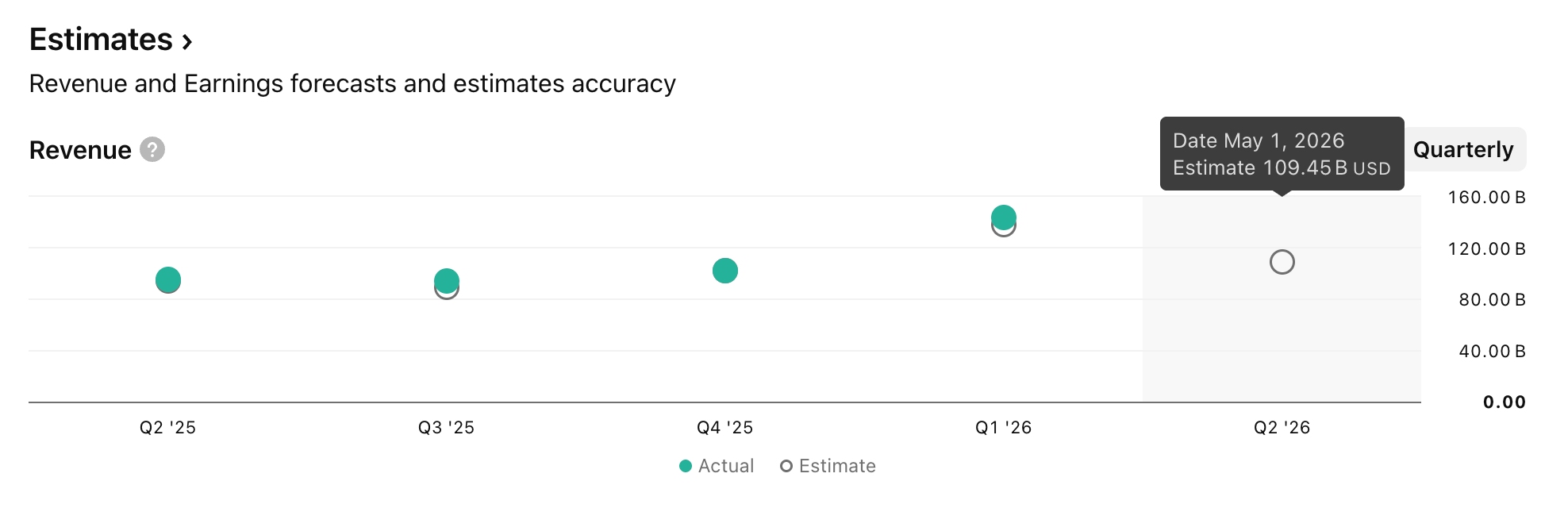
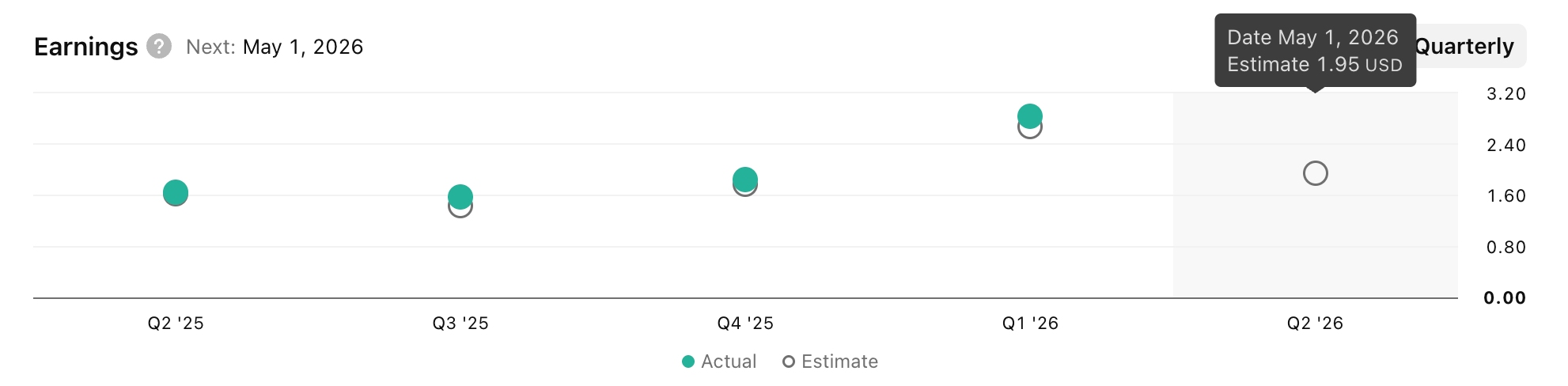
As for Apple's second fiscal quarter, consensus market expectations have become increasingly clear. Wall Street generally expects Apple's Q2 revenue to reach approximately $109.5 billion, representing a year-over-year increase of about 15%, with earnings per share of $1.95. Although this marks a sequential decline, the year-over-year growth remains substantial.
By segment, the iPhone is expected to remain the main revenue driver, with Goldman Sachs forecasting revenue of $56.3 billion; the services segment is expected to maintain a 14% growth rate, consistent with Q1; Mac revenue is projected to remain flat year-over-year, but the MacBook Neo introduced in March may serve as a "small surprise" in the earnings report.
Dual Sales Growth in China and the US Builds a Robust Product Moat
The primary highlight of this earnings report is the iPhone, which accounts for more than half of Apple's revenue. Based on currently disclosed data, the iPhone 17 demonstrated strong performance in both the Chinese and U.S. markets in Q2.
Counterpoint data shows that during the first nine weeks of 2026 in China, the overall smartphone market contracted by approximately 4% year-over-year, yet iPhone sales bucked the trend, surging roughly 23%.
Analysis suggests that Apple's ability to expand against the tide of market contraction in China can be attributed to three factors:
Consumer demand for electronics, spurred by Chinese subsidy policies, has positioned the iPhone 17 well within the range of consumer acceptance.
In addition, by securing long-term supply agreements with partners like Samsung ahead of its peers, Apple locked in lower costs than its competitors, thereby avoiding price increases.
Meanwhile, the high profit margins on Apple's premium models allow the company to absorb some of the upward pressure on costs.
In the U.S. market, demand for high-end models is similarly strong. Trade-in subsidies offered by carriers have made the Pro Max more accessible to the mainstream, while the high-margin iPhone 17 Pro series continues to bolster Apple's revenue and earnings resilience.
Cost Pressures and Tariffs: Profit Margins Under Pressure
While revenue growth is promising, the cost pressures facing the iPhone are being closely watched by the market. At the beginning of the year, UBS referred to memory costs as the "Sword of Damocles" hanging over Apple.
UBS warned that although Apple successfully avoided cost shocks in the December 2025 quarter through advance price locking and early production deployment, gross margins for the June and September quarters could face 50 to 100 basis points of downward pressure as next-generation iPhone production peaks. UBS consequently expressed concern over its gross margin guidance of 48.0% and 47.8% for the June and September quarters, respectively.
Goldman Sachs offered a starkly different assessment, suggesting that the market is "overly pessimistic" about Apple and that the company has a stronger capacity to absorb issues than its competitors, stating, "Given Apple's relatively strong market position, we believe current market concerns appear overly pessimistic."
Notably, the "counter-trend growth" of the iPhone in China provides partial support for this view. As competitors were forced to raise prices, Apple kept its prices stable, a position that allowed Apple to capture more market share. Whether Apple can maintain this advantage in the coming quarters will depend largely on how long its advance price-locking strategy can be sustained.
The Path to AI Catch-up and CEO Turnover
In the field of AI, Apple has moved from "working behind closed doors" to "leveraging external forces." In January 2026, Apple and Google reached a multi-year strategic AI partnership, whereby Google's Gemini model will be integrated into the Apple Intelligence system to provide underlying language model support for Siri. This collaboration marks Apple's shift away from a fully proprietary AI technology stack in exchange for a faster product rollout schedule. HSBC Research believes that Apple Intelligence still needs time to prove its actual ability to contribute to revenue.
For Apple, the June WWDC will be the year's most significant AI narrative milestone. At that time, Apple will need to demonstrate the "concrete implementation of its AI strategy," including the interactive experience of the new Siri, the functional matrix of Apple Intelligence, and the developer integration ecosystem.
Market focus centers on whether Apple's AI narrative can translate into actual purchasing demand. Previously, Wedbush analyst Dan Ives referred to 2026 as "the year Apple finally enters the AI race."
At the same time, the CEO transition is the second-largest narrative topic outside of earnings reports. Cook has announced that he will step down as CEO on September 1, to be succeeded by John Ternus, Senior Vice President of Hardware Engineering. HSBC Research believes that whether a successor with a technical background can find the next hardware breakthrough after the iPhone 17 will be a focal point for ongoing investor assessment.
This content was translated using AI and reviewed for clarity. It is for informational purposes only.
Recommended Articles






Comments (0)
Click the $ button, enter the symbol, and select to link a stock, ETF, or other ticker.