


Google Debuts 8th-Gen TPUs, Shifts to Agentic AI at Google Cloud Next to Drive Growth



AI Podcast


Google announced its 8th-generation TPUs, splitting into training (TPU 8t) and inference (TPU 8i) chips, optimizing AI performance. The Gemini Enterprise Agent Platform was launched on Vertex AI, simplifying AI deployment for businesses. Capital expenditures remain high at $175-$185 billion for 2026, driven by AI infrastructure needs. Analysts maintain 'Buy' ratings, citing synergy between Gemini, TPUs, and the Agent platform. However, rising CapEx poses risks to profit margins and cash flow. Future revenue may shift towards inference consumption.
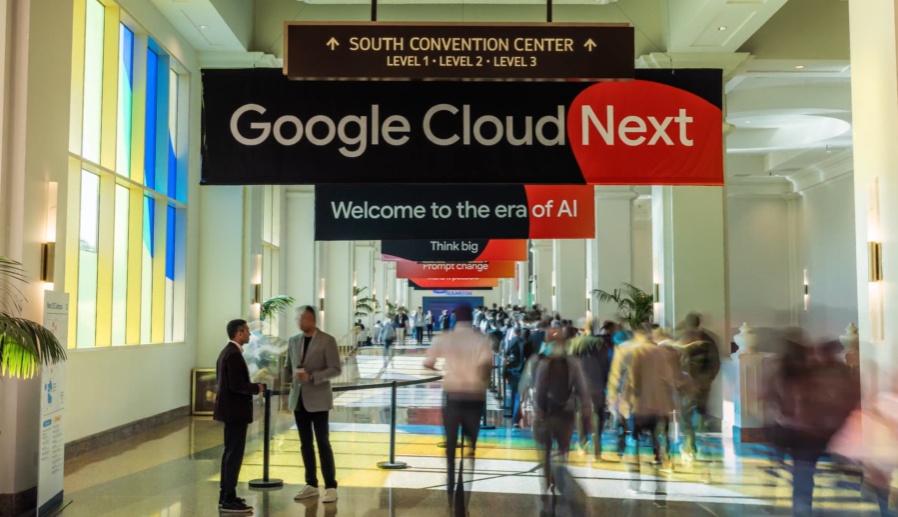
TradingKey - Google (GOOG) (GOOGL) The annual 'Google Cloud Next 26' event was held in the U.S. from April 22 to 24 this year. At the conference, Google unveiled its 8th-generation TPU, launched the Agentic Enterprise technology stack, and reiterated a massive increase in capital expenditures, with planned investments of $175 billion to $185 billion this year.
Following the conference, JPMorgan (JPM), BofA Securities (BAC) and Citi Research (C) all maintained their 'Buy' ratings on Alphabet, noting that Google's core competitiveness lies in the deep synergy between the Gemini model, proprietary TPUs, and the enterprise Agent platform, which will serve as a direct driver for the stock price.
Silicon Bifurcation: TPU 8i vs. TPU 8t
Capital markets are currently closely monitoring Google's progress in its in-house chip development. With this launch, Google's 8th-generation TPU has been split into two independent product lines for the first time: the TPU 8t, designed for AI model training, and the TPU 8i, positioned as a dedicated inference chip.
Amin Vahdat, Google’s Vice President, stated that the TPU 8t training chip utilizes the new Virgo Network fabric to scale clusters to over one million chips per single cluster. The computing performance of the TPU 8t array is nearly triple that of the previous-generation Ironwood, with performance per watt improved by up to twofold.
Traditional chips suffer from the "memory wall" problem—a bottleneck that occurs when chips cannot access data quickly enough, forcing users to endure longer response times. The TPU 8i is Google's solution to "break the memory wall," processing massive amounts of data at ultra-high speeds with minimal latency. This is achieved through its 288GB of High Bandwidth Memory (HBM) and 384MB of on-chip SRAM—the latter being three times that of its predecessor—allowing the model's active working set to run within the chip itself and eliminating the need for long-distance data transfers between the processor and memory.
These two chips are running for the first time on Google’s own Arm-based (ARM) Axion CPU hosts, which allows Google to optimize the entire system for improved performance and efficiency. Both chips utilize Google's fourth-generation liquid cooling technology, maintaining performance densities that are unattainable with air cooling.
JPMorgan stated in a research report that Google's division of the TPU into two independent product lines for inference and training, rather than using training chips for inference, indicates that Google believes the demand for inference computing power has grown large enough to justify dedicated silicon and separate capital allocation. Looking ahead, attention should be paid to changes in Google's revenue structure in this area—it may no longer come solely from training, but increasingly from ongoing consumption on the inference side, forming an independent growth curve.
As management did not address the possibility of external TPU sales during the meeting, institutions currently believe that the 8th-generation TPU is being utilized for Google's internal use and offered through its cloud services.
Agentic AI Enterprise Implementation
In addition to hardware upgrades, Google also announced a restructuring of its platform layer at the conference, launching the Gemini Enterprise Agent Platform on top of Vertex AI.
Vertex AI is a machine learning (ML) platform launched by Google in 2021 that integrates tools like AutoML and AI Platform, providing full-process services from data preparation to model deployment. The platform is primarily geared toward enterprise-level clients; for example, L'Oréal's ModiFace uses Vertex AI to train skin-diagnostic AI.
In a research report, J.P. Morgan described this as effectively "superseding Vertex AI," which integrates enterprise building, orchestration, governance, and security functions into a single entry point rather than dispersed functional modules.
Citi noted that the platform's key value lies in allowing enterprises to run workflows by placing multiple agents within the same management system. For companies, AI deployment no longer requires high technical barriers; once the platform standardizes applications, businesses can achieve "plug-and-play" functionality and proceed directly to production.
Margin Pressure with $175B–$185B CapEx
In his keynote at the conference, Google CEO Sundar Pichai reaffirmed that full-year 2026 capital expenditures are expected to be in the $175 billion to $185 billion range, marking the only statement regarding financial scale at the event. Three institutions have offered differing perspectives on this.
JPMorgan noted that from a near-term perspective, this increases the probability that next week’s earnings report will "leave existing guidance unchanged." However, on a full-year basis, Google’s AI infrastructure CTO Amin Vahdat and Chief AI Scientist Jeff Dean both emphasized that AI remains supply-constrained, suggesting there may still be upside to the capital expenditure trajectory.
BofA Securities pointed directly to the risks: as AI investments drive up capital expenditures and compress free cash flow, they serve as one of the most direct factors weighing on profit margins.
In the coming quarters, the focus will be on the extent to which Google can mitigate the impact on cash flow while likely ramping up AI spending, and whether it can meet the market’s high expectations for Google Cloud’s growth and margins.
This content was translated using AI and reviewed for clarity. It is for informational purposes only.
Recommended Articles








Comments (0)
Click the $ button, enter the symbol, and select to link a stock, ETF, or other ticker.