


Palantir vs. Anthropic: The Niche Battle Even Trump’s Endorsement Cannot Stop



AI Podcast


U.S. President Trump publicly endorsed Palantir Technologies (PLTR) on Truth Social, an unusual presidential stock mention. This occurred as Palantir's stock faced significant pressure, declining nearly 28% year-to-date due to AI industry concerns and short-seller Michael Burry's bearish stance. Despite impressive revenue growth and strong forward guidance, Palantir's valuation remains extremely high, with substantial insider selling. Burry argues AI competitor Anthropic is eroding Palantir's enterprise market share by offering more cost-effective solutions. The market is divided on Palantir's long-term value, debating its "AI moat" against competitive pressures and high valuation.
TradingKey - On April 10, 2026, U.S. President Trump posted a message on Truth Social that garnered significant attention on Wall Street, directly naming and praising the data analytics firm Palantir Technologies ( PLTR ). He wrote: "Palantir Technologies (PLTR) has proven to possess powerful combat capabilities and equipment. Just ask our enemies!!!" According to TheStreet, Trump's rare inclusion of Palantir’s ticker in his post makes him the first president in U.S. history to publicly "shout out" a specific stock using its ticker symbol.
This extraordinary presidential statement comes at a sensitive moment as Palantir's share price remains under pressure. Driven by market concerns over the AI software industry's outlook and persistent pressure from famed short-seller Michael Burry (the inspiration for the film "The Big Short"), Palantir has plummeted about 14% this week, with its year-to-date decline nearing 28%.
I. What kind of company is Palantir?
Palantir Technologies was co-founded in 2003 by Peter Thiel, Alex Karp, and others. From its inception, Palantir's mission was clear: to develop anti-terrorism data analysis software for U.S. intelligence agencies. Between 2005 and 2008, the Central Intelligence Agency (CIA) was its sole client. Through funding from In-Q-Tel, the CIA's internal venture capital arm, Palantir built its early technological foundation within the national security apparatus. This unique "incubation" background shaped a distinct DNA that sets it apart from other tech companies.
The company listed on the New York Stock Exchange through a direct listing in September 2020. Since its listing, the stock has surged nearly 1,500% over five and a half years, with its market capitalization once exceeding $400 billion. Alex Karp has served as CEO since the company's founding and is the central figure driving its transformation from a government contractor to a leader in AI commercialization.
Core products are as follows :
Gotham A decision-making operating system designed for defense and intelligence agencies, famously used to help locate Osama bin Laden.
Foundry An enterprise data operating system for the commercial market, with JPMorgan Chase as its first commercial client.
Apollo A technical foundation for unified delivery and updates, supporting seamless deployment across cloud and edge environments.
AIP (Artificial Intelligence Platform) An AI execution hub integrated with large language models, upgrading Palantir from a data integration platform to an intelligent decision-making system.
II. Market Reaction
Trump's post indeed triggered an intraday spike. According to TheStreet, within minutes of the tweet, Palantir's share price rose nearly 3% from an intraday low of approximately $123. Trading volume for Palantir surged to 116 million shares that day, with a turnover of $14.771 billion, ranking fourth in the U.S. stock market and marking a substantial 22% increase from the previous day.
However, these gains failed to hold. By the close of trading, Palantir ultimately fell 1.86% to finish at $128.06. The stock has seen a cumulative decline of 13.74% over the past five trading days, a 12.46% drop for the month of April, and a year-to-date decline of 27.95%.
The boost from a presidential-level 'shout-out' was fully absorbed by the market within a single day, sending a strong signal: Palantir's current decline is not merely about sentiment-driven volatility, but rather deep-seated divergences regarding its fundamentals and valuation.
III. Just how deep are the ties between Palantir and the Trump administration?
Trump's public endorsement this time was not a whim. A significant intertwining of interests has already formed between Palantir and the Trump administration.
From an operational standpoint, more than half of Palantir's U.S. revenue is derived from government departments, including the Pentagon, the Department of Homeland Security, and Immigration and Customs Enforcement (ICE). Its AI-powered Maven smart combat system is being extensively utilized by the U.S. military for target identification and strikes in the Middle East, as recent tensions with Iran continue to heighten market interest in defense AI firms.
In terms of political connections, although Palantir CEO Alex Karp had previously criticized Trump and donated to Biden's campaign, he has pivoted to supporting the new administration's policies in Trump's second term. Furthermore, multiple former Palantir employees have moved into government positions, and the company has engaged Washington lobbyists with close ties to the White House, resulting in increasingly tight political-business ties.
This deep integration has also triggered controversy. Mark Warner, the Democratic Senator from Virginia, directly questioned on the X platform: 'Is this another blatant example of Trump manipulating the market?'
IV. Why is the stock price still falling despite a surge in earnings?
Setting aside short-term political volatility, Palantir's fundamental performance is actually quite impressive:
Q4 2025 Results :
- Total revenue reached $1.41 billion, up significantly by 70% year-over-year, surpassing analyst expectations of $1.34 billion.
- Adjusted earnings per share (EPS) rose to $0.25 from $0.14 in the prior-year period, beating the expected $0.23.
- Adjusted operating margin reached as high as 56.8%.
2026 Performance Guidance :
- The company expects Q1 2026 revenue to reach $1.532 billion to $1.536 billion, significantly higher than previous analyst estimates.
- The full-year 2026 revenue outlook is projected at $7.182 billion to $7.198 billion, also substantially exceeding the market consensus of approximately $6.22 billion.
However, the issue lies in valuation. As of now, Palantir’s forward P/E ratio stands as high as approximately 109x, compared to an industry median of only about 21x. Even after experiencing a year-to-date correction of nearly 28%, its valuation level remains in an extremely elevated range.
Of concern is that Palantir insiders have sold a cumulative total of approximately $433 million in stock over the past three months, with no recorded insider purchases during the same period. This 'all selling, no buying' insider trading pattern is typically viewed as a signal of a lack of confidence in the company's current share price.
V. Why Burry Dares to Bet Against Presidential Momentum: Palantir vs. Anthropic
Just as Trump posted his support, Michael Burry, the inspiration for "The Big Short," instead doubled down on his short position. He holds two deep out-of-the-money put options (a June 2027 strike price of $50 and a December 2026 strike price of $100), explicitly stating that Palantir is "still heavily overvalued."
Burry's core logic centers on a specific competitive narrative: AI startup Anthropic is eating away at Palantir's enterprise market share. The business models of the two companies are fundamentally different:
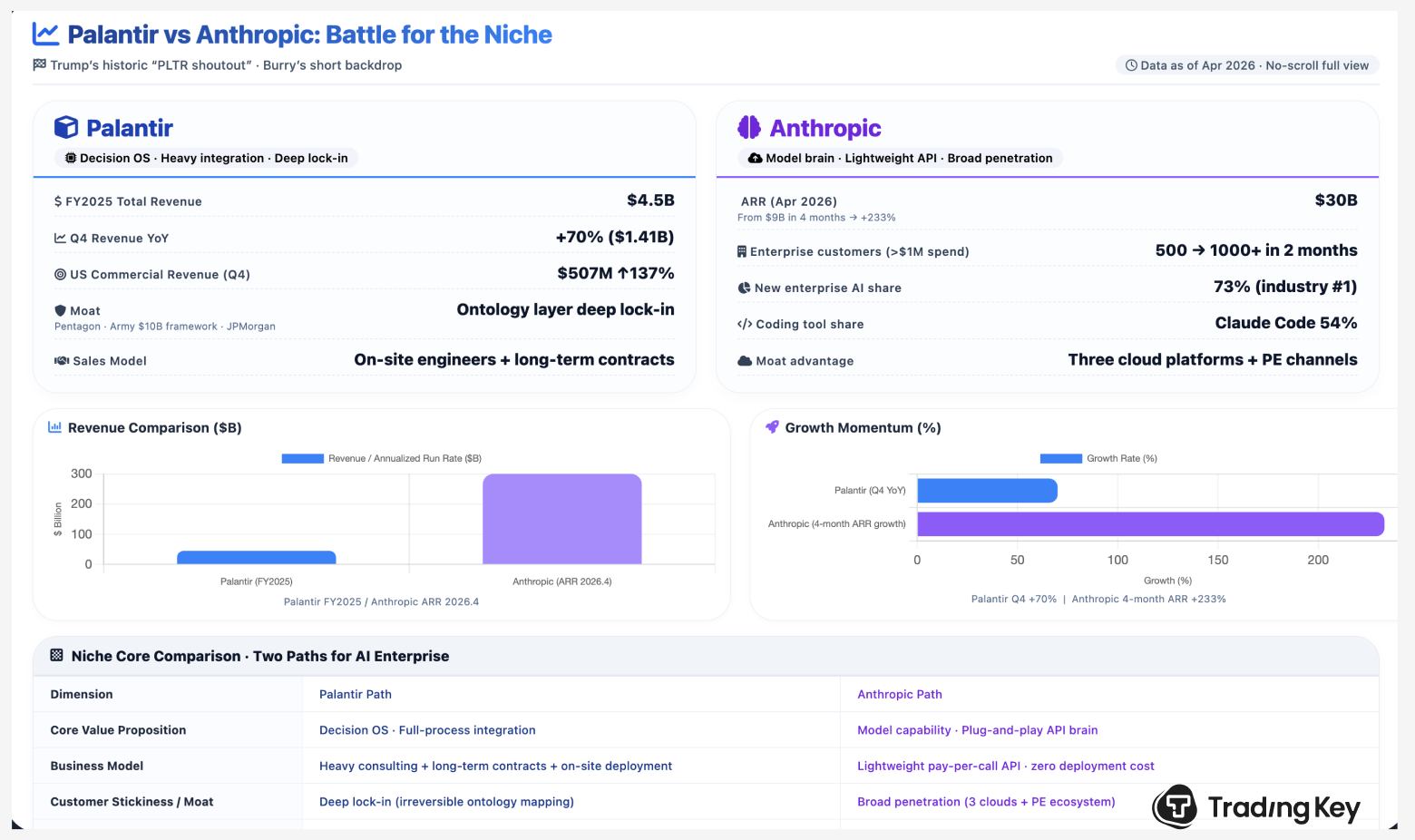
Palantir Sells a "decision operating system"—characterized by heavy integration, deep lock-in, and high contract values. Its U.S. commercial revenue surged 137% to $507 million in Q4 2025, but sales depend on forward-deployed engineers, leading to deep customer lock-in once integrated.
Anthropic Sells plug-and-play "brains" via API. Its annualized revenue has surpassed $30 billion (up from just $9 billion at the end of 2025), with its enterprise customer count doubling to over 1,000 in two months, capturing a 73% market share in new enterprise AI procurement.
Burry's "encroachment" does not imply direct replacement, but rather a shift in enterprise AI budgets from "system integration" toward "model capabilities." When CIOs are faced with a multi-million dollar Palantir deployment versus hundreds of thousands of dollars in Claude API calls, simplicity and cost-effectiveness are gaining more weight. Palantir's U.S. commercial revenue accounts for less than 40% of its total revenue, and the market remains skeptical of its commercial scalability.
However, the relationship is not one of pure substitution. Palantir's Maven military platform originally integrated the Claude model; after the Trump administration banned Anthropic from federal systems in March 2026, Palantir was forced to remove and rebuild certain components. This reveals a deeper fact: Palantir is "model-agnostic infrastructure," and Anthropic is merely one of the models it can call upon. In high-security scenarios like defense, customers require an auditable, customizable decision platform rather than a single "brain."
Nevertheless, if enterprise procurement decision-makers choose to purchase "brains" directly from Anthropic and build a lightweight orchestration layer, Palantir's system integration value will be squeezed. This is precisely what Burry is betting on—as AI capabilities become standardized, customers will bypass the middle layer and use underlying models directly.
Wall Street is deeply divided on this. Wedbush analyst Dan Ives believes that growth in AI demand will lift both companies simultaneously; shorts, however, argue that Palantir's forward P/E ratio of 109x has already priced in "perfect expectations," and any emerging competitive narrative could trigger valuation compression.
The essence of this competition is a race between two paths for enterprise AI implementation: Palantir's "heavy integration and deep lock-in" versus Anthropic's "lightweight access and standardization." The former wins on retention, the latter on speed. Who emerges victorious will determine the power structure of the enterprise AI market.
VI. The Long-Short Battle over Palantir: What ultimately matters?
Trump's recent "presidential touting" serves as a dramatic microcosm of the current bull-bear battle surrounding Palantir:
Bullish Thesis: Palantir boasts solid fundamentals—revenue growth exceeding 70%, deep penetration into core government institutions like the Pentagon, a unique positioning as an AI arms dealer, and the political protection stemming from its deep ties with the U.S. government. The Department of Defense has designated the Maven AI system as a "Program of Record," providing clear growth prospects for Palantir's defense business.
Risk Factors: Lofty valuations remain the greatest hidden danger; the logic of short sellers like Michael Burry—who bet that AI upstarts will erode its market share—is not entirely unfounded; continuous insider selling warrants caution; and the company's deep political ties with the Trump administration are themselves a double-edged sword—any shift in political winds could result in a significant backlash.
Trump's "presidential endorsement" failed to reverse Palantir's decline, underscoring that the market has moved beyond short-term sentiment and into a deep debate over the AI software industry's structural outlook. For investors, Palantir's long-term investment value ultimately hinges on the answer to one fundamental question: How deep is this company's AI moat? This question will face its first major validation just before the release of the Q1 2026 earnings report, expected in late April.
This content was translated using AI and reviewed for clarity. It is for informational purposes only.
Recommended Articles





Comments (0)
Click the $ button, enter the symbol, and select to link a stock, ETF, or other ticker.